



Imagine you’re trying to guess a number between 1 and 100. Easy, right? Now imagine the range changes every two weeks based on how fast people are guessing. If everyone gets too quick, the range shrinks to 1-10. If everyone slows down, it expands to 1-1000. This is essentially what Bitcoin does with its difficulty adjustment. It’s not magic; it’s math designed to keep one thing constant: the time it takes to find a new block.
Most people think Bitcoin produces a block exactly every 10 minutes. They don’t. Some blocks arrive in seconds; others take an hour. But over the long haul, the average hovers near 600 seconds. How? By constantly tweaking the difficulty of the puzzle miners must solve. If you’ve ever wondered why your mining rig suddenly feels slower or faster without changing hardware, this mechanism is the culprit. Let’s break down how this self-correcting system keeps the network stable, secure, and predictable.
The Core Problem: Hash Rate Volatility
Bitcoin relies on Proof of Work. Miners compete to solve a cryptographic puzzle by finding a specific number (a nonce) that makes their block header hash fall below a certain target value. The more powerful the hardware, the more guesses per second they can make. This aggregate computing power is called hash rate.
Here’s the issue: hash rate isn’t static. It fluctuates wildly due to electricity prices, weather patterns affecting hydro-powered mines in China or Texas, new hardware releases, or even miners turning machines off when Bitcoin’s price drops. If the difficulty stayed fixed while hash rate doubled, blocks would appear twice as fast-every 5 minutes. This would mess up Bitcoin’s monetary policy, which issues new coins at a predetermined rate based on block count, not calendar dates. To prevent this, the protocol adjusts the difficulty target every 2,016 blocks.
How the Math Works: Target vs. Difficulty
To understand the adjustment, you have to distinguish between two terms often used interchangeably but technically distinct: target and difficulty.
- Target: A numerical threshold. Your block hash must be lower than this number. A smaller target means a harder puzzle.
- Difficulty: A relative measure derived from the target. Higher difficulty means the target is smaller.
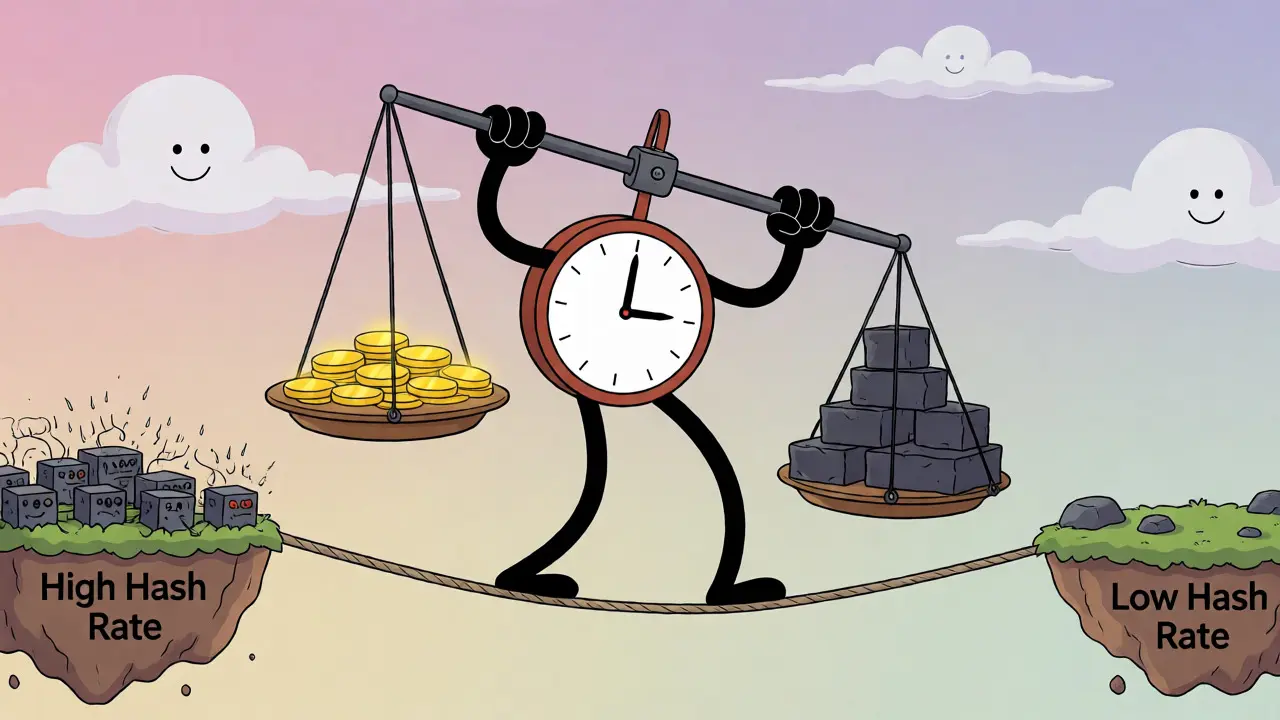
Every 2,016 blocks-a period expected to last about 14 days-the network looks at the timestamps of the first and last blocks in that epoch. It calculates how long those blocks actually took to mine compared to the ideal 1,209,600 seconds (14 days).
The formula is straightforward:
New Target = Old Target × (Actual Timespan / 1,209,600)
If the last 2,016 blocks took only 7 days, the ratio is 0.5. The new target becomes half the size of the old one. Mining becomes twice as hard. Conversely, if blocks took 28 days, the target doubles, making mining easier. This feedback loop ensures that regardless of how much raw computing power joins or leaves the network, the average block time remains anchored around 10 minutes.
The Safety Rails: Clamping the Change
What if something catastrophic happens? Imagine a massive solar flare knocks out 90% of global hash rate overnight. Without safeguards, the next difficulty adjustment might try to reduce difficulty by 90%, potentially destabilizing the network. Bitcoin protects against this extreme volatility using a "clamp."
The protocol limits how much the difficulty can change in a single adjustment. The measured timespan is clamped between 3.5 days (one-quarter of two weeks) and 56 days (four times two weeks). This means:
- Mining can become no more than 4x easier in one step.
- Mining can become no more than 4x harder in one step.
In percentage terms, this translates to a maximum 75% decrease in difficulty or a roughly 300% increase. These bounds prevent wild swings caused by timestamp manipulation or sudden, temporary hash rate spikes. It’s a conservative approach prioritizing stability over rapid responsiveness.
Timestamps: The Imperfect Oracle
You might wonder: where do these times come from? The network doesn’t use atomic clocks. It uses the timestamps embedded in each block header by the miner who found it. Miners can set these timestamps within certain rules-they can’t be too far in the future or past relative to other nodes’ clocks. However, they aren’t perfectly accurate measures of real-world time.
This introduces a subtle vulnerability. Since the adjustment depends on reported time, strategic miners could theoretically manipulate timestamps slightly to influence the next difficulty level. For example, if miners know difficulty is about to drop, they might delay publishing blocks or adjust timestamps to skew the calculation. However, because the window is large (2,016 blocks), individual manipulations get averaged out. It’s difficult for any single entity to game the system significantly without losing revenue elsewhere.
Comparison: Bitcoin vs. Bitcoin Cash (ASERT)
Not all Proof-of-Work networks handle this the same way. Bitcoin Cash, a fork of Bitcoin, faced instability with the original algorithm during periods of low hash rate. In 2020, it switched to a different method called ASERT (Absolutely Scheduled Exponentially Rising Targets).
| Feature | Bitcoin (Original DAA) | Bitcoin Cash (ASERT) |
|---|---|---|
| Adjustment Frequency | Every 2,016 blocks (~2 weeks) | Continuous / Per-block estimation |
| Responsiveness | Slow; lags behind hash rate changes | Fast; corrects gradually toward 10-min average |
| Complexity | Simple linear scaling | Exponential smoothing algorithm |
| Vulnerability | Lag allows temporary block time deviations | More complex implementation risks |
Bitcoin sticks with its simple, battle-tested method. While ASERT reacts faster to shocks, Bitcoin’s simplicity reduces the attack surface and has proven reliable for nearly two decades. The trade-off is clear: Bitcoin accepts short-term block time irregularities in exchange for long-term predictability and ease of verification.

Practical Implications for Miners and Investors
For miners, difficulty is a direct cost driver. When difficulty rises, the probability of earning a block reward decreases unless hash rate increases proportionally. This creates a competitive pressure to upgrade hardware or optimize energy efficiency. If you’re running a mining operation, watching the difficulty forecast is crucial. Services like Hashrate Index provide estimates, but remember: forecasts are just guesses until the boundary block is mined.
For investors, understanding difficulty helps gauge network health. A steady rise in difficulty generally signals growing confidence and security. Sharp drops can indicate miners capitulating due to low prices or high electricity costs. However, don’t confuse difficulty with price. Bitcoin’s price affects miner profitability, which influences whether they stay online, thereby affecting hash rate, which then affects difficulty. It’s a cycle, but not a direct line.
Common Misconceptions
Let’s clear up a few myths:
- "Blocks always take 10 minutes." False. The distribution is Poisson-like. You’ll see clusters of fast blocks followed by slow ones. The 10-minute mark is an average, not a guarantee.
- "Higher difficulty means better technology." Not necessarily. It just means more total computing power is securing the network. It reflects competition, not necessarily innovation in chip design alone.
- "The adjustment happens every 14 days exactly." No. It happens every 2,016 blocks. If blocks are coming fast, the adjustment comes sooner than 14 days. If they’re slow, it takes longer.
Looking Ahead: Stability in a Changing World
As of November 2026, Bitcoin’s core mechanism remains unchanged since Satoshi Nakamoto’s whitepaper. With hash rates hovering near 1,000 EH/s (exahashes per second) and difficulty exceeding 148 trillion, the system continues to perform its job quietly. There are ongoing academic debates about whether shorter adjustment windows or different algorithms could improve resilience against selfish mining attacks, but no major changes are imminent on the mainnet.
The beauty of Bitcoin’s difficulty adjustment lies in its decentralization. No CEO decides when to make mining harder. No committee votes on the target. It’s code, executed identically by thousands of independent nodes worldwide. As long as there are miners and electricity, the puzzle will adjust itself, keeping the heartbeat of the blockchain steady.
Why does Bitcoin adjust difficulty?
Bitcoin adjusts difficulty to maintain an average block generation time of approximately 10 minutes. This ensures predictable issuance of new bitcoins and stable transaction confirmation times, regardless of fluctuations in the total computing power (hash rate) securing the network.
How often does Bitcoin difficulty change?
Difficulty adjusts every 2,016 blocks. Under normal conditions, this interval lasts about 14 days. However, if blocks are mined faster or slower than average, the actual time between adjustments will be shorter or longer than 14 days, respectively.
Can difficulty go down?
Yes, difficulty can decrease. This happens when the previous 2,016 blocks were mined slower than the 14-day target, indicating that the network's total hash rate has dropped. The protocol lowers the difficulty to encourage miners to continue producing blocks at the desired rate.
What is the difference between target and difficulty?
The target is the maximum value a block hash can have to be valid. Difficulty is a relative measure derived from the target. A higher difficulty corresponds to a smaller target, making the proof-of-work puzzle harder to solve. They move in opposite directions numerically.
Does difficulty affect Bitcoin's price directly?
No, difficulty does not directly determine Bitcoin's price. However, they are correlated through miner economics. High prices incentivize more miners, raising hash rate and eventually difficulty. Low prices may cause miners to shut down rigs, lowering hash rate and eventually difficulty. Price drives hash rate, which drives difficulty.







Write a comment