

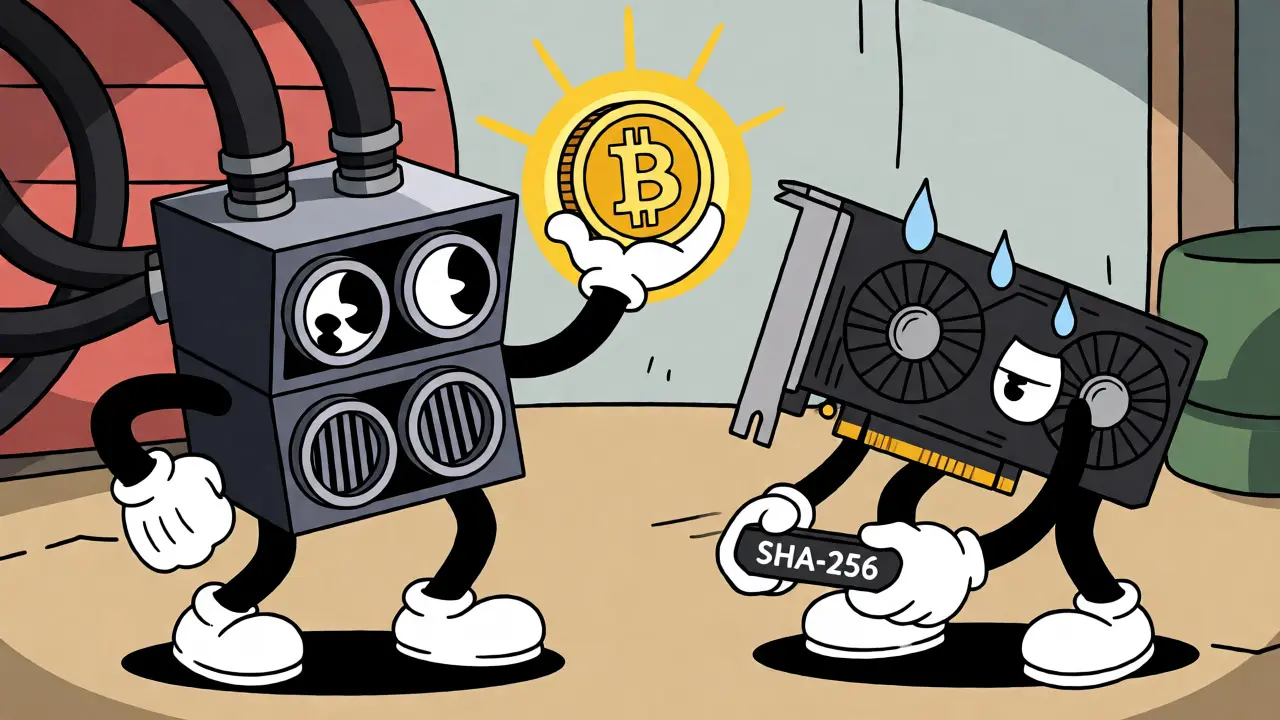

Imagine buying a $3,700 machine that hums like a jet engine, eats electricity faster than you can pay the bill, and does exactly one thing: crunch numbers. That is an ASIC miner. Now imagine a GPU, the kind you use to play games or edit video, trying to compete. Who wins? If you are mining Bitcoin, the ASIC wins by a landslide. But if you want flexibility, the story gets messy.
Most people think they can just plug in a graphics card and start printing money. They can’t. Not anymore. The race for Bitcoin has evolved from CPUs to GPUs to FPGAs, and finally to silicon designed solely for hashing. Today, using a GPU for Bitcoin is like bringing a knife to a gunfight. This guide breaks down why that is, what it actually costs to run these machines in late 2026, and how to calculate if you’ll make a profit before you spend a dime.
The Hardware Divide: Specialized Silicon vs. General Purpose Chips
To understand the cost difference, you have to look at the architecture. A GPU is a jack-of-all-trades. It has thousands of programmable cores, massive memory bandwidth, and complex drivers designed to render 3D graphics, train AI models, and mine various cryptocurrencies. It’s flexible. You can mine Ethereum Classic today, switch to Ravencoin tomorrow, or sell it on eBay next month if prices crash.
An ASIC, or Application-Specific Integrated Circuit, is a specialist. It is hard-wired to perform only one task: calculating the SHA-256 algorithm used by Bitcoin. Because it doesn’t need graphics rendering capabilities or general-purpose logic, engineers strip away all the overhead. The result is extreme efficiency. A study by the University of Michigan showed custom ASIC designs achieving energy efficiencies nearly 15 times higher than comparable GPU setups. In the real world, this gap is even wider due to manufacturing advances.
Think of it this way: A GPU is a Swiss Army knife. An ASIC is a laser-guided scalpel. For cutting bread (mining altcoins), the knife works fine. For performing heart surgery (mining Bitcoin efficiently), the scalpel is non-negotiable.
Current Market Benchmarks: What You’re Actually Buying
In November 2026, the market is dominated by a few key players. Bitmain remains the giant, holding roughly 70-80% of the ASIC market share. Their current flagship, the Antminer S21 Pro, sets the standard for air-cooled residential mining. It delivers 234 TH/s (terahashes per second) while consuming 3,510 watts. That equals 15 J/TH (joules per terahash).
For comparison, let’s look at a high-end consumer GPU, like the NVIDIA RTX 4090. Even under ideal conditions, a single 4090 might manage around 150 MH/s (megahashes per second) on SHA-256. Do the math: 150 MH/s is 0.00015 TH/s. The Antminer S21 Pro does 234 TH/s. One ASIC is equivalent to over 1.5 million GPUs in raw hash power. No amount of undervolting or overclocking changes this fundamental disparity.
| Hardware Model | Type | Hash Rate | Power Consumption | Efficiency (J/TH) | Approx. Price |
|---|---|---|---|---|---|
| Antminer S21 Pro | ASIC | 234 TH/s | 3,510 W | 15.0 | $3,744 |
| Antminer S23 Hydro | ASIC (Liquid) | 580 TH/s | 5,510 W | 9.5 | $8,500+ |
| NVIDIA RTX 4090 | GPU | ~0.00015 TH/s | 450 W | ~3,000,000* | $1,600 |
| AMD RX 7900 XTX | GPU | ~0.00012 TH/s | 355 W | ~2,950,000* | $900 |

The Economics: Calculating Your Real Profit
Purchasing the hardware is just step one. The real game is managing operating expenses. The industry metric you need to watch is hashprice. This represents the revenue earned by one petahash (PH/s) of computing power per day. As of late 2026, with Bitcoin trading near historical highs and difficulty adjusting post-halving, hashprice hovers between $32 and $36 per PH/day.
Let’s run the numbers for an Antminer S21 Pro. It produces 0.234 PH/s. At a conservative hashprice of $32/PH/day, your gross daily revenue is:
- 0.234 PH/s * $32 = $7.49 per day.
Now subtract electricity. The machine uses 3,510 watts. Running 24 hours a day, that’s 84.24 kWh daily. If you live in Madison, USA, where industrial rates might be lower but residential rates are often above $0.10/kWh, your costs vary wildly:
- @ $0.05/kWh (Industrial/Cheap): Cost is $4.21. Profit: $3.28/day.
- @ $0.07/kWh (Moderate): Cost is $5.90. Profit: $1.59/day.
- @ $0.10/kWh (Residential): Cost is $8.42. Loss: -$0.93/day.
This simple calculation reveals why location matters more than hardware specs. If you don’t have access to power below $0.07/kWh, you are likely losing money every time the machine runs, regardless of how efficient the chip is. Don’t forget hidden costs: pool fees (usually 1-2%), internet connectivity, cooling upgrades, and potential downtime repairs.
Why GPUs Are Obsolete for Bitcoin (But Not for Everything Else)
If GPUs are so inefficient for Bitcoin, why do people still buy them? Two reasons: flexibility and resale value. When you buy an ASIC, you are betting entirely on the future of Bitcoin’s price and network difficulty. If Bitcoin crashes, your ASIC becomes expensive space heaters. You can’t repurpose them for gaming or AI workloads. They have zero utility outside of SHA-256 mining.
A GPU rig, however, retains value. If Bitcoin mining becomes unprofitable, you can switch algorithms to mine other coins that rely on memory bandwidth rather than pure SHA-256 speed. Or, you can simply sell the cards to gamers. In 2026, the secondary market for high-end GPUs remains robust. For hobbyists who want to learn about blockchain mechanics without committing to industrial noise and heat, a small GPU setup is still viable for education, though rarely for profit.
Furthermore, some miners use GPUs as a "bridge." They mine profitable altcoins, sell those coins for Bitcoin, and hold the BTC. This strategy decouples their hardware from Bitcoin’s direct difficulty curve. It’s a valid hedge, but it adds complexity and tax implications that pure ASIC miners avoid.
Infrastructure Challenges: Noise, Heat, and Power
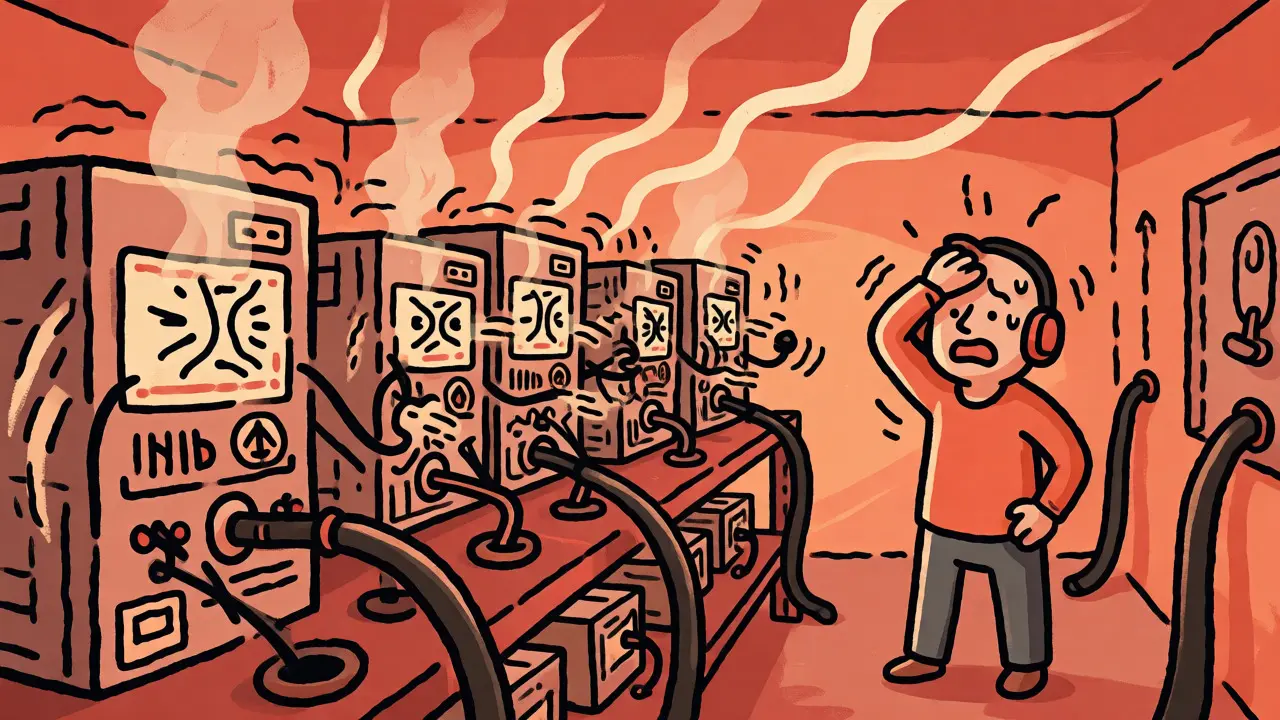
Before you click "buy," consider your living situation. An Antminer S21 Pro produces approximately 76 dBA of noise. That is louder than a vacuum cleaner running continuously. It generates 3.5 kW of heat-enough to warm a small room in winter but turn a garage into a sauna in summer.
Electrical requirements are strict. These units typically require 220-277V AC service. Most US homes have 120V outlets for standard appliances. You will need an electrician to install a dedicated 240V circuit, similar to what you’d use for a dryer or oven. A single unit draws about 20 amps. Running ten units requires significant panel capacity and potentially three-phase power, which most residential grids lack.
Heat management is critical. Air-cooled ASICs push hot air out through fans. Without proper ventilation, they throttle performance or fail. Many home miners build exhaust ducts leading outside. Industrial operations use hydro-cooling or immersion tanks, which reduce noise and improve efficiency but add massive upfront infrastructure costs. If you rent, check your lease. Landlords rarely appreciate the constant hum and heat of a mining farm.
Risks and Future Outlook
Mining is not passive income; it’s a business with margins measured in pennies. The primary risk is difficulty adjustment. Every two weeks, the Bitcoin network adjusts difficulty to keep block times at 10 minutes. If more miners come online globally, your share of the reward shrinks. Since the April 2024 halving, the block subsidy dropped to 3.125 BTC. Future halvings will cut this further, squeezing profits unless transaction fees rise significantly.
Supply chain concentration is another factor. With Bitmain, MicroBT, and Canaan controlling nearly 99% of the ASIC market, you are vulnerable to manufacturer delays, firmware bugs, or pricing manipulation. Used ASICs offer cheaper entry points but carry risks of degraded hashboards and expired warranties.
Looking ahead, the trend is toward liquid cooling and sub-10 J/TH efficiency. The S23 Hydro already hits 9.5 J/TH. To stay competitive, miners must constantly upgrade or secure ultra-cheap renewable energy contracts. Small-scale residential miners face a tough road unless they have subsidized solar power or off-peak night rates.
Can I mine Bitcoin profitably with a GPU in 2026?
Generally, no. While technically possible, the energy cost of running a GPU to mine SHA-256 far exceeds the value of the Bitcoin earned. GPUs are better suited for mining altcoins or serving as a store of value that can be resold later. Only consider GPU mining for Bitcoin if you have free electricity or are doing it strictly for educational purposes.
What is the break-even electricity price for an Antminer S21 Pro?
Break-even depends on the current hashprice and Bitcoin price. Assuming a hashprice of ~$32/PH/day, an S21 Pro breaks even at approximately $0.08-$0.09 per kWh. To be profitable, you generally need electricity rates below $0.07 per kWh. Rates above $0.10 per kWh usually result in a net loss after accounting for fees and depreciation.
How loud are ASIC miners compared to computers?
ASIC miners are extremely loud, typically producing 70-80 decibels. This is comparable to a loud vacuum cleaner or a lawnmower running nearby. They are not suitable for living spaces like bedrooms or offices unless placed in a soundproof enclosure or a separate detached structure like a garage or shed.
Do I need special electrical wiring for ASIC miners?
Yes. Most modern ASIC miners require 220-277V AC power. Standard US residential outlets are 120V. You will need a licensed electrician to install a dedicated 240V circuit (often NEMA 6-20 or 6-30 outlets) with appropriate amperage rating (usually 20A or 30A) to handle the continuous load safely.
What happens to my ASIC if Bitcoin price drops?
If the Bitcoin price drops significantly, your revenue decreases while your electricity costs remain fixed. Older ASICs may become unprofitable and shut down automatically or manually. Unlike GPUs, ASICs cannot be easily repurposed for other tasks, so their resale value also drops during bear markets. You essentially hold a depreciating asset tied directly to Bitcoin's market cap.






Write a comment