



You’re staring at a network dashboard. Your call quality is decent, but your bandwidth bill is climbing. You know G.711 sounds great but eats up too much data. You’ve heard of G.729, but it introduces noticeable delay and licensing headaches. Is there a middle ground? Enter G.726, an ITU-T standardized adaptive differential pulse-code modulation (ADPCM) codec that balances voice quality and bandwidth efficiency. If you are managing legacy PBX systems, DECT phones, or constrained trunk lines, this might be exactly what you need.
This isn’t just another technical spec sheet. We’re breaking down why G.726 remains relevant in 2026, how it compares to modern alternatives, and where it fits in your infrastructure. Let’s figure out if this mid-bandwidth option deserves a spot in your VoIP strategy.
What Exactly Is G.726?
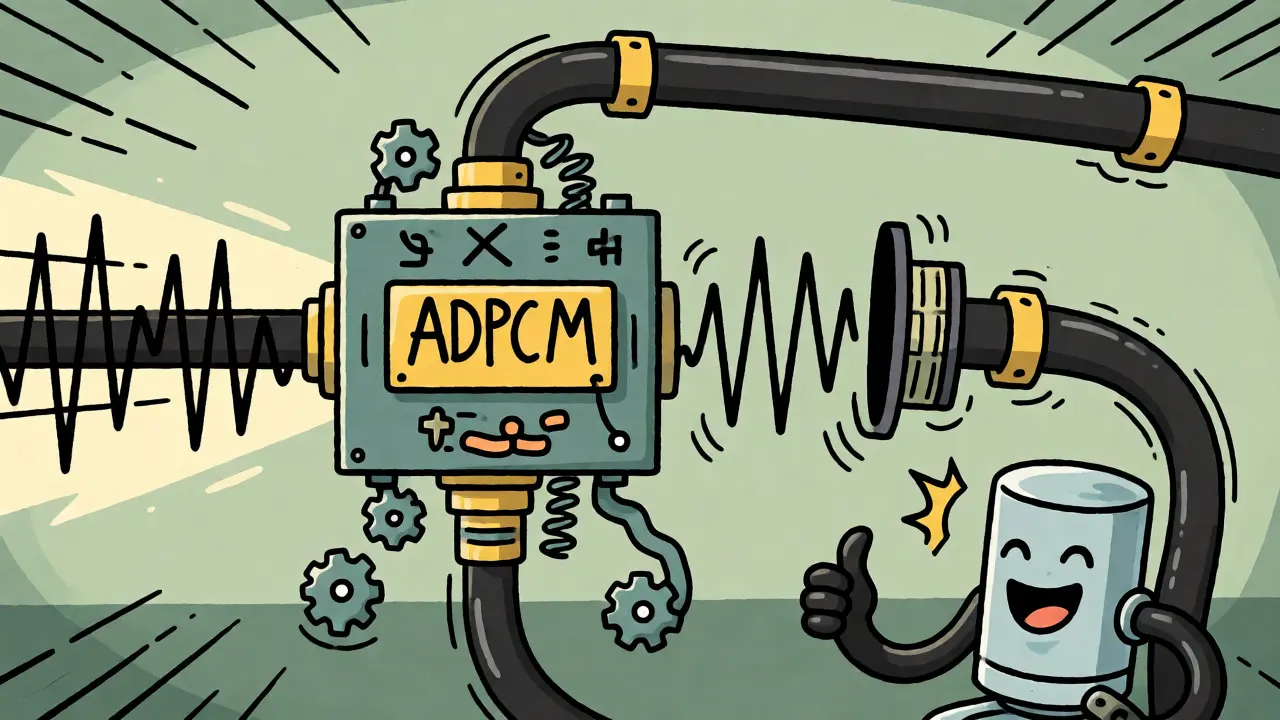
Think of G.726 as the sensible cousin in the codec family. Approved by the ITU-T back in December 1990, it consolidates earlier standards like G.721 and G.723 into one flexible standard. It takes raw digital audio-typically 8 kHz PCM-and compresses it using ADPCM. Instead of sending the full sample every time, it predicts the next sample based on previous history and only transmits the difference. This trick allows it to cut bandwidth usage significantly without requiring heavy computational power.
The beauty of G.726 lies in its flexibility. It supports four distinct bitrates: 40 kbit/s, 32 kbit/s, 24 kbit/s, and 16 kbit/s. Most deployments settle on 32 kbit/s because it offers the best trade-off between quality and cost. At this rate, you’re using half the payload bandwidth of uncompressed G.711 (which runs at 64 kbit/s), yet you avoid the higher latency and complexity associated with low-rate codecs like G.729.
| Bitrate Mode | Bits per Sample | Payload Bandwidth | Typical Use Case |
|---|---|---|---|
| G.726-40 | 5 bits | 40 kbit/s | High-quality voice, minimal compression artifacts |
| G.726-32 | 4 bits | 32 kbit/s | Standard enterprise VoIP, DECT phones, balanced load |
| G.726-24 | 3 bits | 24 kbit/s | Constrained links, moderate quality requirement |
| G.726-16 | 2 bits | 16 kbit/s | Severe bandwidth limits, lower fidelity acceptable |
Why Choose G.726 Over Other Codecs?
You might ask, "Why not just use Opus for everything?" Or stick with G.711 for simplicity? The answer depends on your constraints. G.726 shines in specific scenarios where other codecs fall short.
First, consider latency. G.726 has incredibly low algorithmic delay-often around 1 ms. Compare that to G.729, which can introduce up to 25 ms of packetization delay due to its more complex processing. For real-time conversations, especially in contact centers or trading floors, that extra quarter-second feels like an eternity. G.726 keeps responses snappy.
Second, look at interoperability. While modern internet apps love Opus, traditional telephony infrastructure often speaks G.726. Many older PBXs, gateways, and DECT handsets have hardware DSPs designed specifically for ADPCM algorithms. Implementing G.726 leverages existing hardware capabilities without needing expensive upgrades or software transcoding bottlenecks.
Third, there’s the licensing angle. Unlike some proprietary or patent-heavy codecs from the past, G.726 patents have expired. This makes it attractive for embedded systems and open-source implementations like Asterisk and FFmpeg. You get predictable costs and no surprise royalty fees.
The Interoperability Trap: AAL2 vs. RFC Packing
Here’s where things get tricky. If you deploy G.726, you must watch out for bit-packing conventions. Two main methods exist: the RFC 3551 standard and the ITU-T I.366.2 Annex E (AAL2) convention used in ATM networks. They differ in how they order bits within bytes.
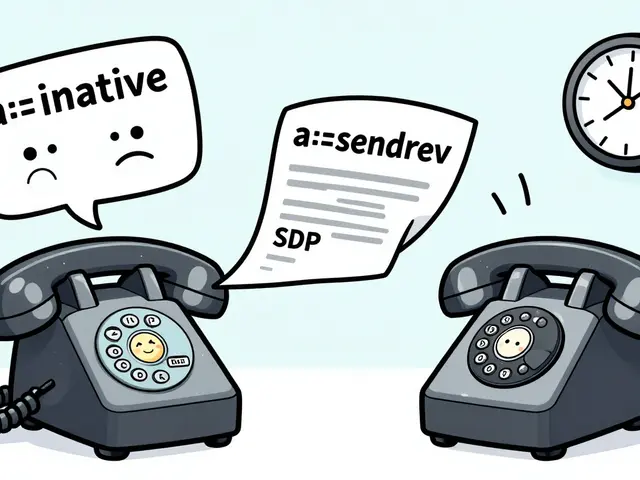
If your endpoint expects AAL2 packing but sends RFC-packed data (or vice versa), you’ll hear garbled noise instead of speech. This happens despite successful SIP negotiation. The SDP says "we agree," but the actual audio stream is mismatched. In Asterisk, for example, you might need to configure `g726aal2` explicitly if your peer device uses the ATM convention. Always test both directions with known voice samples before going live.
Quality Metrics: What Does It Sound Like?
Let’s talk Mean Opinion Score (MOS). This is a subjective measure of voice quality, ranging from 1 (bad) to 5 (excellent).
- G.711: Typically scores around 4.1-4.4. It’s uncompressed, so it’s the gold standard for narrowband telephony.
- G.726-40: Scores approximately 4.16. Very close to G.711, barely noticeable difference for most users.
- G.726-32: Scores around 4.04. Still very clear, suitable for professional business calls.
- G.726-16: Drops to about 2.82-3.5. Noticeable degradation, robotic tones, less natural timbre.
Notice that G.726-32 holds up remarkably well. It provides near-toll-quality audio while cutting bandwidth in half. However, remember that G.726 is narrowband. It doesn’t support wideband frequencies (up to 7 kHz) like G.722 or Opus do. So, while it sounds clear, it lacks the "crispness" of HD voice.
Bandwidth Reality Check
Don’t confuse payload bitrate with total network bandwidth. G.726-32 uses 32 kbit/s for audio data. But add IP, UDP, and RTP headers, plus Layer-2 overhead, and your actual consumption rises.
With standard 20 ms packets, G.726-32 consumes roughly 35.6 to 55.2 kbit/s depending on your link type and header compression settings. Ethernet frames add significant overhead compared to compressed RTP over specialized links. Always calculate total throughput, not just codec rate, when provisioning circuits.

When to Use G.726 (And When Not To)
Use G.726 if:
- You operate legacy PBX-to-gateway trunks.
- You manage DECT cordless phone systems (ETSI requires G.726-32 conformance).
- You have embedded devices with limited CPU power but sufficient memory.
- You need low latency but want to save bandwidth compared to G.711.
Avoid G.726 if:
- You’re building a new internet-based app; choose Opus or G.711 instead.
- You require wideband audio (HD Voice); use G.722 or Opus.
- Your network suffers from severe packet loss; ADPCM relies on previous samples, so lost packets cause longer recovery times than some robust codecs.
Implementation Tips for Engineers
If you’re configuring G.726 in Asterisk, check your module status. Ensure `codec_g726` is loaded. Verify whether your peers expect standard RFC packing or AAL2. If you encounter static or unintelligible audio, try toggling the packing mode.
For packetization, stick to 20 ms unless you have extreme jitter issues. Smaller packets (10 ms) reduce impact of loss but increase header overhead and CPU load. Larger packets (30+ ms) save bandwidth but risk choppy audio if a packet drops.
Finally, monitor MOS metrics in production. Tools like VoIPmonitor can track real-time quality scores. If G.726-32 consistently scores below 3.8, investigate network impairments or consider switching to G.726-40 if bandwidth permits.
Is G.726 better than G.729?
It depends on priorities. G.726-32 offers lower latency (~1ms vs ~25ms) and higher quality (MOS ~4.0 vs ~3.5) but uses more bandwidth (32 kbit/s vs 8 kbit/s). Choose G.726 for speed and clarity; choose G.729 for maximum bandwidth savings.
Does G.726 support HD Voice?
No. G.726 is a narrowband codec operating at 8 kHz sampling rates. It does not support wideband frequencies (up to 16 kHz) found in HD Voice codecs like G.722 or Opus.
Why do I hear static when using G.726?
Static often results from bit-packing mismatches between RFC 3551 and AAL2 conventions. Ensure both endpoints negotiate the same packing order. Check your PBX or gateway configuration for options like 'g726aal2'.
Which G.726 bitrate should I use?
Start with 32 kbit/s. It provides the best balance of quality and bandwidth. Use 40 kbit/s if quality is critical and bandwidth is available. Avoid 16 kbit/s unless strictly necessary, as quality degrades significantly.
Are there licensing fees for G.726?
Generally, no. Patents for G.726 have expired. It is widely implemented in open-source projects like Asterisk and FFmpeg without royalty concerns, though legal review is always prudent for commercial products.





Write a comment