


Why Cross-Border Payments Are a Compliance Nightmare
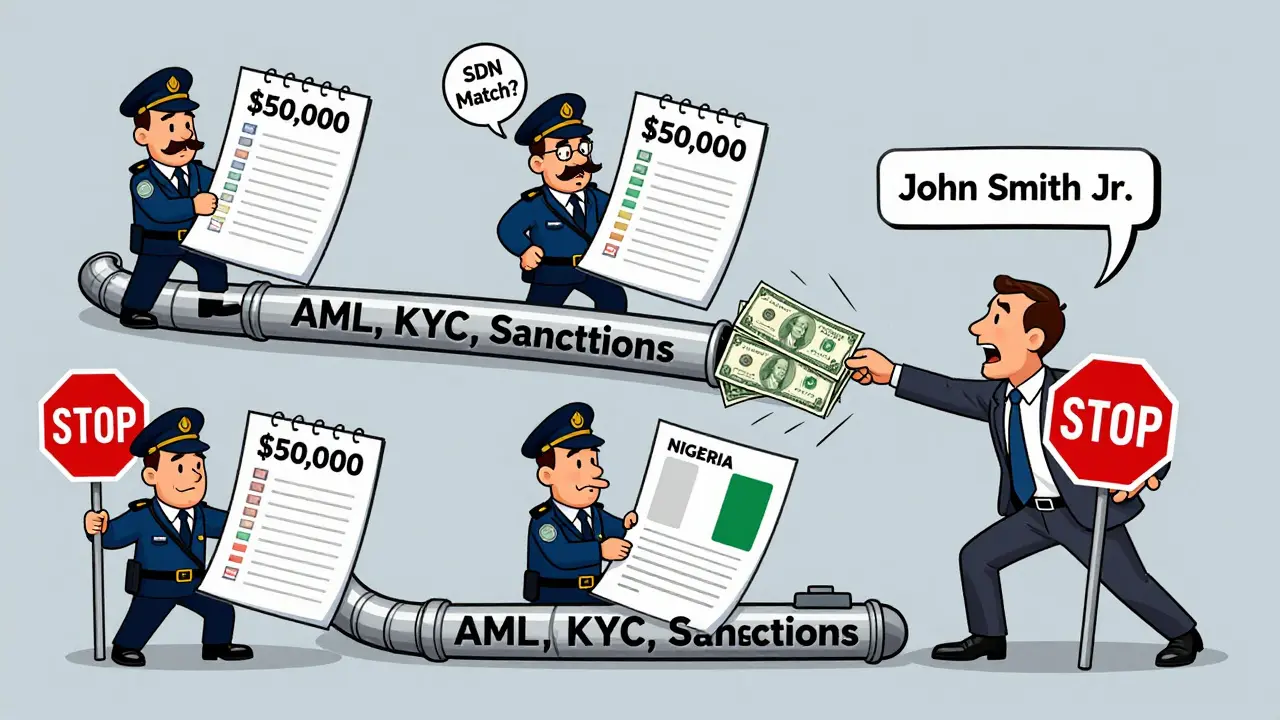
Imagine sending $50,000 from your U.S.-based company to a supplier in Nigeria. The payment sits for three days. No error message. No explanation. Then, your bank freezes your account. Why? Because the recipient’s name matched a name on a sanctions list - a name that turned out to be a coincidence, but the system didn’t know that. This isn’t rare. In 2025, over half of all fintechs and mid-sized payment processors faced at least one regulatory penalty for cross-border transactions. The problem isn’t the money. It’s the rules.
Every time money crosses a border, it must pass through layers of AML (Anti-Money Laundering), KYC (Know Your Customer), and sanctions checks. These aren’t optional. They’re enforced by fines up to $1 million per violation under U.S. OFAC rules, and criminal charges can follow. The EU’s new Anti-Money Laundering Authority (AMLA) started full operations in December 2025, and it’s already auditing firms across 27 countries. If you’re moving money internationally, you’re in the crosshairs.
What AML, KYC, and Sanctions Actually Mean in Practice
AML isn’t just a buzzword. It’s a legal requirement to stop criminals from hiding dirty money in the financial system. KYC is how you prove you know who you’re sending money to - not just their name, but who really owns the business, where they live, and if they’ve ever been linked to fraud. Sanctions screening means checking every transaction against lists of people and companies banned by governments, like those on OFAC’s Specially Designated Nationals (SDN) list.
Here’s what happens in real time: When a payment is initiated, the system checks three things:
- KYC: Does the sender and recipient pass identity verification? Are their documents valid? Is the ultimate beneficial owner (UBO) disclosed?
- AML Monitoring: Is this transaction unusual? Did $50,000 suddenly appear in a company that usually handles $2,000? Did funds move through five different countries in 48 hours?
- Sanctions Screening: Is anyone involved on a global sanctions list? Even a partial name match can trigger a block.
Under the EU’s new Transfer of Funds Regulation (TFR), which took effect in January 2025, payment providers must transmit full originator and beneficiary data - name, address, account number - within 10 seconds for euro transfers. In the U.S., the Bank Secrecy Act (BSA) requires Currency Transaction Reports for any transfer over $10,000. Miss one step, and you’re in violation.
The Real Cost of Getting It Wrong
Penalties aren’t theoretical. In July 2025, a UK fintech startup lost its license after failing to update its sanctions list for three weeks. A single payment to a blocked entity cost them $1.2 million in fines and six months of suspended operations. Meanwhile, Stripe blocked $47 million in prohibited transactions in Q4 2025 alone - not because they were overzealous, but because their system caught patterns others missed.
Convera’s 2025 survey of 300 payment processors found 52% had been fined in the past 18 months. The average fine? $350,000. But the hidden cost is worse: delayed payments, lost customers, and reputational damage. One logistics firm in Texas lost a major client after a payment to their Mexican vendor was flagged for 11 days. The client assumed they were involved in money laundering. They never came back.
And it’s not just about fines. If your systems fail to detect structuring - breaking large payments into smaller ones to avoid reporting thresholds - you could be seen as complicit. That’s a federal crime.
How Compliance Systems Work (And Why They’re Still Flawed)
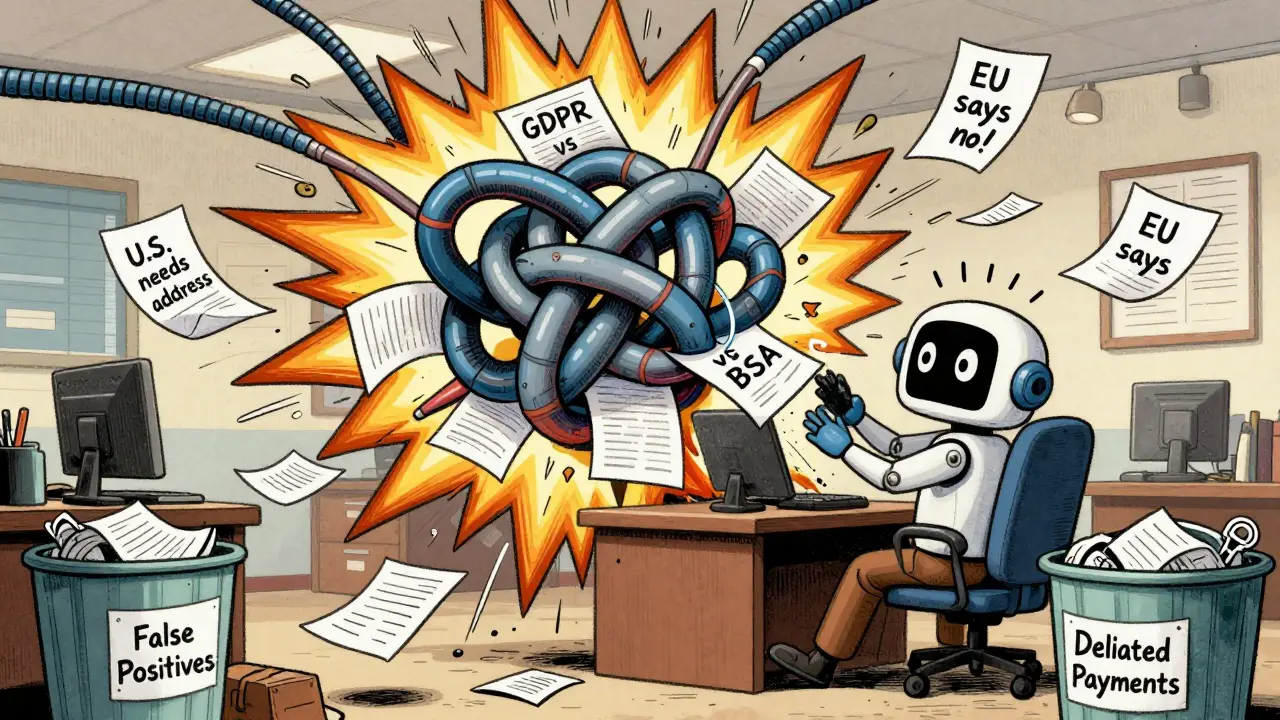
Most firms use AI-powered platforms that scan transactions against global databases: OFAC, EU UBO registers, FinCEN’s BSA E-Filing System, and FATF’s Travel Rule data. These tools analyze velocity, geography, and behavioral anomalies. Alessa’s 2025 case studies show these systems cut false positives by 40% and reduced failed payments by 30%.
But they’re not perfect. The biggest problem? Conflicting rules. The EU’s GDPR demands strict data privacy. The FATF’s Travel Rule demands full data sharing. A German payment processor can’t legally send a U.S. customer’s home address to a U.S. bank under GDPR - but the U.S. requires it under AML rules. This tension causes delays, blocks, and compliance officers pulling their hair out.
Another issue: opaque payment chains. In 41% of cross-border transactions, data gets chopped off at intermediary banks. You send $10,000 to India. Your bank sends it through a Swiss intermediary. The Indian bank never sees the full originator info. That’s a compliance gap. The BIS’s Project Mandala found this happens in nearly half of all transactions.
What Works: Automated Systems vs. Manual Checks
Small businesses with fewer than 50 international payments a month might still use spreadsheets and manual checks. But it’s risky. One owner in Ohio missed an updated OFAC listing because he didn’t check the website for six weeks. A payment to a supplier was blocked, and the supplier sued for lost business.
For anyone doing more than that, automation isn’t optional - it’s survival. Convera’s benchmarks show automated systems process transactions 75% faster and reduce compliance staff workload by 60%. One SaaS company in Austin cut its onboarding time from 72 hours to 4 hours after implementing an AI-driven KYC platform. The catch? It cost $1.2 million upfront.
Enterprise systems range from $500,000 to $2 million. But the ROI is clear: fewer fines, faster payments, and more trust from partners. Stripe, PayPal, and Wise all invest heavily in real-time screening. Their systems update sanctions lists automatically, flag high-risk countries, and adapt to new FATF guidelines within days - not months.
The New Rules Coming in 2026
2026 is the year compliance gets even harder. Two major frameworks went live in January:
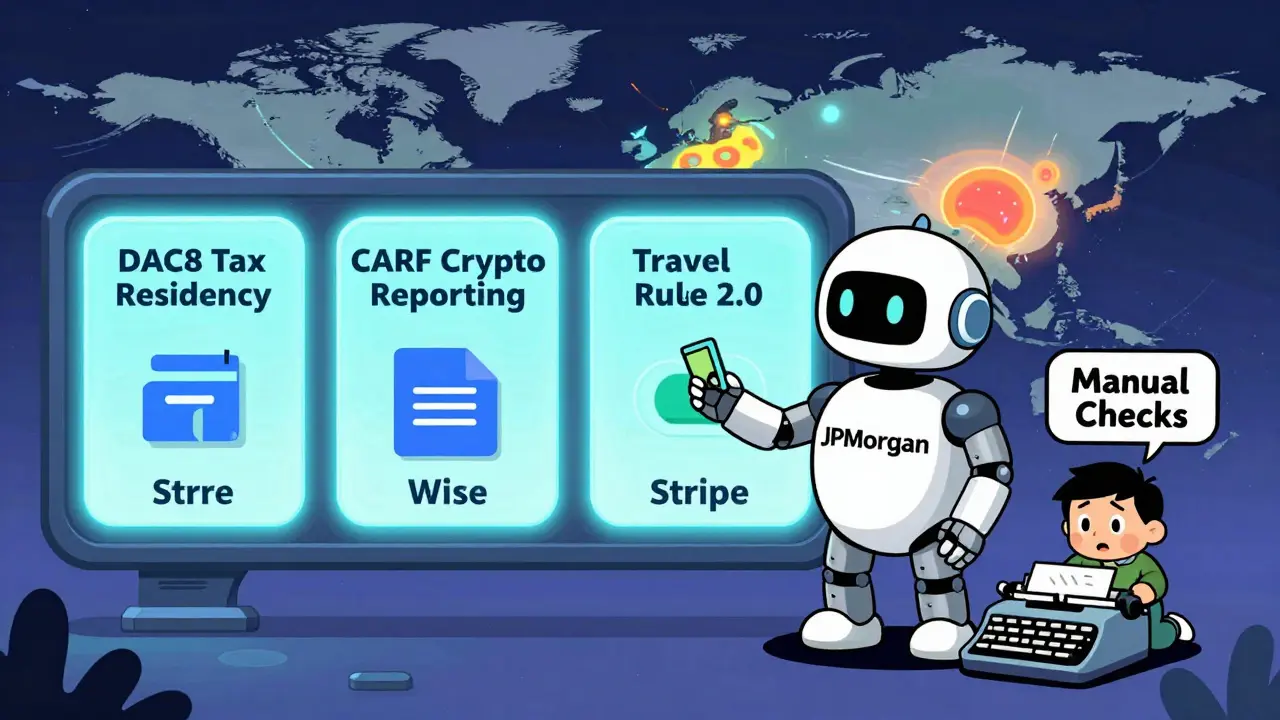
- DAC8 (EU): Requires payment processors to collect tax residency data - where customers live, their tax IDs, and transaction amounts - and report it to tax authorities.
- CARF (OECD): The Common Reporting Standard for Automatic Exchange of Information now applies to digital payments, not just bank accounts. If you process crypto or stablecoin payments, you’re now under the same reporting rules as banks.
FATF is also rolling out “Travel Rule 2.0,” expanding data requirements for virtual asset transfers. And the SEC launched a cross-border fraud task force targeting crypto payments disguised as regular transfers. If you’re using crypto for international payments, you’re now in the same compliance bucket as a bank.
What does this mean? Your compliance system must now handle financial crime, tax reporting, and crypto regulation - all at once. That’s not three separate tasks. It’s one integrated system.
Who’s Doing It Right
Companies that survive are those building compliance into their tech from day one - what’s called “compliance by design.” JPMorgan Chase and HSBC are piloting this approach, embedding AML checks directly into their payment architecture. They don’t add compliance as an afterthought. It’s baked in.
Smaller players can follow suit with modular platforms like those from LexisNexis Risk Solutions or ComplyAdvantage. These tools let you plug in rules based on jurisdiction: GDPR-compliant data handling for Europe, BSA rules for the U.S., and local requirements for Latin America or Southeast Asia. One Canadian fintech scaled into 12 countries in 14 months by using a platform that auto-adjusts rules per region.
Key takeaway: Don’t wait for a fine to force you to act. The regulatory wave is here. The question isn’t whether you need compliance - it’s whether you’re ready for what’s next.
What You Should Do Now
If you’re moving money across borders in 2026, here’s your action plan:
- Map your flows: List every country you send or receive payments from. Check if any are high-risk under FATF’s list.
- Verify your tech: Does your payment processor screen against OFAC, EU sanctions, and UBO registers? Does it support ISO 20022 data standards?
- Check your data retention: You must keep records for five years under BSA. Are you doing it legally and securely?
- Train your team: One employee misreading a sanctions list can cost you millions. Make AML/KYC training mandatory.
- Plan for 2026 updates: If you handle crypto or tax-related payments, your system must now capture residency and tax ID data. Start now.
There’s no shortcut. But you don’t need to build everything from scratch. Start with a modular platform. Focus on the countries you actually transact with. And never assume your vendor is handling everything - ask for proof.
Why This Isn’t Going Away
The global cross-border payments market will hit $250 trillion by 2027. That’s more than double what it was in 2023. With that growth comes more scrutiny. The IMF says 92% of regulators will tighten rules through 2030. AI will help - but only if you use it right. Manual processes won’t cut it. Neither will ignoring updates.
Compliance isn’t a cost center. It’s your license to operate. The companies that win aren’t the ones with the cheapest tech. They’re the ones who treat compliance as a competitive advantage - faster approvals, fewer disruptions, and trust from global partners.
Don’t wait for the next fine to wake you up. The system is watching. Are you ready?









E Jones
26 Jan 2026 at 00:26They’re not trying to stop money laundering-they’re trying to stop *you*. You think this is about crime? Nah. It’s about control. Every time you send money abroad, they’re logging your life: where you eat, who you pay, what you believe. The ‘sanctions list’? A ghost database with 12 million names, half of them common surnames like ‘Wang’ or ‘Garcia.’ One guy in Ohio got flagged because his supplier’s dad had the same name as a guy in Syria who died in 2008. The bank froze his account for 17 days. No apology. No explanation. Just silence. And now they want to track your crypto payments like you’re a drug lord? You know what’s really being laundered? Your privacy. Your freedom. Your right to exist without being interrogated by an algorithm that thinks ‘Nigeria’ equals ‘criminal.’ They’re building a panopticon with SWIFT codes and calling it ‘compliance.’ Wake up. They’re not protecting the system. They’re protecting themselves-from you.
And don’t even get me started on DAC8. Now they want your tax ID, your residency, your birth certificate, your pet’s name? Next thing you know, they’ll demand your Spotify playlist to assess ‘financial behavior patterns.’ This isn’t regulation. It’s surveillance capitalism with a compliance badge.
I’ve seen it. My cousin in Brazil got blocked because his ‘UBO’-his 82-year-old mom who owns 1% of his business-had a Gmail account registered in Florida. They called it ‘high risk.’ She’s a retired teacher. She doesn’t even know what Bitcoin is. But the algorithm? It screamed ‘fraud.’ And now she can’t pay her medical bills. Who’s the real criminal here?
The system doesn’t care about truth. It cares about checkboxes. And if you’re not rich enough to afford a $2 million AI compliance suite, you’re not a customer-you’re a target. They don’t want to fix the system. They want to make sure you never escape it.
I’m not paranoid. I’m just the guy who read the fine print. And it’s not fine. It’s a prison.
They call it ‘the Travel Rule.’ But nobody’s traveling anymore. We’re just being tracked.
And they wonder why people are turning to crypto. At least then, they can’t see your name. Just your wallet. And even that’s getting tagged now. What’s next? Facial recognition on your payment app? You’ll get a pop-up: ‘Your face matches a high-risk profile. Please provide 3 selfies and a DNA sample to proceed.’
I’m not joking. They’re already testing it.
They’re not here to help you. They’re here to own you.
And they’re winning.