


Decentralized Autonomous Organizations (DAOs) don’t have CEOs, offices, or email chains. Instead, they run on DAO coordination tools-a mix of chat apps, discussion boards, and voting platforms that let thousands of strangers make decisions together without ever meeting. If you’ve ever wondered how a DAO with 10,000 members votes on a $5 million treasury spend, or why everyone’s screaming in Discord over a new token proposal, this is how it actually works.
Discord: The Unofficial DAO HQ
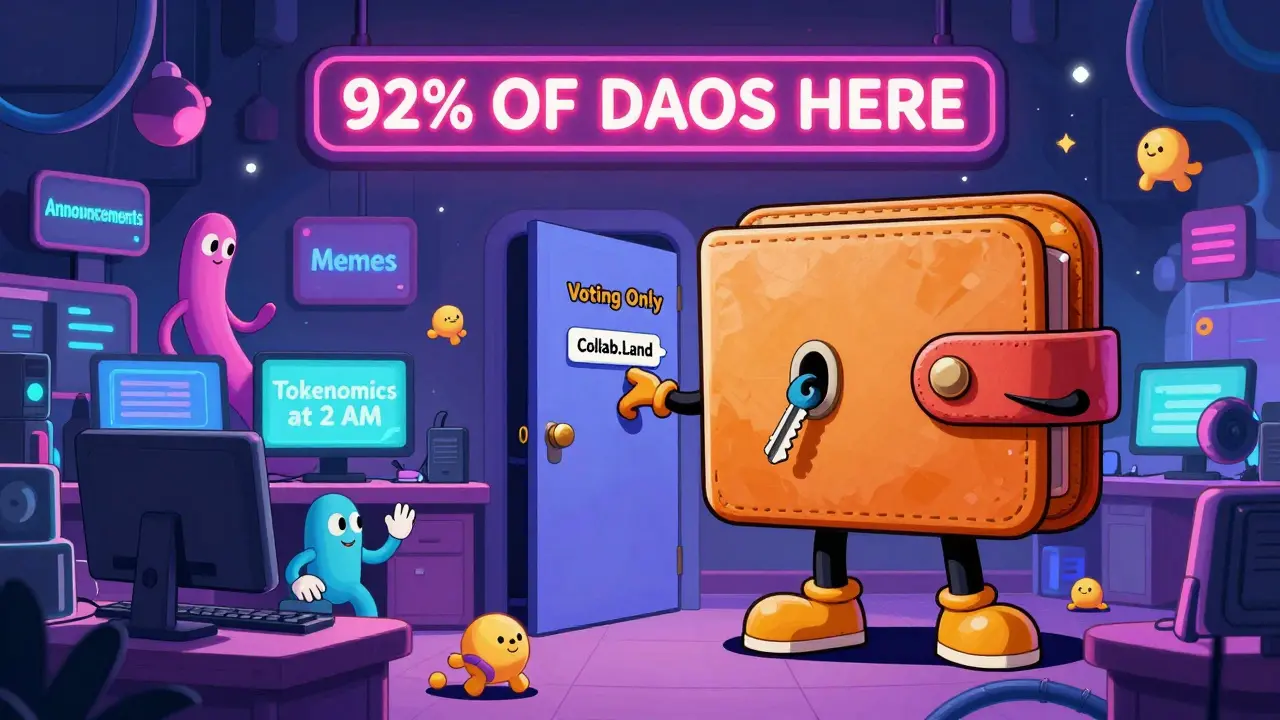
Almost every DAO you’ll find today lives on Discord. It’s not because it was designed for this-it wasn’t. It’s because it’s easy, fast, and familiar. By December 2025, 92% of active DAOs use Discord as their main communication hub, according to BanklessDAO’s survey of 1,200 organizations. You’ll find channels for announcements, memes, governance debates, and even voice rooms where people argue about tokenomics at 2 a.m.
But Discord has a dark side. It’s a centralized platform owned by a single company. That means if Discord goes down-or if a moderator gets hacked, like in the October 2023 BanklessDAO breach-your entire DAO’s communication can vanish. And with an average of 47 channels and 1,200 daily messages per server, most members suffer from what’s now called “Discord fatigue.” One Reddit user reported spending three hours a day just clearing notifications across seven DAOs.
To make Discord work for DAOs, teams use bots like Collab.Land to lock channels behind token ownership. Need to join the $UNI voting channel? You need at least 100 UNI tokens in your wallet. That’s great in theory. In practice, syncing wallet roles takes an average of 7.2 minutes, and sometimes roles just don’t update. That’s why some DAOs are testing alternatives like Telegram or the newer Dots platform-but nothing has come close to matching Discord’s user base or ease of use.
Discourse: The Forgotten DAO Forum
Back in 2019, some DAOs tried using Discourse-the open-source forum software built by Stack Overflow’s co-founder-as a more structured alternative to Discord. It was clean, thread-based, and searchable. Perfect for deep policy debates. But it required self-hosting, technical setup, and didn’t connect to blockchain wallets. By 2025, only 3% of DAOs still use Discourse as their primary discussion space.
MolochDAO, one of the earliest DAOs, still runs a Discourse forum alongside Discord and Snapshot. But even they admit it’s mostly for archival purposes. Most members don’t check it. Why? Because if your proposal isn’t pinned in Discord with a loud notification, no one sees it. Discourse didn’t solve the discovery problem-it made it worse. Today, it’s mostly a relic, used by legacy groups who value long-form debate over speed.
Governance Hubs: Where Decisions Actually Happen
Discord is for talking. Governance hubs are for deciding. These are the platforms where votes are cast, treasury proposals are submitted, and rules are changed-all on-chain or off-chain with cryptographic proof. The three big players are Snapshot, Aragon OSx, and Tally.
Snapshot is the most popular. It handles 78% of all major DAO votes, including those from Uniswap, Aave, and Lido. You don’t need to pay gas to vote. Instead, it reads your wallet balance from the blockchain and lets you sign a message with your private key. Votes are stored on IPFS, not the blockchain, which keeps costs near zero. It’s simple: create a space, write a proposal, and let token holders vote. Over 1.2 million votes were cast on Snapshot in a single quarter for Uniswap’s governance. But it has a flaw: votes are off-chain. If someone hacks your wallet and signs a fake vote, there’s no way to undo it. That’s what happened in February 2024, when 12 DAOs lost $87 million to signature replay attacks.
Aragon OSx is the opposite. It’s complex, modular, and built for serious governance. MakerDAO uses it to manage its $6.2 billion treasury with a dual-layer system: one group proposes, another approves. Aragon lets you create custom permission levels-like “can propose treasury spend,” “can veto emergency actions,” or “can change voting rules.” It runs on 12 blockchains, including Ethereum and Solana. But it’s not for beginners. Setting up a full Aragon DAO takes 80 to 120 hours of developer time. Most small DAOs can’t afford that.
Tally sits in the middle. It’s sleek, fast, and built for teams that want analytics and delegation without the complexity. Tally processes 4.7 million votes a month across 875 DAOs. It lets you assign delegates, track voting history, and even simulate transactions before executing them. But it charges 0.5% on every executed proposal-up from 0.3% in 2024. For a $1 million treasury vote, that’s $5,000 in fees. Some DAOs hate it. Others say it’s worth it for the reliability.
The Real Problem: Too Many Tools, Too Little Clarity
Most DAOs don’t use just one tool. They use a patchwork: Discord for chat, Snapshot for voting, Gnosis Safe for treasury access, and sometimes Tally for delegation. That’s a nightmare for newcomers. A Chainalysis survey found 63% of DAO participants are highly technical-usually software engineers under 35. The rest? They get lost.
One DAO member told me: “I got invited to a DAO with a $20 million treasury. I spent two weeks trying to figure out where to vote. There were three links in Discord, two of them dead. I missed the vote. Someone else got my tokens.” That’s not decentralization. That’s chaos.
Even worse, notifications are broken. In March 2025, ConstitutionDAO II tried to raise $25 million for a legal defense. 83% of eligible voters didn’t see the vote because Discord notifications got buried. The proposal failed.
What’s Next? AI, Wallets, and Consolidation
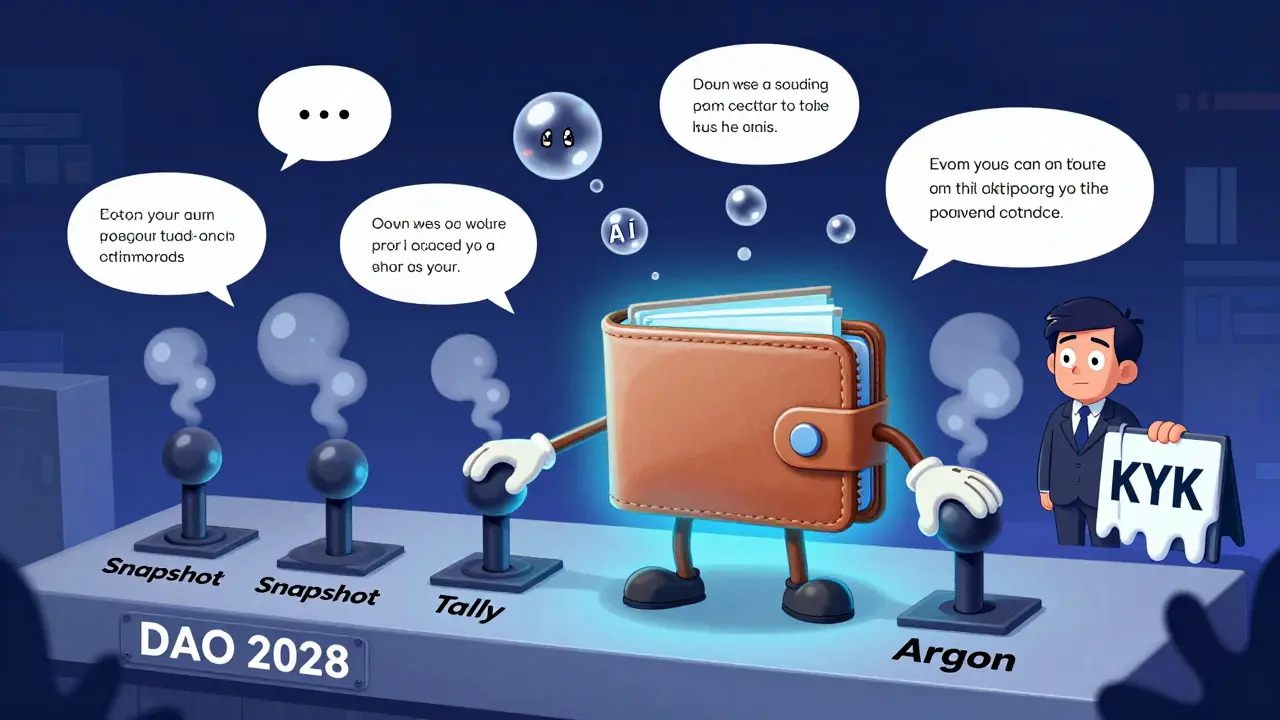
The next wave of DAO tools isn’t about adding more apps-it’s about removing the friction between them. Snapshot just added AI that summarizes proposals in plain English. Tally’s “Governance Copilot” predicts whether a vote will pass based on past behavior. DAOhaus and XDAO are building all-in-one platforms that combine chat, voting, and treasury management in one place.
And wallets are getting smarter. WalletConnect v3, integrated into Discord in November 2025, lets you log in with your wallet and see your voting power without switching apps. If this works, the need for Discord + Snapshot + Safe could vanish. By 2028, experts predict 80% of DAO governance will happen inside your wallet-no extra platforms needed.
But there’s a catch. The SEC is watching. In May 2025, they warned that tools enabling token-weighted voting might count as unregistered securities exchanges. That’s why 41% of governance hubs are now adding KYC modules-something that goes against the whole point of DAOs.
What Should You Use?
If you’re starting a DAO:
- Use Discord for daily talk. But prune channels. Keep it under 12. Use Collab.Land for token-gating.
- Use Snapshot for voting. It’s free, fast, and trusted. Don’t use it for emergency votes-too slow to respond.
- Use Tally if you have over 500 members and need delegation or analytics. Accept the 0.5% fee.
- Avoid Aragon OSx unless you have a developer on retainer.
- Never rely on Discourse unless you’re building a historical archive.
And here’s one pro tip from experienced DAO members: Always test your vote with SafeSnap before executing. Simulate the transaction. Check the gas. Confirm the wallet. One typo in a proposal can drain your treasury.
Final Thought
DAOs are the first real attempt at digital self-governance. But they’re still using tools built for other purposes. Discord wasn’t made for token-gated communities. Snapshot wasn’t made for legal liability. And no tool yet solves the core problem: how do you get non-technical people to participate without drowning them in notifications?
The answer might not be better tools. It might be fewer. The future of DAOs isn’t in adding more apps-it’s in making one app do everything. Until then, you’re not running a DAO. You’re managing a digital circus.
Is Discord safe for DAO governance?
No, Discord is not safe for critical governance. It’s centralized, vulnerable to hacks, and lacks blockchain verification. While 92% of DAOs use it for communication, votes and treasury decisions should always happen on governance hubs like Snapshot or Aragon OSx. Discord is for discussion only.
What’s the difference between Snapshot and Aragon OSx?
Snapshot is for off-chain voting-fast, free, and simple. It reads your wallet balance and lets you sign a vote without paying gas. Aragon OSx is for on-chain governance with complex rules. It lets you create custom permissions, automate treasury actions, and enforce multi-sig approvals. Snapshot is for voting. Aragon is for running a DAO like a company.
Do I need to pay to use governance tools?
Snapshot is free. Tally charges 0.5% on executed proposals. Aragon OSx is free to use but requires expensive developer time to set up. Collab.Land for Discord costs $99/month. Most DAOs use a mix: free tools for voting, paid tools for automation. Always check fees before committing your treasury.
Why do DAO members miss votes?
Because notifications are broken. Discord has too many channels. Snapshot doesn’t send emails. Tally’s alerts get buried. A DAO Compass survey found 52% of participants missed critical votes due to notification overload. The fix? Use SafeSnap for proposal alerts, set up a dedicated #votes channel in Discord, and assign a delegate to remind members.
Can I use Telegram instead of Discord for my DAO?
You can, and 23% of DAOs do. Telegram is better for mobile users and has stronger encryption. But it lacks moderation tools, token-gating, and bot integrations. Most DAOs use Telegram for side chats or emergency alerts, not as their main platform. If you’re serious about governance, stick with Discord for now.
What’s the biggest mistake new DAOs make with coordination tools?
Trying to do everything at once. They create 50 Discord channels, set up Aragon OSx, integrate Tally, and launch a Discourse forum-all on day one. The result? Confusion, low participation, and burnout. Start simple: one Discord server, one Snapshot space, one Safe wallet. Add tools only when you need them.







Salomi Cummingham
16 Dec 2025 at 12:47Oh my god, I just spent three hours trying to figure out why my vote didn’t count and realized I’d been checking the wrong Discord channel for weeks. I swear, DAOs are like trying to find your keys in a hurricane-you’re shouting into the wind and everyone’s got their own version of the storm. I’ve got seven DAOs in my wallet and I’m not even a dev. I just want to vote on whether we fund the cat meme fund or not. Why does it feel like I need a PhD in blockchain just to say ‘yes’ to pizza money? I started using SafeSnap alerts and it’s been a game-changer. Now I get a little ping when something’s up, and I don’t have to scroll through 400 memes about Shiba Inus wearing suits. Still, I miss the days when we just emailed each other. Remember emails? They were slow, sure, but at least they didn’t require a wallet.
Also, can we talk about how Tally’s 0.5% fee feels like a toll booth on the highway to democracy? I get it, infrastructure costs, but when your treasury is $2 million and you’re paying $10k to vote on whether to buy a new server, it starts to feel less like decentralization and more like a SaaS company with a very niche customer base.
And Discord? I love it. I hate it. I’m addicted to it. I wake up to 147 notifications and I still open it. It’s the digital equivalent of a coffee shop where everyone’s talking over each other but somehow you still feel like you belong. But yeah, if it goes down tomorrow, we’re all screwed. And no, Telegram isn’t the answer. It’s just Discord with worse bots and more spammy crypto ads.
Someone please build a tool that just says ‘Hey, your vote is due’ in a voice that sounds like your grandma. I’d vote for that.
Also, I’m not even mad anymore. I just laugh. Because if we can’t figure this out, who can? We’re literally trying to run governments with memes and smart contracts. We’re the future. And the future is chaotic. And weirdly beautiful.
Also also-yes, I did just cry over a failed proposal about funding a DAO-funded art installation of a giant floating duck. Don’t judge me.
Anyway. I’m going to go check my wallet. Again. Because I know I’m missing something. Again.