



Remember the last time you tried to use a decentralized application (dApp) during peak hours? You probably stared at your screen, watching the gas meter climb, wondering if that $50 transaction fee was worth swapping a few dollars’ worth of tokens. It’s a frustrating experience that has kept mainstream users away from blockchain technology for years. But something fundamental is changing. The era of expensive, slow transactions is ending because developers are moving their apps to Layer 2 solutions.
Layer 2 isn’t just a buzzword; it’s the infrastructure fix we’ve been waiting for. By processing transactions off the main blockchain and only settling them later, these networks deliver speeds and costs that rival traditional web services. If you’re building or using dApps in 2026, understanding this shift isn’t optional-it’s essential for staying competitive and keeping your wallet healthy.
What Exactly Is Layer 2 Scaling?
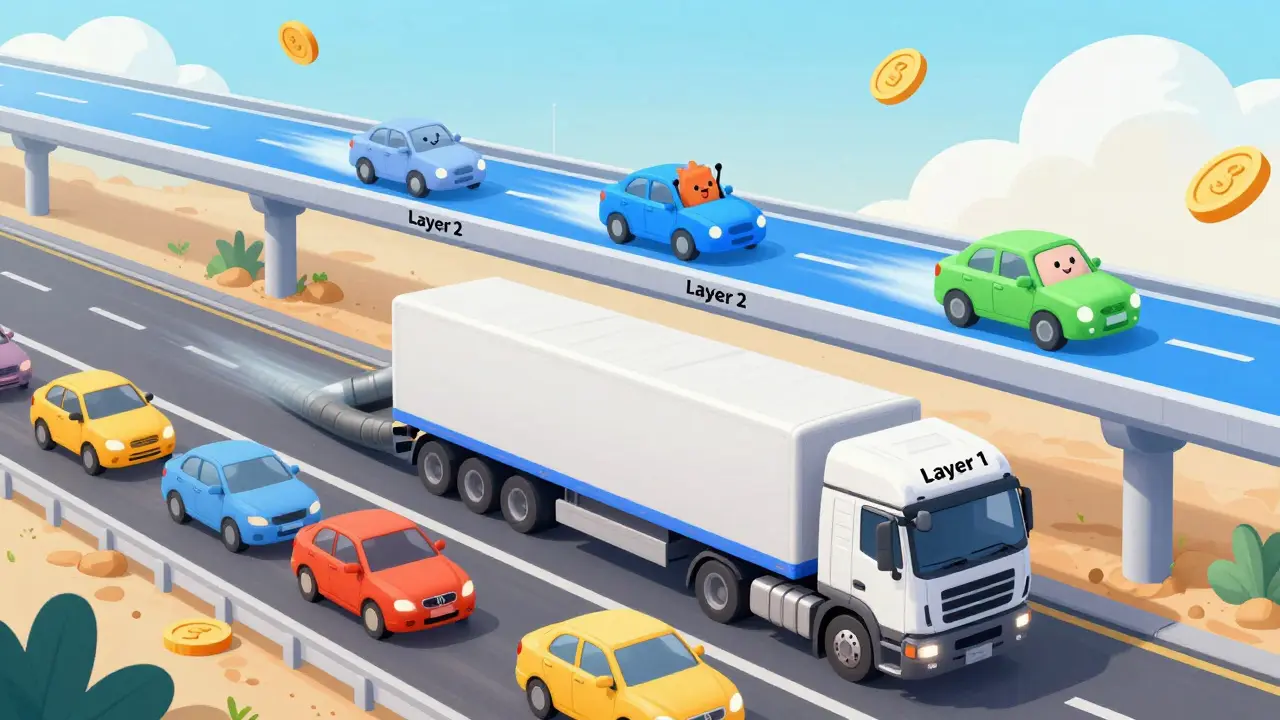
To understand why Layer 2 matters, you first need to grasp the problem with Layer 1 blockchains like Ethereum. Ethereum is secure and decentralized, but it’s also congested. Imagine a single-lane highway where every car (transaction) needs to be inspected by every police officer (validator) before moving forward. That inspection ensures safety, but it creates massive traffic jams.
Layer 2 solutions act like express lanes built on top of that highway. They bundle thousands of transactions together, process them quickly off-chain, and then send a single summary back to the main Ethereum chain for final settlement. This approach keeps the security guarantees of Ethereum while drastically reducing the load on the main network.
According to data from L2Beat in late 2024, over $30 billion was locked in Ethereum Layer 2 solutions, proving that money is voting with its feet. The result? Transaction costs drop from an average of $15-$50 on mainnet to pennies on Layer 2. Throughput jumps from 15-30 transactions per second (TPS) to thousands. For a user, this means no more "gas anxiety." For a developer, it means their app can actually scale.
The Four Main Types of Layer 2 Solutions
Not all Layer 2s are created equal. There are four primary architectural approaches, each with distinct trade-offs between speed, cost, and complexity. Choosing the right one depends heavily on what your dApp does.
| Type | How It Works | Speed (TPS) | Cost | Best For |
|---|---|---|---|---|
| Optimistic Rollups | Assumes transactions are valid unless challenged (fraud proofs) | 2,000-4,000 | Low ($0.01-$0.50) | DeFi, general-purpose dApps |
| ZK-Rollups | Uses cryptographic proofs (validity proofs) to verify bundles | 2,000-10,000+ | Very Low ($0.0005+) | Gaming, high-frequency trading |
| Plasma Chains | Child chains submit Merkle roots to mainnet periodically | 7,000+ | Ultra-Low | High-volume microtransactions |
| State Channels | Direct peer-to-peer transactions; only open/close states go on-chain | Unlimited (for participants) | Near Zero | Payments, gaming interactions |
Optimistic Rollups, used by networks like Arbitrum and Optimism, are currently the most popular choice for DeFi apps. They assume transactions are correct by default. If someone detects fraud, they can post a "fraud proof" within a 7-day challenge window. This makes them easy to develop for since they are compatible with the Ethereum Virtual Machine (EVM), meaning existing Solidity code runs with minimal changes.
In contrast, ZK-Rollups (Zero-Knowledge Rollups) like zkSync and StarkNet generate complex mathematical proofs to validate every transaction bundle. This offers near-instant finality and no waiting periods for withdrawals, which is crucial for gaming and real-time applications. However, development is harder because many ZK-rollups require specialized programming languages like Cairo or Zinc, rather than standard Solidity.
Why Developers Are Migrating to Layer 2
The incentives for developers to move to Layer 2 are purely economic and experiential. Let’s look at the numbers. In September 2024, Transak reported that typical Ethereum mainnet transactions cost between $1.50 and $50 depending on congestion. On Layer 2 networks, those same transactions often cost less than $0.01.
This price difference transforms user behavior. A study by Transak analyzing 4.7 million transactions found that Layer 2 users complete 3.2 times more monthly transactions than Layer 1 users. When fees are negligible, users don’t think twice about interacting with your app. They swap tokens, mint NFTs, and participate in governance without calculating the ROI of each click.
Consider Uniswap, the largest decentralized exchange. By Q1 2024, 40% of its trading volume had migrated to Arbitrum alone. Why? Because traders can execute multiple strategies in a day without losing profits to gas fees. Similarly, gaming platforms like Immutable X can process 9,000 NFT mints per second at near-zero cost. On Ethereum mainnet, that same action would clog the network and cost players hundreds of dollars.
For enterprise adoption, the stakes are even higher. JPMorgan launched its JPM Coin settlement system on Consensys’ Linea zk-Rollup in August 2024 to handle $500 million in daily institutional transactions. Banks cannot operate with unpredictable latency and costs; Layer 2 provides the stability they require.
The Hidden Challenges: Fragmentation and Bridges
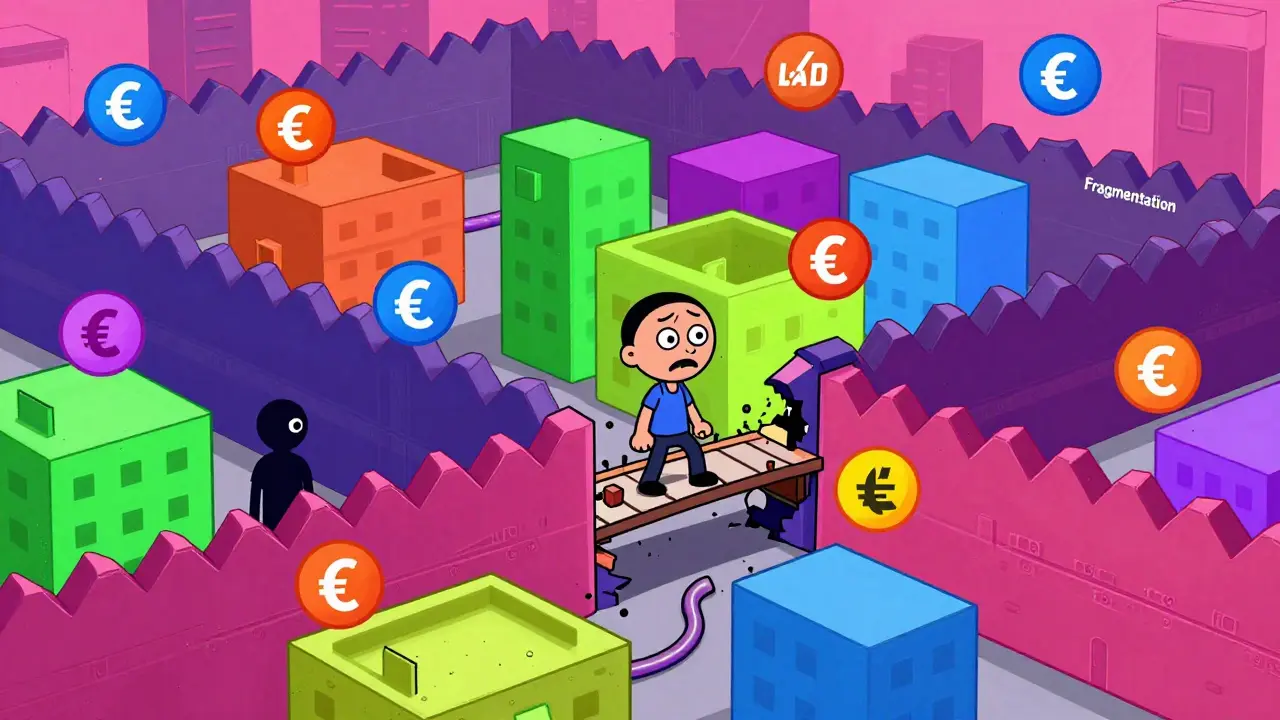
If Layer 2 is so perfect, why hasn’t everyone switched yet? The answer lies in fragmentation. While individual Layer 2 networks are fast and cheap, moving assets between them is still clunky.
Imagine living in a city where every neighborhood has its own currency. You can buy coffee easily in your district, but if you want to visit a friend in another district, you have to go through a slow, expensive exchange office. This is the current state of cross-Layer 2 communication.
Data from L2Beat in September 2024 showed that bridging funds between different Layer 2 networks typically takes 4-8 hours and incurs fees of $5-$15. This creates liquidity silos. A user might have plenty of ETH on Base but none on Arbitrum, forcing them to wait days to access funds elsewhere. DappRadar’s survey of over 12,000 users confirmed this pain point: 63.2% cited "fragmented liquidity across multiple Layer 2 networks" as their top frustration.
There’s also a security learning curve. With Optimistic Rollups, users must wait up to 7 days to withdraw funds securely due to the fraud-proof challenge period. Cornell University researchers found in May 2024 that 68% of Optimism users were unaware of this delay, leading to panic when they couldn’t access their funds immediately. One Reddit user documented losing $287 because a withdrawal took 8 days instead of 7, causing them to miss a critical liquidation deadline.
Choosing the Right Layer 2 for Your Project
Selecting a Layer 2 solution requires balancing technical compatibility, community support, and long-term roadmap alignment. Here is how to evaluate your options:
- EVM Compatibility: If you have an existing Solidity codebase, stick with Optimistic Rollups like Arbitrum, Optimism, or Base. Porting usually takes 2-4 weeks for experienced engineers. ZK-Rollups may require rewriting your smart contracts in new languages, adding 3-6 months to your timeline.
- User Demographics: Coinbase’s Base network attracts a younger demographic, with 68% of users under 35 and significant growth in Southeast Asia and Latin America. If your target audience is retail investors or gamers, Base or Immutable X might offer better organic reach.
- Developer Support: Check the documentation quality. Coinbase’s Base scored 4.6/5 in developer satisfaction in Q3 2024, while newer projects like Metis Andromeda scored lower due to inconsistent examples. Strong Discord communities also matter-Arbitrum resolves 87% of developer queries within 24 hours.
- Security Model: Ensure you understand the consensus mechanism. Remember, Layer 2s do not have their own independent security; they inherit it from Layer 1. Verify that the sequencer (the entity ordering transactions) is reputable, as centralization risks remain a concern with some top sequencers being operated by single entities.
The Future: A Multi-Layered Architecture
We are moving toward a "rollup-centric" future, a term popularized by Vitalik Buterin. In this model, Ethereum Layer 1 becomes primarily a settlement layer-a secure, immutable ledger for high-value transactions and inter-network communication. Layer 2 handles the vast majority of user interactions.
Ethereum’s Dencun upgrade in March 2024 introduced proto-danksharding (EIP-4844), which reduced Layer 2 data costs by 90-95%. This triggered a 300% increase in new dApp deployments on Layer 2 networks. Looking ahead, the upcoming "Surge" phase aims to implement full danksharding, potentially supporting over 100,000 TPS across Layer 2 networks by 2025.
Specialization is also emerging. We’re seeing dedicated Layer 2s for AI compute (like Ritual Network) and social applications (like Farcaster). By 2027, Forrester predicts that 85% of high-transaction-volume dApps will operate primarily on Layer 2 solutions. The question is no longer *if* you should move to Layer 2, but *which* one aligns best with your specific use case.
Is Layer 2 safer than Layer 1?
Layer 2 inherits the security of Layer 1 (like Ethereum) but introduces new risk vectors related to bridges and sequencers. While the underlying settlement is as secure as Ethereum, users must trust the Layer 2 operator until a dispute arises (in Optimistic Rollups) or rely on the correctness of cryptographic proofs (in ZK-Rollups). Always use audited bridges and reputable networks.
Do I need to rewrite my smart contracts for Layer 2?
It depends on the type of Layer 2. EVM-compatible Optimistic Rollups (Arbitrum, Optimism, Base) allow you to deploy existing Solidity contracts with minimal changes. ZK-Rollups often require rewriting contracts in specialized languages like Cairo or Zinc, which is more time-consuming but offers greater efficiency.
Why are there so many different Layer 2 networks?
The ecosystem is fragmented because different teams are experimenting with various scaling technologies (Optimistic vs. ZK) and business models. This competition drives innovation but creates liquidity fragmentation. Over time, interoperability protocols aim to connect these networks seamlessly.
Which Layer 2 is best for beginners?
Base and Arbitrum are currently considered the most user-friendly due to extensive documentation, large communities, and seamless integration with popular wallets like MetaMask and Rainbow. They also host the highest volume of familiar dApps, making navigation easier for new users.
Will Layer 2 replace Ethereum?
No, Layer 2 is designed to complement Ethereum, not replace it. Ethereum serves as the base layer for security and settlement, while Layer 2 handles execution and scalability. This multi-layered architecture allows the entire system to scale efficiently without compromising decentralization.






Bineesh Mathew
11 Jun 2026 at 09:16The tragedy of modern blockchain isn't the technology, it's the human condition we project onto it. We build these 'express lanes' only to fill them with the same greed that clogged the single-lane highway in the first place. You speak of efficiency as if it were a moral virtue, but it is merely a faster way to lose your soul to the machine.