

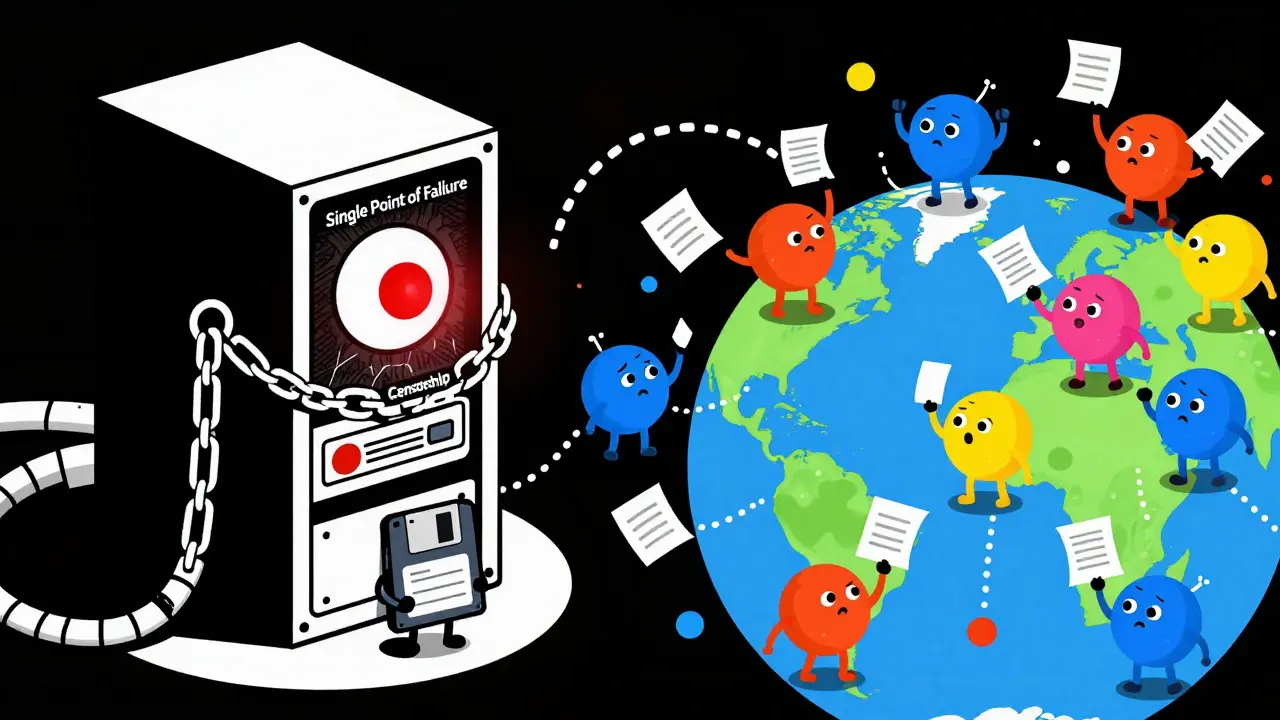

Imagine uploading a critical document to the cloud, only to find it gone six months later because your subscription lapsed or the provider changed their terms. Now imagine that same document being stored on thousands of computers worldwide, accessible forever, without a single company holding the keys. This is the promise of decentralized storage, which distributes data across a global network of nodes to eliminate central authority and ensure censorship resistance. For Web3 developers and businesses in 2026, this isn't just hype; it’s essential infrastructure.
Traditional cloud giants like Amazon Web Services (AWS) and Google Cloud dominate the internet, but they come with single points of failure, censorship risks, and recurring costs that can spiral out of control. As blockchain applications grow more complex, relying on centralized servers defeats the purpose of decentralization. That’s why protocols like IPFS, Arweave, and Filecoin have emerged as the backbone of the new web. But how do you choose between them? They aren’t interchangeable plug-and-play solutions. Each solves a different problem.
The Problem with Centralized Cloud Storage
Before diving into the solutions, let’s look at why the old way is failing Web3. When you store data on AWS or Azure, you are renting space from a corporation. If that corporation decides your content violates their community guidelines, they can take it down. If they go bankrupt, your data might disappear. If hackers target their massive centralized database, millions of users are affected simultaneously.
In the context of Web3, a paradigm shift toward decentralized ownership and trustless systems requires storage that matches those values. You cannot build a censorship-resistant application on top of a server that can be shut down by a click of a button. Decentralized storage addresses this by breaking files into chunks and scattering them across a peer-to-peer (P2P) network. No single node holds the entire file, making it nearly impossible to censor or destroy unless every participant in the network agrees to delete it.
IPFS: The Foundation of Content Addressing
IPFS (InterPlanetary File System) is a peer-to-peer protocol for storing and sharing files in a distributed file system using content addressing. Think of IPFS not as a storage drive, but as a new way to address information on the web. Traditional URLs point to a location (like a specific server in Virginia). IPFS uses Content Identifiers (CIDs), which are cryptographic hashes based on the actual content of the file.
This means if you request a file via its CID, the network finds whoever has that exact data, regardless of where they are physically located. It’s incredibly fast for distribution because popular files get cached by multiple nodes. However, IPFS has a major catch: it doesn’t guarantee persistence. Just because a file is on the network doesn’t mean it stays there. Nodes can go offline. To keep your data alive, you need "pinning services"-third-party providers who agree to keep your data pinned to their nodes. This introduces a layer of dependency that purists dislike, but it makes IPFS highly flexible for dynamic content that changes frequently.
Arweave: Permanent Storage for the Permaweb
If IPFS is about speed and flexibility, Arweave is a permanent, decentralized web storage protocol that uses a one-time payment model to store data forever. Arweave was built to solve the persistence problem. Its core innovation is the "blockweave," a structure similar to a blockchain but designed to store arbitrary data rather than just transaction records.
Here’s the kicker: you pay once, and your data stays forever. Arweave achieves this through a perpetual endowment model. A portion of your upfront fee goes into a fund that pays storage providers over time. As long as the fund exists, providers are economically incentivized to keep your data safe. This makes Arweave ideal for historical records, legal contracts, NFT metadata, and any data that must never change or disappear. It powers the "Permaweb," a vision of an immutable internet where applications run entirely off-chain but remain permanently accessible.

Filecoin: The Market-Driven Storage Layer
Filecoin is a decentralized storage marketplace built on top of IPFS that uses economic incentives to ensure data durability. While IPFS provides the protocol for finding files, Filecoin adds the economic engine to keep them there. It operates as a market where storage providers rent out disk space and earn FIL tokens in return. Users specify how long they want data stored and how much redundancy they need, and the network selects providers based on price and reputation.
Filecoin uses cryptographic proofs to verify that providers are actually storing your data. If a provider fails to prove they hold the data, they lose their stake. This creates a competitive environment where providers strive for reliability to maintain their earnings. Filecoin is best suited for large-scale archival needs where cost-efficiency and verifiable security are paramount, bridging the gap between the flexibility of IPFS and the permanence of Arweave.
Comparing the Giants: Which One Do You Need?
Choosing between these platforms depends entirely on your use case. There is no single "best" solution. Here is how they stack up in practical scenarios:
| Feature | IPFS | Arweave | Filecoin |
|---|---|---|---|
| Persistence Model | Relies on pinning (rental) | Permanent (one-time fee) | Contract-based duration |
| Primary Use Case | Dynamic content, dApps | Archival, immutable records | Large-scale backup, enterprise |
| Cost Structure | Recurring pinning fees | Upfront payment | Market-driven pricing |
| Data Retrieval Speed | Fast (P2P caching) | Moderate | Variable (depends on provider) |
| Ecosystem Maturity | High (standard for Web3) | Growing (Permaweb apps) | Established (enterprise focus) |

Practical Implementation Strategies
Most sophisticated Web3 projects don’t pick just one. They combine them. For example, a decentralized social media app might use IPFS to host user profile images and posts because the content changes often and needs fast retrieval. Simultaneously, it could use Arweave to store the smart contract code and initial genesis data, ensuring the application’s rules can never be altered. Finally, the company might use Filecoin to back up the entire dataset monthly for disaster recovery.
When implementing these tools, consider the developer experience. IPFS has the most mature tooling, including desktop clients and browser extensions. Arweave offers robust support for JavaScript, Rust, and Solidity, along with GraphQL queries for interacting with stored data. Filecoin integrates seamlessly with existing IPFS workflows since it builds directly on top of the protocol.
Challenges and Considerations
Despite their strengths, decentralized storage networks face hurdles. Regulatory uncertainty remains a significant risk. Governments may struggle to enforce laws on data stored across thousands of anonymous nodes. Additionally, while the technology is sound, user adoption is still growing. Average consumers are accustomed to clicking a link and getting instant access. Decentralized gateways can sometimes be slower or require additional configuration.
Security is another factor. While the networks themselves are secure, the interfaces used to interact with them (gateways) can be targeted. Always use reputable gateway providers or run your own node for critical applications. Furthermore, the cost dynamics can be unpredictable. Cryptocurrency volatility affects the real-world value of payments made in AR or FIL tokens, requiring careful budgeting for long-term projects.
Is decentralized storage cheaper than AWS?
It depends on the volume and duration. For small, short-term files, AWS is often cheaper due to economies of scale. However, for large datasets stored permanently, Arweave’s one-time fee model can be significantly more cost-effective over time. Filecoin’s market-driven pricing can also undercut traditional cloud providers for bulk archival storage.
Can I recover my data if I lose my private key?
No. In decentralized storage, you control the access keys. If you lose your private key or wallet credentials, you lose the ability to decrypt or manage your data, even though the data itself remains on the network. This is a fundamental trade-off for self-sovereignty.
Which protocol is best for NFT metadata?
Arweave is generally preferred for NFT metadata because it guarantees permanence. NFTs rely on immutable links to assets; if the metadata disappears, the NFT becomes broken. IPFS is also widely used, but it requires active pinning to ensure the data doesn’t vanish.
Do I need to run a node to use these services?
Not necessarily. Most users interact with these networks via gateways or SDKs provided by third-party services. However, running your own node increases privacy and reduces reliance on external providers, which is recommended for high-security applications.
How does censorship resistance work in practice?
Because data is fragmented and distributed across thousands of independent nodes globally, no single entity can remove it. To censor a file, an attacker would need to identify and compromise a majority of the nodes storing that specific data, which is computationally and logistically impractical for large networks.









Joe Walters
23 Jun 2026 at 01:30honestly this whole web3 storage thing is just hype for people who dont understand basic economics
why would anyone pay more to store data on a network that could disappear overnight?
i mean sure it sounds cool but its not practical for real business use cases
the average joe doesnt care about censorship resistance they just want their files to load fast