

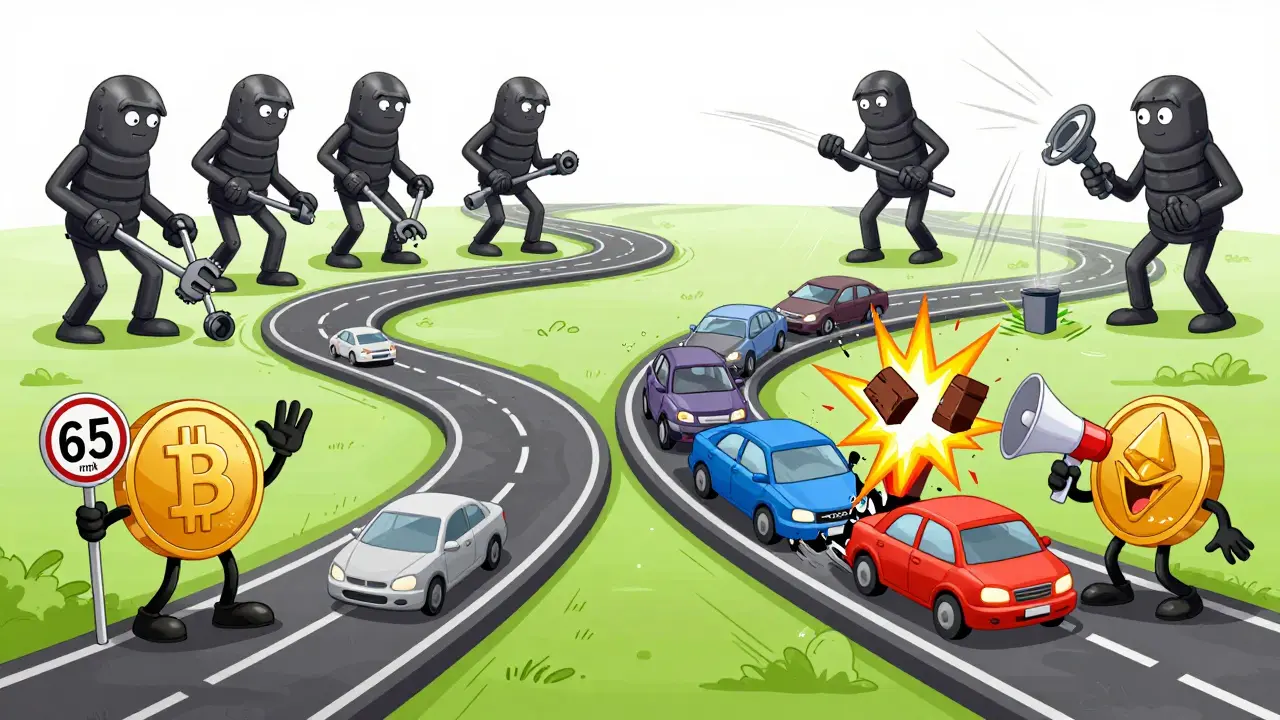

When a blockchain updates its rules, it doesn’t just click a button and change. It has to split - either cleanly or chaotically. That split is called a fork. And depending on how it’s done, it can either keep everyone on the same chain or tear the whole network apart. Understanding the difference between hard forks and soft forks isn’t just for developers. If you hold crypto, you need to know what happens when a fork hits - because your coins might suddenly exist in two places.
What Exactly Is a Fork?
A blockchain is a chain of blocks - each one containing a batch of transactions. Every node on the network runs software that checks if those blocks follow the rules. If a block breaks the rules, it gets rejected. But what happens when those rules need to change? That’s where forks come in. A fork is when the blockchain’s software rules are updated. But not all updates are the same. Some are like a software patch you install without rebooting. Others are like replacing your entire operating system. The difference? Backward compatibility.Hard Forks: The Big Split
A hard fork is a radical change. It breaks the old rules. Anything that was once valid under the old rules might now be invalid - or the other way around. And here’s the kicker: nodes running the old software can’t understand the new blocks. They’ll see them as invalid. So if some nodes upgrade and others don’t, you get two blockchains. Think of it like this: imagine everyone on a highway suddenly has to drive on the left side. If half the drivers refuse to change, you now have two roads - one with left-side driving, one with right-side. Both are real. Both have traffic. And neither can talk to the other. Hard forks require everyone to upgrade. No exceptions. If even one miner or full node keeps running the old version, they’ll keep building on the old chain. And if enough people support that old chain, it lives on as a separate blockchain. That’s exactly what happened with Bitcoin and Bitcoin Cash. In 2017, a group of developers wanted to increase the block size from 1 MB to 8 MB to handle more transactions. The Bitcoin community couldn’t agree. So they forked. Bitcoin Cash was born. The original Bitcoin stayed the same. Two chains. Two communities. Two prices. Same thing with Ethereum and Ethereum Classic. When the DAO hack happened in 2016, Ethereum’s team proposed a hard fork to reverse the theft. Some believed code was law - no reversals allowed. They kept the original chain. That became Ethereum Classic. The rest moved to the new chain. Today, both still exist. Hard forks give you freedom. They let you make big changes: bigger blocks, new features, better privacy, even changing how mining works. But they come with a cost: fragmentation. Community trust. Liquidity. Developer focus. All get split.Soft Forks: The Quiet Upgrade
A soft fork is the opposite. It tightens the rules - without breaking anything old. Imagine a highway with a speed limit of 70 mph. A soft fork lowers it to 65. Cars that were going 68 before? Still fine. They’re under the new limit. But now, any car going 72? That’s a violation. The new rules just make the old ones stricter. That’s how soft forks work. They don’t change what old nodes can accept. They just make new blocks follow stricter rules. Old nodes still see those blocks as valid - even if they don’t understand all the new details. As long as most miners upgrade, the network keeps moving as one. The most famous example? SegWit. In 2017, Bitcoin adopted Segregated Witness (SegWit) as a soft fork. It changed how transaction data was stored - moving signature data out of the main block to free up space. That allowed more transactions per block without increasing the block size. And here’s the magic: nodes that didn’t upgrade still accepted SegWit blocks. They didn’t know the details, but they saw the blocks as valid. No split. No chaos. Just a smoother ride. Another example? BIP66. That soft fork made Bitcoin’s signature verification stricter. It didn’t change what transactions could do - just how they had to be formatted. And because it was backward-compatible, it rolled out smoothly. Soft forks are safer. They’re quieter. They don’t force you to upgrade immediately. You can keep using your old wallet, your old node, your old miner - and still be part of the network. The upgrade happens gradually. Miners who update first start enforcing the new rules. Once enough of them do, the rest have no choice but to follow.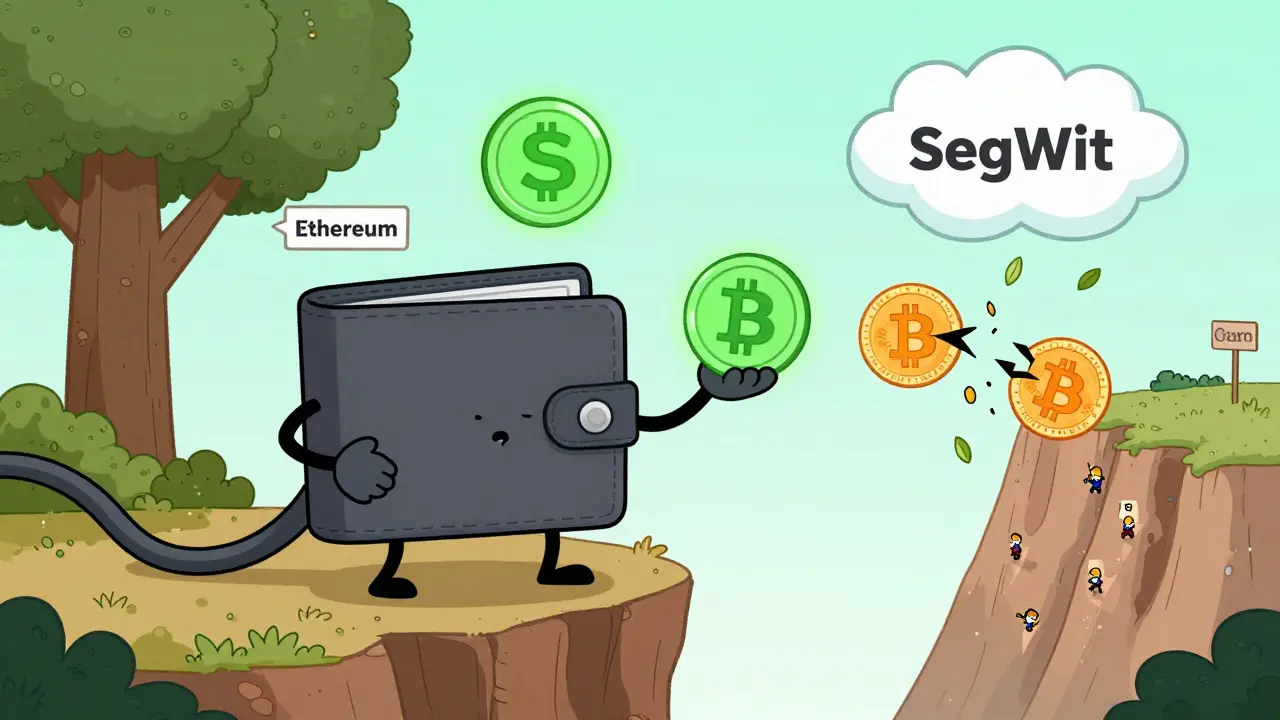
Key Differences at a Glance
| Feature | Hard Fork | Soft Fork |
|---|---|---|
| Backward Compatibility | No - old nodes can’t validate new blocks | Yes - old nodes still accept new blocks |
| Network Split | Yes - creates two separate blockchains | No - only one chain continues |
| Upgrade Requirement | All nodes must upgrade | Only miners need to upgrade |
| Consensus Threshold | High - needs broad community agreement | Lower - needs majority of mining power |
| Change Type | Loosens or changes rules | Restricts or tightens rules |
| Example | Bitcoin Cash, Ethereum Classic | SegWit, BIP66 |
Why It Matters to You
If you hold Bitcoin, Ethereum, or any other cryptocurrency, you’ve probably been affected by a fork without even realizing it. With a hard fork, you often get free coins. If you held 1 BTC before Bitcoin Cash forked, you got 1 BCH. Sounds great - until you realize the market value split. Liquidity dropped. Exchanges got confused. Some wallets didn’t support the new chain. Suddenly, your “free money” is locked in a wallet you can’t access. Soft forks? They’re invisible. You don’t get extra coins. But you get a stronger, more secure network. Transactions become faster. Fees drop. The blockchain becomes more scalable. No drama. Just improvement. That’s why most upgrades today are soft forks. They’re less risky. Less divisive. More sustainable. Hard forks? They’re reserved for when the community absolutely can’t agree - and is willing to split apart.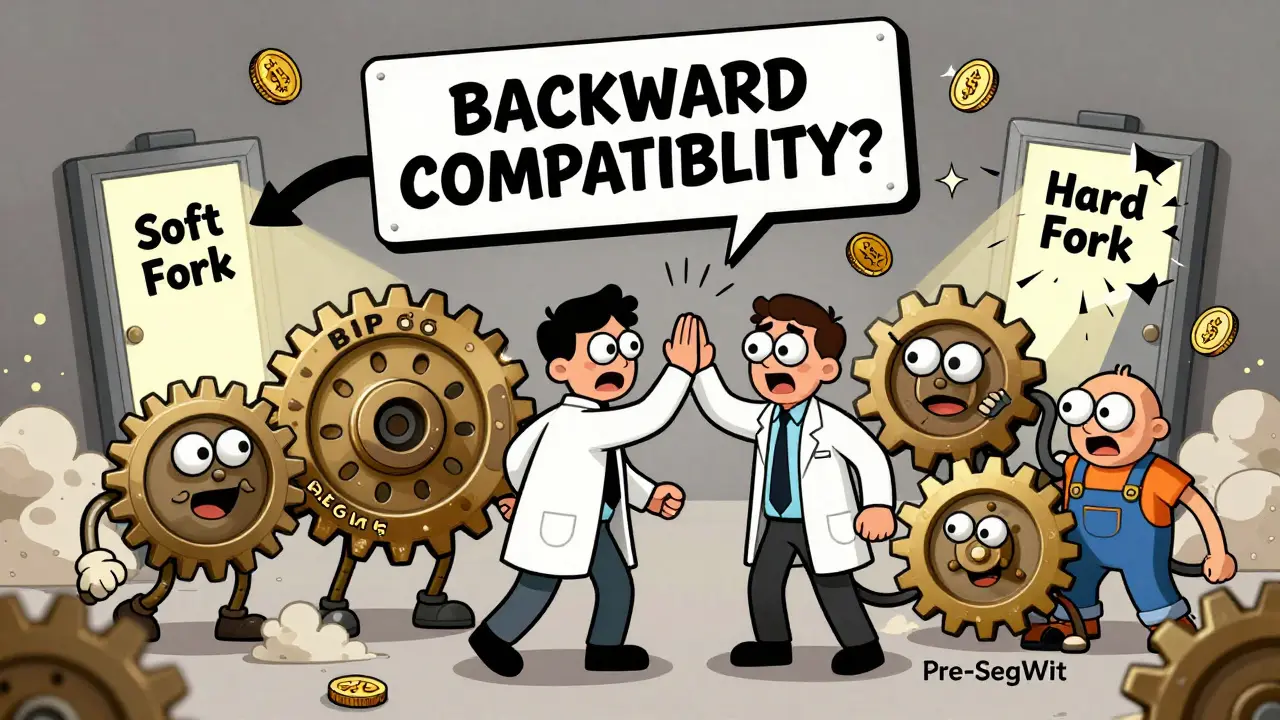
What Happens If You Don’t Upgrade?
If you’re using an old wallet or node and a hard fork happens? You’re stuck on the old chain. Your coins still exist - but only on the chain everyone else abandoned. If no one else supports it, the chain dies. Your coins become worthless. With a soft fork? You’re fine. You can keep using your old software. The network adapts around you. You don’t have to rush. You don’t have to panic. That’s why soft forks are the default choice for most blockchain projects. They’re the upgrade path that doesn’t break trust.Which One Should You Prefer?
If you’re a user? You want soft forks. They’re safer. Less disruptive. More predictable. If you’re a developer? Hard forks give you power. You can redesign the whole system. Add smart contract upgrades. Change consensus mechanisms. But you pay for it with community tension. The best blockchains use both - wisely. Bitcoin uses soft forks for almost everything. Ethereum used hard forks to fix the DAO hack - but since then, it’s leaned into soft forks for upgrades like EIP-1559 and the Merge. The lesson? Don’t fear forks. Understand them. A hard fork isn’t always bad. A soft fork isn’t always good. It’s about context. About trade-offs. About whether the network is trying to grow - or just survive.Can a soft fork turn into a hard fork?
No. A soft fork is designed to be backward-compatible by definition. If a change breaks compatibility, it’s no longer a soft fork - it becomes a hard fork. The two are mutually exclusive by design.
Do I need to do anything during a soft fork?
Usually not. If you’re just holding crypto in a wallet, you don’t need to do anything. Your coins stay safe. Exchanges and wallet providers handle the upgrade. But if you run a node or mine, you’ll eventually need to update software to keep validating blocks properly.
Why do some people prefer hard forks?
Hard forks allow radical changes that soft forks can’t. Want to double the block size? Change the mining algorithm? Remove a feature everyone hates? Only a hard fork can do that. Some communities value freedom to innovate over unity - and that’s why forks like Bitcoin Cash exist.
Are soft forks always safe?
Not always. If less than 50% of miners upgrade, the new rules might not be enforced consistently. That can lead to temporary confusion - like double-spends or orphaned blocks. But it rarely causes a permanent split. The risk is low, but not zero.
Can a hard fork be undone?
No. Once a hard fork happens and two chains exist, there’s no technical way to merge them back. Even if one chain dies out, the other remains permanently altered. That’s why hard forks are treated like irreversible decisions.







Bhavishya Kumar
21 Mar 2026 at 10:14The distinction between hard and soft forks is fundamentally rooted in backward compatibility, a principle that underpins the integrity of distributed systems.
Hard forks, by their very nature, introduce non-consensual changes that invalidate prior states, thereby fracturing consensus.
Soft forks, conversely, operate within the existing rule set, enforcing stricter validation without altering the fundamental protocol.
This is not merely a technical nuance-it is a philosophical divergence between evolution and revolution in decentralized governance.
Bitcoin’s adherence to soft forks reflects a commitment to stability over radical reconfiguration.
Any deviation from this path risks undermining the network’s trustless foundation.
Moreover, the notion that hard forks provide "freedom" is misleading; true freedom lies in consensus, not fragmentation.
When a community splits, it does not gain autonomy-it loses scalability, liquidity, and security.
SegWit’s success demonstrates that innovation need not be disruptive to be transformative.
It is not a question of whether change is necessary, but how it is implemented.
Systems that prioritize backward compatibility preserve user sovereignty by minimizing coercion.
Users should not be forced to choose between chains; their assets should remain unified under a single, coherent protocol.
Hard forks may satisfy ideological purists, but they impose real costs on the broader ecosystem.
Therefore, the preference for soft forks is not conservatism-it is prudence.
One must ask: Is the benefit of a hard fork worth the permanent schism it creates?