

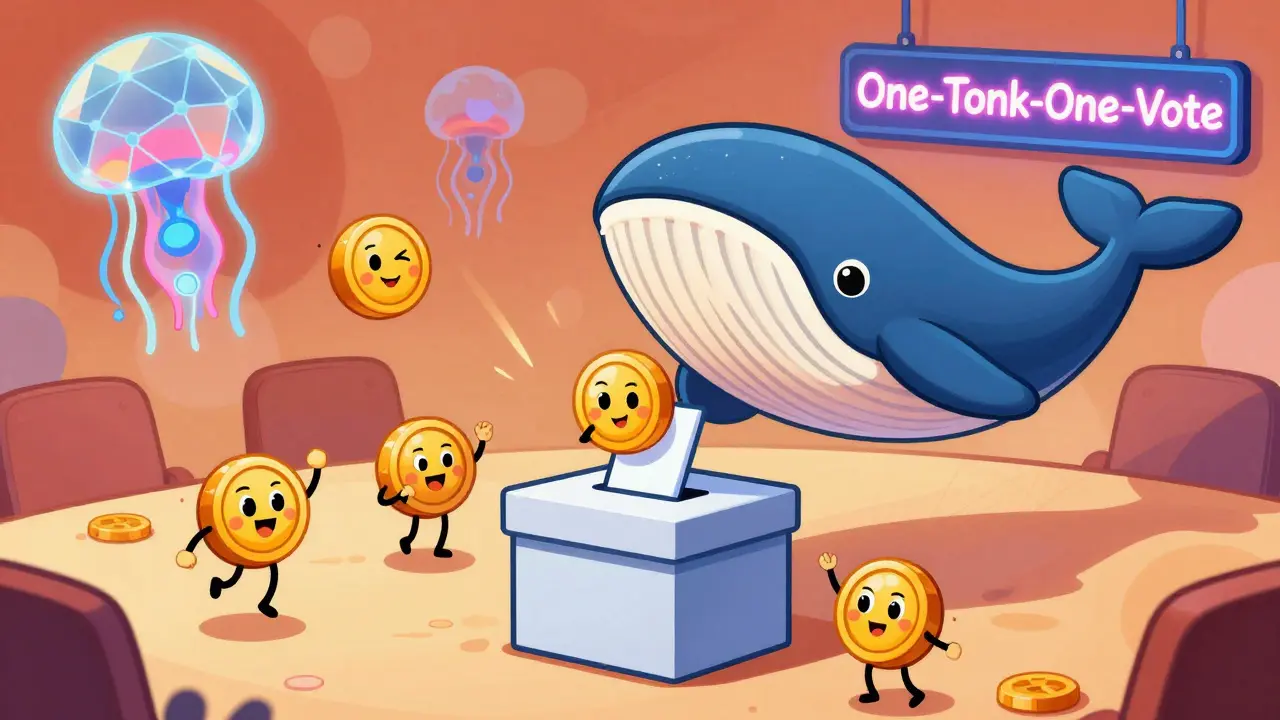

When you hold a governance token, you’re not just owning a piece of a blockchain project-you’re holding a vote. That vote can decide whether a protocol changes its fees, spends its treasury, or even upgrades its core code. But not all votes are created equal. The way those votes are counted shapes who has power, who gets heard, and ultimately, who controls the future of decentralized systems.
What Are Governance Tokens?
Governance tokens are digital assets that give holders the right to vote on decisions within a decentralized autonomous organization (DAO) or blockchain protocol. These tokens don’t always have monetary value on their own, but they carry decision-making power. Think of them like shares in a company, except instead of dividends, you get to vote on how the company runs.
Protocols like MakerDAO, Uniswap, and Aave all use governance tokens-MKR, UNI, and AAVE respectively-to let their communities decide on changes. Without these tokens, decisions would be made by a small team of developers or investors. With them, anyone who holds the token can weigh in. But here’s the catch: how you count those votes makes all the difference.
One-Token-One-Vote: The Simple, Dominant Model
The most common system used today is one-token-one-vote. It’s straightforward: one token equals one vote. If you hold 100 tokens, you get 100 votes. If you hold 10,000, you get 10,000 votes. It’s easy to understand, easy to code, and easy to implement.
This model powers over 83% of active DAOs as of 2024. It’s the default because it works with standard ERC-20 tokens and existing wallet infrastructure. Platforms like Snapshot and Aragon let DAOs set up voting in a few days using this model. Compound Finance requires you to stake at least 100,000 COMP tokens just to submit a proposal, and votes need at least 4% of total tokens to pass. Uniswap’s UNI token has been used to vote on over $42 billion in treasury assets using this exact method.
The big advantage? Speed. According to Guardarian’s 2024 study, token-based proposals get resolved in under 48 hours on average. That’s critical when a protocol needs to react fast-like patching a security flaw or adjusting interest rates after a market crash.
But there’s a dark side. The more tokens you own, the more control you have. And in most DAOs, a tiny group owns most of the tokens. In Curve DAO’s Q1 2024 vote, the top 10 holders controlled 64.3% of the voting power. That’s not democracy-it’s plutocracy. As Coinbase co-founder Michael Ehrsam put it: “Voting does turn into a game of chasing whales though, which is annoying.”
Quadratic Voting: A Mathematical Fix for Inequality
What if you could give small holders more influence without giving up the simplicity of token ownership? That’s the idea behind quadratic voting, first proposed by economist Glen Weyl in 2012 and later adapted for blockchain by Gitcoin and 1Hive.
Here’s how it works: your voting power is the square root of the number of tokens you commit. So if you use 4 tokens, you get 2 votes. If you use 9 tokens, you get 3 votes. If you use 10,000 tokens, you get 100 votes-not 10,000. The cost of influence grows faster than the benefit, which naturally limits how much power any single holder can accumulate.
This model flips the script. In Gitcoin’s 14th funding round, users who donated under $100 made up 83% of all voters. Under one-token-one-vote, they’d have gotten maybe 12% of the matching pool. With quadratic voting, they got 47%. That’s not a fluke-it’s by design. It rewards participation over wealth.
It’s especially powerful for funding public goods-like open-source software, developer grants, or community tools-where the goal isn’t efficiency, but fairness. The Ethereum Foundation has used quadratic funding since 2020 to distribute over $50 million in grants. Projects like Optimism now use it specifically for their “Citizen House,” which handles public goods funding, while keeping one-token-one-vote for protocol upgrades.

Why Quadratic Voting Isn’t Everywhere
Despite its fairness, quadratic voting isn’t winning the popularity contest. Only 9% of DAOs use it. Why?
First, it’s complicated. Most people don’t understand square roots in voting contexts. Gitcoin’s own user testing showed only 34% of new users could correctly predict their voting power without guidance. That’s a huge barrier. Compare that to one-token-one-vote, where even someone with zero crypto knowledge gets it immediately: “More tokens = more votes.”
Second, it’s harder to build. Krayon Digital found quadratic systems require 37% more development time. Integrating it into a DAO often takes weeks, not days. Gitcoin’s implementation cost averages $47,000 just in setup and education. That’s not feasible for small DAOs with limited budgets.
Third, participation drops. Hiro.so’s 2024 report found quadratic voting systems have 28% lower voter turnout than token-based ones. People get confused. They give up. They don’t trust the system. Trustpilot reviews for quadratic interfaces average 3.3 out of 5 stars, mostly because users say the interface feels “clunky” or “mysterious.”
And there’s a security risk. Cornell professor Emin Gün Sirer warned in a 2023 IEEE paper that quadratic voting opens doors to sybil attacks-where someone creates hundreds of small accounts to manipulate outcomes. That’s exactly what happened in the 2022 SushiSwap incident, where conflicting proposals passed because of fragmented voting.
Which Model Should You Use?
There’s no one-size-fits-all answer. The right model depends on what you’re voting on.
Use one-token-one-vote when you need fast, decisive action:
- Emergency protocol upgrades
- Treasury spending decisions
- Changing core economic parameters
Use quadratic voting when you want broad, fair input:
- Distributing public goods funding
- Choosing community grants
- Setting long-term vision or values
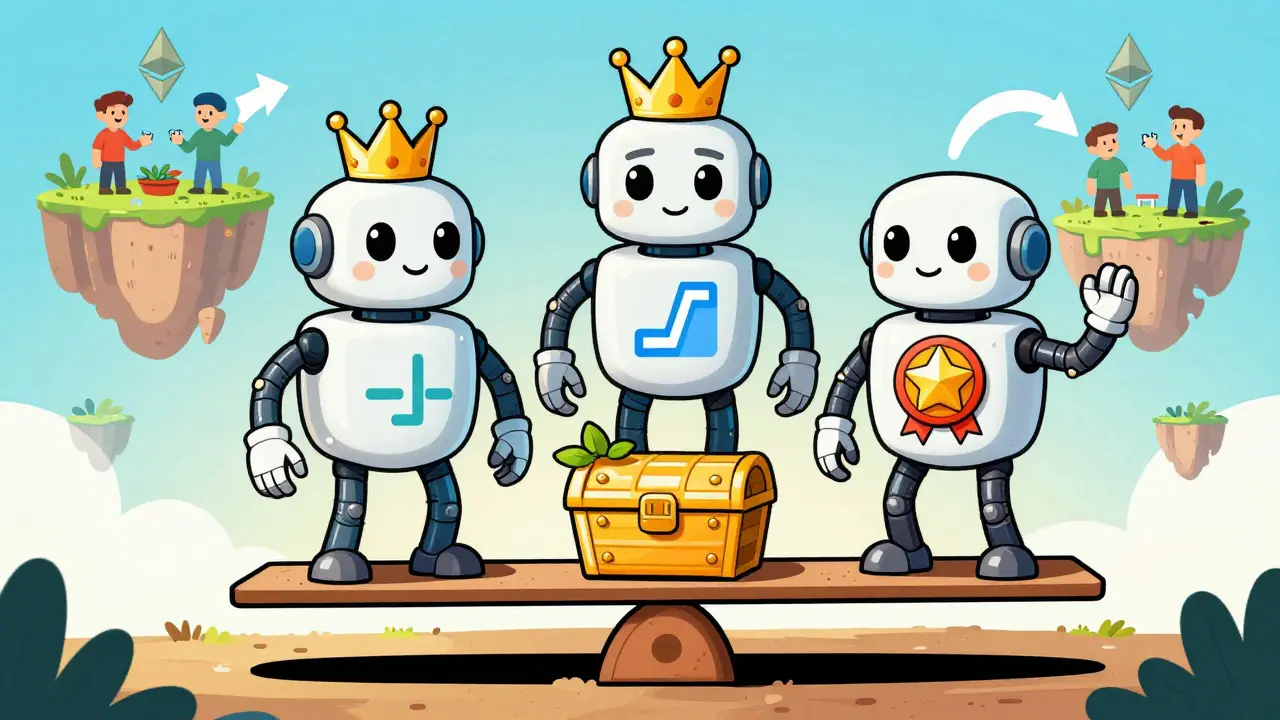
That’s why the smartest DAOs are starting to mix both. Optimism uses quadratic voting for grants and token-based voting for upgrades. Aragon’s New Court module, launched in May 2024, adds reputation-based weighting to token voting-so active contributors get extra influence, even if they don’t own many tokens.
Snapshot, the most popular off-chain voting tool, introduced delegated quadratic voting in April 2024. Now, users can assign their quadratic votes to someone they trust-like a community leader or developer-without losing the math behind the fairness. That’s a big step toward making quadratic voting usable at scale.
The Future: Hybrid Systems Are Winning
The next wave of governance isn’t about choosing one model over the other. It’s about combining them.
By 2026, Joseph Lubin of ConsenSys predicts 60% of major DAOs will use multi-layered systems: token-based for treasury and upgrades, quadratic for public goods, and reputation-based for community moderation. The Ethereum Foundation just awarded $20 million to the RadicalxChange Foundation to standardize quadratic voting across protocols. Version 2.1 of their spec, released in June 2024, fixes earlier sybil vulnerabilities.
Regulators are watching too. The SEC’s 2023 case against Uniswap questioned whether governance tokens are securities. That means future systems will need to be more transparent, more auditable, and more resistant to manipulation. Hybrid models offer more control points to meet compliance needs.
Meanwhile, the total value locked in DAO governance tokens hit $12.4 billion in Q2 2024. Gartner predicts that number will grow to $28.7 billion by 2026. But the real winner won’t be the model with the most votes-it’ll be the one that balances fairness, speed, and participation.
What’s Next for DAO Voters?
If you hold governance tokens, don’t just vote. Understand how the system works.
- Check if your DAO uses one-token-one-vote or quadratic voting.
- Look at who’s proposing changes-and who’s voting.
- Use delegation if available. Many small holders don’t vote, so delegating your vote to an active member can make your voice heard.
- If you’re building a DAO, start simple. Use token-based voting for now. Add quadratic or reputation layers only when you have enough community trust and technical capacity.
Decentralized governance isn’t about perfect systems. It’s about evolving them. The first DAOs used one-token-one-vote because it was the only option. Now we have better tools. The challenge isn’t choosing the best model-it’s choosing the right one for the job.
What’s the main difference between one-token-one-vote and quadratic voting?
One-token-one-vote gives each token equal voting power, so the more tokens you hold, the more control you have. Quadratic voting gives you voting power equal to the square root of your tokens, so large holders gain less influence per additional token. This reduces the power of whales and gives small holders more relative weight.
Why isn’t quadratic voting used by all DAOs?
Quadratic voting is harder to understand, harder to build, and harder to use. It requires specialized interfaces, more development time, and extensive user education. Many users get confused by the math, leading to lower participation. It also costs more to implement-up to $47,000 extra in setup and outreach.
Can quadratic voting be manipulated?
Yes, it’s vulnerable to sybil attacks, where someone creates many small accounts to influence outcomes. This happened in the 2022 SushiSwap vote, where conflicting proposals passed due to fragmented voting. Newer versions of quadratic voting, like version 2.1 from RadicalxChange, include anti-sybil measures like identity verification and reputation checks to reduce this risk.
Which model is better for treasury decisions?
One-token-one-vote is better for treasury decisions because it allows for faster, decisive action. Treasury management often requires quick approvals for spending or emergency upgrades, and token-weighted voting ensures those with the most financial stake-those most affected by poor decisions-have the most say.
Is quadratic voting fairer for small token holders?
Yes, it’s designed to be. In Gitcoin’s 14th funding round, users who donated under $100 made up 83% of voters and received 47% of the matching pool-something they’d have gotten only 12% of under one-token-one-vote. It levels the playing field by making it expensive for whales to dominate, while giving small contributors meaningful influence.
What’s the trend in DAO governance for 2025?
The trend is moving toward hybrid systems. Most new DAOs are combining one-token-one-vote for core protocol changes with quadratic voting for public goods funding, and adding reputation systems to reward active contributors. By 2026, experts predict 60% of major DAOs will use multi-layered governance models tailored to different types of decisions.
Understanding how votes are counted isn’t just technical-it’s political. The system you choose determines who runs the future of the internet. Don’t assume the default is the best. Ask questions. Test the system. Participate.





Ian Maggs
2 Jan 2026 at 02:05One-token-one-vote is just feudalism with a blockchain logo, isn't it? The math here is elegant-square roots as a corrective force against concentration of power-but we're talking about human systems, not abstract models. The real issue isn't complexity-it's trust. People don't distrust quadratic voting because they can't do the math; they distrust it because they've seen too many 'fair' systems get gamed by the same whales who own the wallets and the narrative.
And let's be honest: if you need a 37% increase in dev time to implement fairness, you're not building a DAO-you're building a marketing brochure for egalitarianism. The fact that Gitcoin's users still need guidance to understand their voting power? That's not a bug-it's a feature of exclusion disguised as innovation.
But here's the kicker: the most democratic system is the one people actually use. If 72% of voters abandon a vote because it feels like a tax exam, then fairness is just a theoretical luxury. The Ethereum Foundation throwing $20M at RadicalxChange? That's not progress-it's institutional wishful thinking. Real change happens when the interface is so intuitive, even a grandparent can vote without a flowchart.
Hybrid models aren't the future-they're the compromise we settle for when we can't agree on what 'fair' even means. And that's the real failure: we've outsourced moral reasoning to algorithms, then blamed users for not understanding them.
Maybe the real question isn't 'which voting system?' but 'who gets to define the rules?' Because right now, the answer is still: the ones with the most tokens. And that's not democracy. That's just capitalism with better branding.