

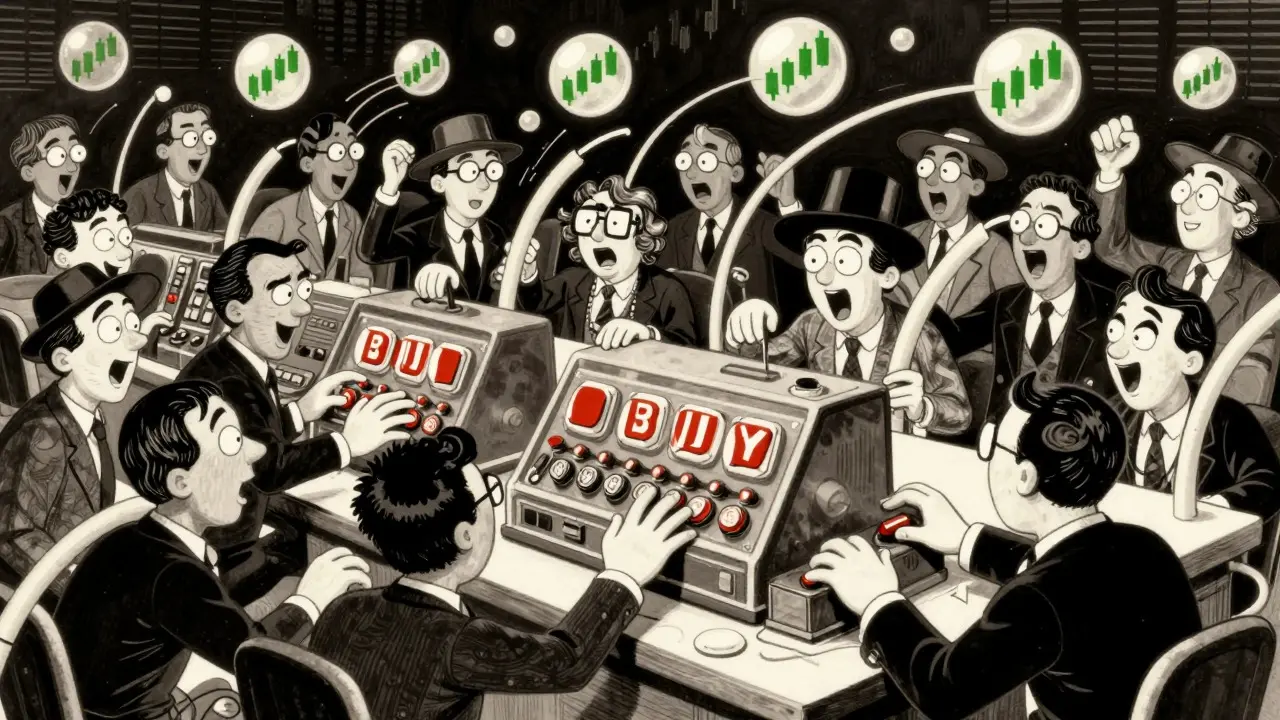

Imagine watching your friend’s bank account triple overnight because they bought a new token. Your heart races. Your thumb hovers over the "Buy" button. You don’t know what the project does, you haven’t read the whitepaper, and you certainly haven’t checked the team’s background. But everyone else is buying it. So, you buy it too.
This isn't just bad luck; it's biology meeting technology. In the world of digital assets, this impulse is known as herd mentality, which is the psychological tendency for investors to mimic the actions of the majority rather than relying on independent analysis. It is the engine behind every massive bubble and the trigger for every sudden crash in cryptocurrency markets. Understanding why we follow the crowd is the first step toward stopping yourself from getting trampled by it.
The Psychology Behind the Panic Buy
We are wired to fit in. For thousands of years, being cast out of the tribe meant death. Today, being left out of a viral investment trend feels like social exile. Behavioral economists define herding as a situation where rational people start behaving irrationally by imitating the judgments of others. When you see prices skyrocketing on green candlesticks, your brain interprets that upward movement not as data, but as validation. If thousands of other people are buying, they must know something you don’t.
In traditional stock markets, this happens too, but it moves slower. A company has earnings reports, dividends, and physical products. In cryptocurrency markets, which are digital asset exchanges operating 24/7 with high volatility and minimal regulatory oversight, there are no quarterly reports to slow you down. There is only price action and social media noise. This lack of fundamental anchors makes traders rely heavily on what others are doing. It creates a feedback loop: prices rise, more people notice, more people buy, and prices rise further. This is called an informational cascade.
The fear of missing out, or FOMO, which stands for Fear Of Missing Out, a psychological state of anxiety that an exciting or interesting event may currently be happening elsewhere, is the fuel for this fire. When Bitcoin hit its all-time highs in late 2021, retail investors weren't analyzing blockchain throughput. They were looking at their neighbors' profits. That emotional pressure overrides logic faster than any chart indicator can warn you.
How Crypto Herds Differ From Stock Market Crowds
You might think herding is universal across all investing. It is similar, but the mechanics in crypto are distinct. Studies comparing digital currencies to traditional equities show that herd behavior in crypto is often stronger during bull markets. In the stock market, herding tends to intensify during downturns when panic sets in. In crypto, the enthusiasm of a rising tide pulls everyone in together.
| Feature | Cryptocurrency Markets | Traditional Stock Markets |
|---|---|---|
| Primary Driver | Social media narratives, viral trends, influencer endorsements | Earnings reports, macroeconomic data, analyst ratings |
| Peak Herding Period | Bull markets (rising prices) | Bear markets (falling prices/panic) |
| Market Hours | 24/7/365 continuous trading | Fixed exchange hours (e.g., 9:30 AM - 4:00 PM EST) |
| Information Source | Twitter/X, Telegram, Reddit, Discord | Bloomberg, Reuters, SEC filings, annual reports |
| Volatility Impact | Extremely high; rapid spikes and crashes | Moderate; regulated circuit breakers exist |
The speed of information flow is another key difference. In stocks, news takes time to digest. In crypto, a single tweet from a high-profile figure can move billions of dollars in minutes. This creates a environment where reaction time matters more than research depth. Consequently, traders often skip due diligence entirely, assuming that the collective wisdom of the internet is sufficient. It rarely is.

Network Effects and The Role of Bitcoin
Not all coins herd equally. Research into network effects shows that connectivity drives imitation. Bitcoin, which is the first and largest cryptocurrency by market capitalization, often serving as the benchmark for the entire digital asset sector, acts as the alpha wolf in this pack. When Bitcoin moves, smaller altcoins tend to follow suit, not necessarily because of their own fundamentals, but because traders treat them as leveraged bets on Bitcoin’s direction.
This phenomenon is reinforced by how exchanges list tokens. If a new coin is listed alongside major players, it inherits some of that trust by association. Traders see the familiar interface and assume safety. This structural link means that herding isn't just psychological; it's built into the architecture of how these markets operate. The more interconnected a cryptocurrency is via trading pairs and shared listings, the more it contributes to herd behavior.
During periods of high uncertainty, such as the early days of the COVID-19 pandemic in 2020, studies found that herding activity spiked significantly. Investors didn't have clear data on how the virus would impact digital infrastructure, so they defaulted to copying the visible actions of others. However, later crises showed different patterns. Some recent analyses suggest that during extreme geopolitical shocks, investors actually diverge, showing "anti-herding" behavior as they scramble for unique safe havens. This proves that herd mentality is not constant; it fluctuates based on market regime and clarity.
Recognizing the Signs of a Herd
How do you know if you are part of a herd? Look for these concrete signals in your own trading habits:
- The "Everyone Is Talking About It" Test: If your non-investor friends are asking you about a specific coin, the peak may already be near. Retail saturation usually marks the end of the easy money phase.
- Igoring Red Flags: You notice high transaction fees, low liquidity, or anonymous developers, but you dismiss them because the price is going up. Rational investors pause; herd members accelerate.
- Time Pressure: You feel an urgent need to buy *now* before the price goes higher. Healthy investing is deliberate; herding is impulsive.
- Lack of Thesis: Try to explain why you own the asset in one sentence without using the words "price," "moon," or "community." If you can't, you are likely following the crowd.
Another sign is portfolio concentration. During herd-driven manias, traders often allocate 50% to 80% of their capital into a single trending narrative. This violates basic risk management principles. When the herd turns, having all your eggs in one basket ensures maximum damage.
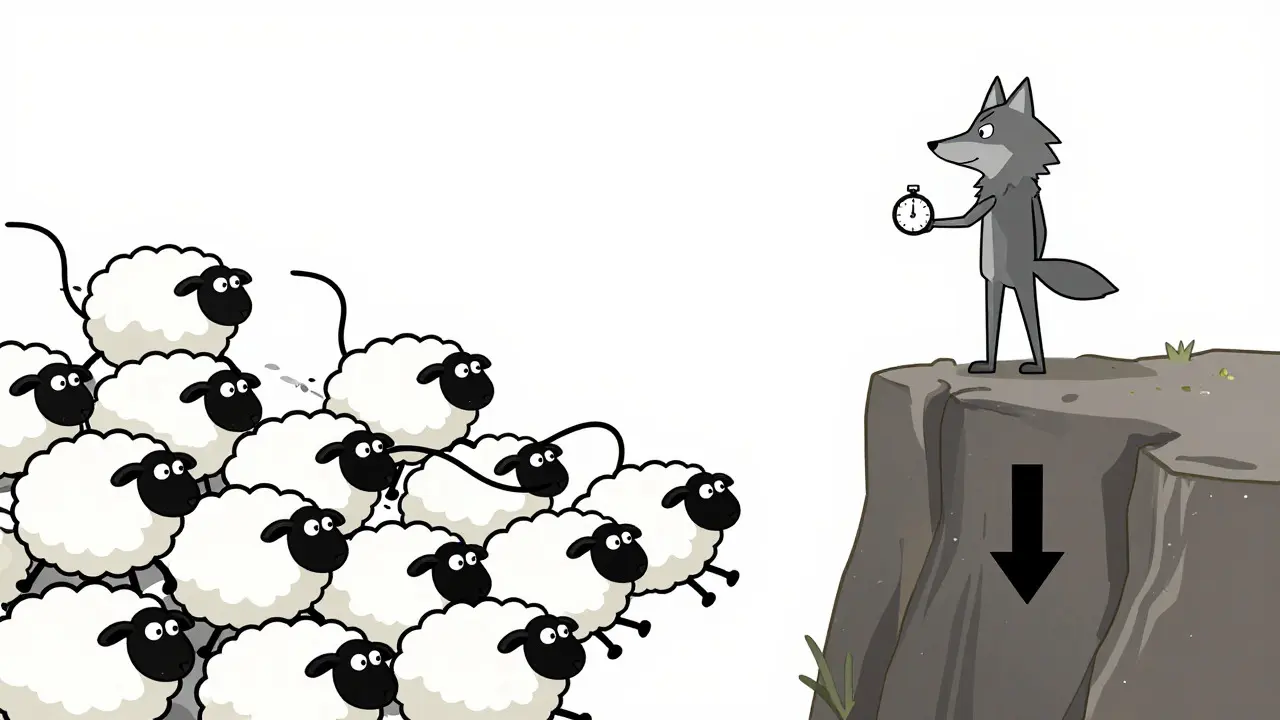
Strategies to Break Free From the Crowd
Beating the herd doesn't mean ignoring the market. It means adding friction to your decision-making process. Here are practical steps to protect your capital:
- Implement a Cooling-Off Period: Force yourself to wait 24 hours before executing any trade driven by emotion. Often, the urge to FOMO-buy fades after a good night's sleep.
- Diversify Across Asset Classes: Don't put everything into crypto. Holding stable assets reduces the emotional pressure to chase gains in volatile markets.
- Use Stop-Loss Orders: These automated tools sell your position if the price drops by a certain percentage. They remove emotion from the exit strategy, preventing panic selling when the herd flees.
- Curate Your Information Diet: Unfollow accounts that post hype without data. Follow analysts who focus on on-chain metrics, protocol upgrades, and economic models rather than price predictions.
- Define Your Entry Logic: Write down why you are buying before you click the button. If the reason changes after the purchase, admit it was a mistake and learn from it.
Experienced traders also use position sizing limits. By capping any single trade at a small percentage of total capital (e.g., 2-5%), they ensure that even if they misjudge a herd move, the loss is manageable. This discipline allows them to stay in the game long enough to benefit from genuine value creation rather than short-term speculation.
The Future of Herding in Digital Assets
As institutional investors enter the space, the nature of herding is evolving. Large funds have strict compliance rules and longer time horizons. Their presence adds stability but doesn't eliminate crowd behavior; it just shifts the timeline. We now see "institutional herding," where large players move together based on regulatory news or ETF approvals.
Regulators are taking note. Consumer protection agencies increasingly cite herd mentality as a source of systemic risk. Educational initiatives are being developed to help participants recognize crowd-following tendencies. While herd behavior will likely remain a central feature of crypto markets due to their inherent volatility and social nature, understanding it transforms it from a threat into a tool. By recognizing when the crowd is irrational, you can position yourself to buy when others are fearful and sell when others are greedy.
What causes herd mentality in crypto markets?
Herd mentality is caused by a combination of evolutionary psychology (fear of exclusion), FOMO (fear of missing out), and the rapid spread of information via social media. In crypto, the lack of traditional fundamental anchors like earnings reports forces traders to rely on price action and peer behavior for validation.
Is herd behavior always bad for investors?
While often associated with bubbles and crashes, herd behavior can sometimes signal strong market consensus around a legitimate innovation. However, for individual investors, blindly following the herd usually leads to buying at peaks and selling at bottoms. Independent analysis yields better long-term results.
How does Bitcoin influence herd mentality in altcoins?
Bitcoin acts as the market leader. Due to network effects and high correlation, when Bitcoin rises, traders often assume all cryptocurrencies will rise. This causes capital to flow into smaller altcoins based on Bitcoin's momentum rather than the altcoin's own merits, creating a cascading herd effect.
Can you predict when a herd will turn?
It is difficult to predict exact turning points, but signs include extreme retail participation, widespread media coverage, and high trading volumes accompanied by slowing price growth. On-chain metrics showing large holders moving funds to exchanges can also indicate an impending sell-off.
What is the difference between herding in crypto and stocks?
In stocks, herding is often driven by earnings surprises and macroeconomic data, and tends to spike during market crashes. In crypto, herding is driven by social narratives and price momentum, and is typically strongest during bull markets. Crypto also trades 24/7, allowing herd behavior to develop and unwind much faster.








tiffany King
11 Aug 2026 at 10:59I really love this perspective because it validates so much of what I’ve been trying to tell my friends who are constantly chasing the next big thing. It’s honestly refreshing to see someone break down the psychology instead of just screaming "buy low sell high." We all have that little voice in our heads telling us we’re missing out, but remembering that it’s just biology meeting tech helps keep things grounded. I think everyone needs to read this before they click buy on their phone during lunch break.