



You bought Bitcoin in 2021 when it was cheap. You bought more in 2024 when prices spiked. Now you’re selling some to pay off a credit card or just take profits. The question isn’t just how much cash you get-it’s how much the IRS thinks you owe. If you pick the wrong accounting method, you could be paying thousands extra in taxes on gains that didn’t really happen.
For years, crypto traders treated cost basis like an afterthought. But starting with the 2025 tax year, the Internal Revenue Service tightened the screws. The days of guessing your gain or retroactively picking the best lots are over. Today, you need a clear strategy before you click 'sell'.
The Core Problem: What Is Crypto Cost Basis?
Cost basis is the original value of your cryptocurrency investment, including purchase price and transaction fees. It is the number you subtract from your sale price to find your taxable profit. Simple math, right? Buy for $10, sell for $15, gain is $5.
The complication arises because most people don't hold just one coin. You have dozens, maybe hundreds, of different "lots"-specific purchases made at different times and prices. When you sell 1 BTC, which lot did you sell? The one from 2017? Or the one you bought yesterday? The answer determines your tax bill.
The IRS requires you to track this meticulously. Since 2025, digital assets are treated similarly to stocks under Section 8309 of the Internal Revenue Code, meaning exchanges must report your transactions to the government. If your records don't match their reports, you trigger an audit flag.
FIFO: The Default Path of Least Resistance
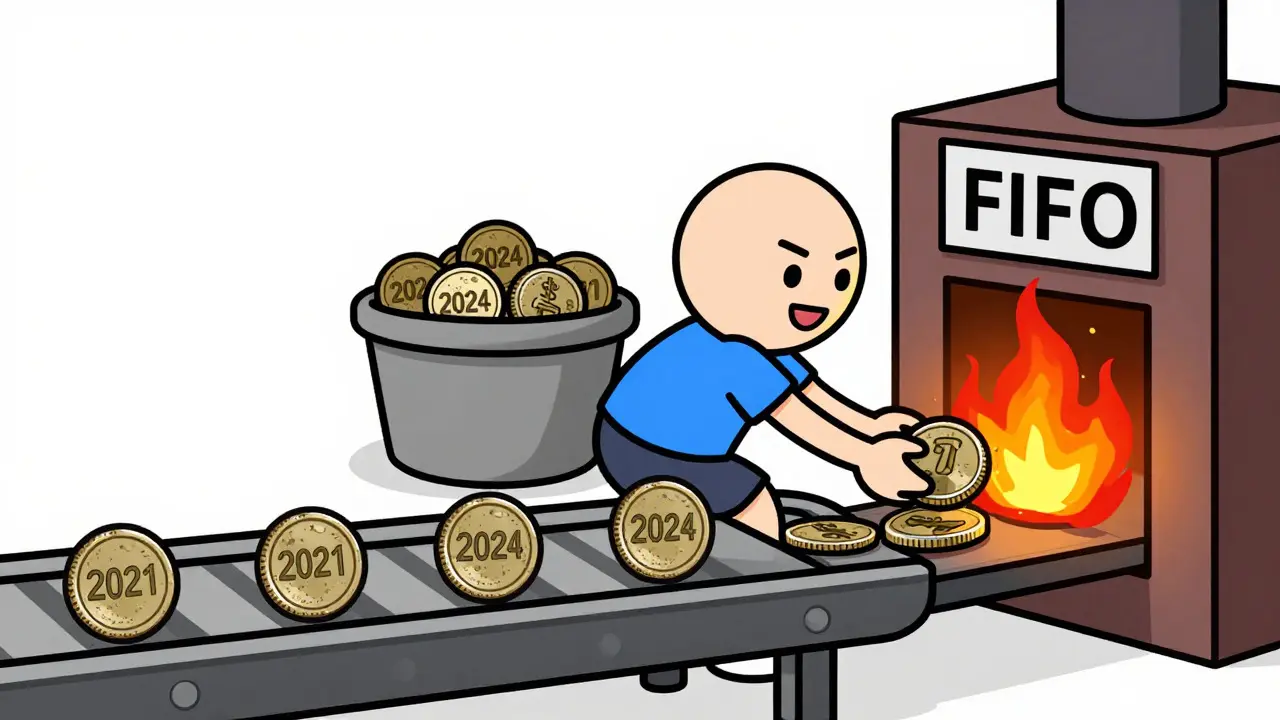
First-In, First-Out (FIFO) is the default method if you do nothing else. Under FIFO, the IRS assumes you sold the oldest coins first. It is simple, predictable, and requires zero special documentation beyond standard trade logs.
Here is how it works in practice. Imagine you own three Bitcoin units:
- Unit A: Bought Jan 2021 for $30,000
- Unit B: Bought June 2023 for $25,000
- Unit C: Bought Dec 2024 for $60,000
In August 2026, you sell 1 BTC for $70,000. Under FIFO, you are deemed to have sold Unit A. Your cost basis is $30,000. Your capital gain is $40,000. Because you held it for more than a year, this qualifies as a long-term capital gain, taxed at lower rates (0%, 15%, or 20% depending on income).
FIFO is great for compliance simplicity. Most crypto exchanges default to this setting. However, in a rising market, FIFO often results in higher taxes. You are consistently matching low-cost old coins against high-price sales, maximizing the spread. If you want to minimize tax liability, FIFO might leave money on the table.
Specific Identification: The Tax Efficiency Power Move
If you want control, you use Specific Identification. This method allows you to tell the IRS exactly which coin you sold. You can choose to sell Unit C (the expensive one) instead of Unit A. In our example, selling Unit C would result in a gain of only $10,000 ($70,000 sale - $60,000 cost). That is a massive difference in tax owed.
But there is a catch. The IRS has strict rules for 2026. To use Specific Identification, you must identify the specific lot at or before the time of sale. Retroactive selection is banned. This means you cannot wait until tax season to look back and say, "Oh, I meant to sell the loss-making ones." You have to make the choice when you execute the trade.
This shift kills strategies like OPTI (Optimization), where software automatically picked the best lot after the fact. Those methods now carry high audit risk. Instead, investors rely on HIFO (Highest-In, First-Out) or LIFO (Last-In, First-Out) as execution strategies within Specific Identification.
LIFO and HIFO: Strategies Within Specific ID
Last-In, First-Out (LIFO) sells your newest coins first. In a bull market, your recent buys likely cost more. Selling them reduces your immediate gain. However, LIFO keeps your older, low-basis coins in your portfolio. If you hold those forever, you die with a huge unrealized gain, though estate planning laws may offer step-up benefits.
HIFO (Highest-In, First-Out) is the aggressive optimizer's favorite. You specifically target the most expensive lots to sell first. This minimizes current taxable income. Many professional trading platforms now allow you to tag lots manually or set algorithms to auto-select highest-cost bases at the moment of execution, satisfying the contemporaneous requirement.
| Method | Complexity | Tax Impact (Bull Market) | Documentation Needed |
|---|---|---|---|
| FIFO | Low | Highest Gains (Bad) | Standard Trade Logs |
| Specific ID (HIFO) | High | Lowest Gains (Good) | Contemporaneous Lot Selection Proof |
| LIFO | Medium | Moderate Gains | Lot Tracking Records |
How to Implement Specific Identification Correctly
To survive an audit using Specific Identification, your paper trail must be ironclad. Here is what you need to do in 2026:
- Use Compatible Software: Ensure your tax software or exchange interface allows manual lot selection at the point of sale. Platforms like Koinly or CoinTracker now integrate with major exchanges to capture this data.
- Document Contemporaneously: Take screenshots or save transaction IDs that show which wallet address or lot ID was moved. The timestamp must precede or match the settlement time.
- Track Fees Accurately: Transaction fees add to your cost basis. If you paid $50 in gas fees to buy ETH, that $50 is part of your basis. Ignoring it inflates your gain.
- Avoid Mixed Wallets: Sending coins from multiple purchases into one hot wallet makes tracking difficult. Use separate wallets for different acquisition periods if possible.

Common Pitfalls to Avoid
Many investors lose money by mixing up personal spending with investing. Buying coffee with Bitcoin is a taxable event. Using DeFi protocols to swap tokens is a taxable event. Each action triggers a realization of gain or loss based on your chosen method.
Another trap is ignoring wash sales. While the IRS has not fully clarified wash sale rules for crypto yet, conservative advisors recommend avoiding buying back the same asset within 30 days of selling it at a loss. If they enforce stock-style wash sale rules retroactively, disallowed losses could pile up.
Next Steps for Your Portfolio
Review your current holdings. Do you have significant unrealized gains sitting in old, low-basis coins? If so, consider switching to Specific Identification with a HIFO strategy for future trades. Consult a CPA who specializes in digital assets. They can help model scenarios to see if the administrative burden of Specific ID saves you enough in taxes to justify the effort. For small portfolios, FIFO might still be the sensible, low-stress choice.
Is LIFO allowed for crypto taxes in 2026?
Yes, but not as a standalone default. LIFO must be executed under the Specific Identification framework. You must prove you intended to sell the newest lots at the exact time of the transaction.
What happens if I don't specify a cost basis method?
The IRS will assume you used FIFO. This is usually the least tax-efficient method in rising markets, potentially leading to higher tax bills.
Can I change my cost basis method mid-year?
Generally, no. You should establish your method at the start of the tax year. Changing methods later requires IRS permission via Form 3115, which is complex and rarely granted for individual crypto investors.
Does Specific Identification work for all cryptocurrencies?
Yes, it applies to all digital assets classified as property by the IRS, including Bitcoin, Ethereum, and altcoins. It does not apply to stablecoins used strictly as currency equivalents without investment intent, though caution is advised.
How do I prove Specific Identification during an audit?
You need contemporaneous records. This includes transaction logs showing lot selection timestamps, screenshots from your exchange interface, and detailed spreadsheets linking specific purchase hashes to sale hashes.







Write a comment