


You’ve spotted a promising altcoin. You hit "Buy" on your exchange, expecting a clean entry price. Instead, you get filled at a price 2% higher than the screen showed. Where did that money go? It didn’t vanish into thin air; it paid for liquidity depth. For altcoin traders, understanding how stable pairs function and where liquidity actually resides is often more critical than picking the right token. If you ignore the mechanics of order books and automated market makers (AMMs), you’re essentially gambling with your execution costs.
This guide breaks down exactly how stable pairs quote altcoins against stablecoins like USDT or USDC to provide a predictable pricing baseline interact with market depth. We’ll look at why USDT dominates centralized exchanges, how DeFi protocols concentrate liquidity, and what specific numbers you need to check before placing a trade. By the end, you’ll know how to spot a trap in a shallow order book and calculate whether a trade is worth the slippage.
Why Stable Pairs Are the Default for Altcoin Trading
Most retail traders quote altcoins against stablecoins rather than Bitcoin or fiat currency. Why? Simplicity and risk isolation. When you trade SOL/USDT, you are isolating the performance of Solana from the broader crypto market volatility represented by Bitcoin. If you traded SOL/BTC, a drop in Bitcoin’s price could make your Solana position look profitable even if Solana itself stayed flat. Stable pairs remove this noise.
However, not all stable pairs are created equal. The stability of the quote asset matters, but so does its liquidity anchor. As of late 2026, USDT (Tether) the most widely used stablecoin for trading pairs due to its massive adoption on centralized exchanges remains the dominant liquidity provider. Data from Kaiko indicates that aggregated 1% market depth for USDT pairs reaches approximately $200 million per side across major venues. In contrast, USDC (Circle) a regulated USD-backed stablecoin favored by institutional investors for its transparency typically offers about half that depth, around $100 million per side. This 2:1 ratio means that for large trades, USDT pairs generally offer better execution quality, assuming the peg holds.
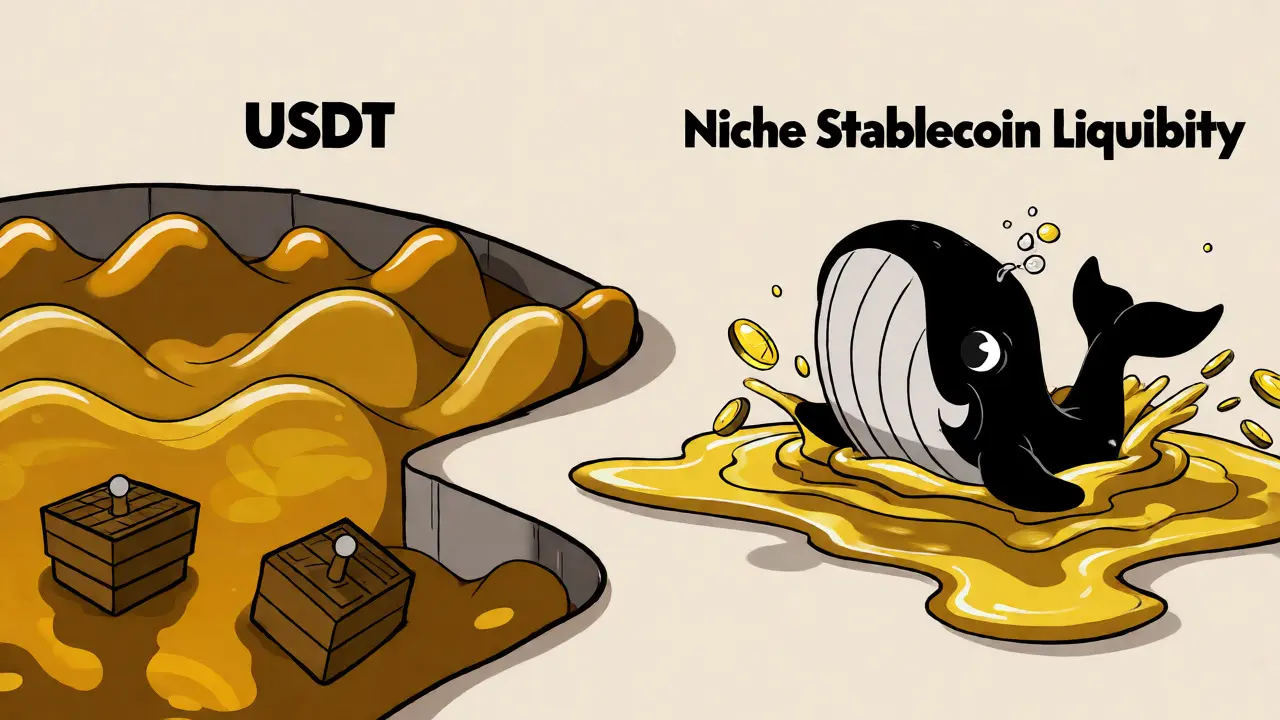
Don’t assume that just because a pair is quoted in a stablecoin, it’s safe. Niche stablecoins like GYEN or CADC have tiny market caps-often under $5 million. Pairing an altcoin against these creates a double-liquidity problem. If the stablecoin itself has thin liquidity, any move in the altcoin will cause wild swings in the pair’s price, regardless of the altcoin’s actual value.
Decoding Order Book Depth and Bid-Ask Spreads
On centralized exchanges (CEXs) like Binance, Kraken, or OKX, liquidity is visible in the order book. Market depth isn’t just about total volume; it’s about how much volume sits within a tight percentage band around the current price. Traders use a metric called "1% depth," which measures the total dollar value of resting buy and sell orders between 0.99 and 1.01 times the mid-price.
A study published by MDPI in early 2025 highlighted that depth increases non-linearly as you widen the price band. For example, on Huobi, depth at 0.5% from the mid-price was significantly lower than at 3.67%. This tells us something crucial: small orders execute easily, but large orders force the price to move further away from the mid-point to find enough sellers or buyers.
The bid-ask spread the difference between the highest price a buyer is willing to pay and the lowest price a seller is willing to accept is your first warning sign. Here is a quick reference for what healthy spreads look like:
| Asset Type | Example Pair | Healthy Spread Range | Risk Level |
|---|---|---|---|
| Blue Chip Crypto | ETH/USDT | 0.01% - 0.02% | Low |
| Mid-Cap Altcoin | SOL/USDT | 0.05% - 0.10% | Moderate |
| Small-Cap Altcoin | OBC/USDT | 0.50% - 3.00%+ | High |
If you see a spread wider than 0.5% on a mid-cap altcoin, be careful. That gap represents immediate loss when you enter and exit a market order. Altfins research suggests that for small-cap tokens, spreads can exceed 3%, meaning you start every trade down 3% before the price moves a single tick.
Liquidity Depth in Decentralized Exchanges (DEXs)
DeFi works differently. There is no central order book. Instead, liquidity exists in pools governed by smart contracts. On platforms like Uniswap v3 a decentralized exchange protocol allowing users to provide concentrated liquidity within specific price ranges, liquidity providers (LPs) choose specific price ticks to deposit their funds. This concentration allows for deeper liquidity near the current price compared to older models like Uniswap v2.
For major stablecoin pairs, LPs often concentrate liquidity within 50 basis points (0.50%) of the mid-price. Chaos Labs reported in August 2026 that this design enables large swaps with minimal price impact, provided the Total Value Locked (TVL) is high. For instance, the EURC/USDC pool on Ethereum mainnet holds about $56 million in TVL. While that sounds substantial, daily volume is only around $860,000. This low turnover relative to TVL suggests that while the pool is deep, it isn’t heavily utilized for active trading compared to USDT/USDC pairs.
When trading altcoins on DEXs, you must check two things beyond TVL: recent 24-hour volume and fee tiers. High TVL with low volume is a mirage. It looks safe, but if everyone tries to exit at once, the price impact will be severe because there aren’t enough active participants routing through the pool. Curve Finance often serves as the primary depth anchor for large stablecoin swaps, while Uniswap handles the long-tail altcoin pairs. Always verify that the specific pool you are using has sufficient activity.
Calculating Slippage Before You Trade
Slippage is the difference between the expected price of a trade and the price at which the trade is executed. It’s inevitable, but it’s also controllable. Slippage is directly inversely proportional to liquidity depth. If the order book is thin, a $10,000 market order might walk through multiple price levels, moving the price against you.
Cleansky’s simulator data shows that when order book depth falls below $20,000 per side within a ±2% band, a single $10,000 market order can move the price by more than 1.5%. That’s a massive cost for a short-term trade. Coinbureau’s checklist defines a "danger zone" as books showing less than $20,000 per side within ±2%. Conversely, a healthy mid-cap pair should have at least $100,000 per side in that range.
Here is a simple heuristic for setting slippage tolerances:
- Major Pairs (BTC, ETH): Set tolerance to 0.1% - 0.5%. Expect actual slippage of 0.05% - 0.20%.
- Mid-Caps (SOL, ADA): Set tolerance to 0.5% - 1.0%. Monitor spreads closely.
- Small-Caps/DEX Swaps: Set tolerance to 1% - 3%. Use limit orders whenever possible to avoid paying the full spread.
Remember, setting a high slippage tolerance doesn’t guarantee a fill; it just guarantees you won’t reject the trade due to price movement. If the market moves against you faster than your transaction confirms, you still suffer the loss.
Practical Checklist for Evaluating Altcoin Liquidity
Before you deploy capital into a new altcoin, run this diagnostic. It takes two minutes but saves thousands in potential losses.
- Check Daily Volume: Is it above $1 million? If yes, proceed. If no, treat it as illiquid regardless of market cap.
- Inspect the Spread: Look at the top bid and ask. Is it tighter than 0.15%? If it’s over 0.5%, use limit orders only.
- Measure Order Book Depth: Look at the cumulative volume within ±2% of the mid-price. Do you see at least $100,000 on both sides? If not, avoid market orders larger than 10% of that depth.
- Test with a Small Trade: Execute a $100 test trade. Observe the actual fill price versus the displayed price. Calculate the real-world slippage.
- Verify Venue Stability: Ensure the exchange has a high trust score (e.g., CoinMarketCap score > 750). Fragmented liquidity across many minor exchanges increases counterparty risk.
One nuance often missed: Fiat-denominated pairs (like BTC/USD) sometimes have deeper liquidity than stablecoin pairs on certain exchanges. MDPI’s 2025 study found that institutional fiat markets retain an edge in some venues. Don’t blindly assume USDT is always better. Check the specific pair on the specific exchange you are using.

Common Pitfalls and How to Avoid Them
The biggest mistake traders make is confusing "listed" with "liquid." An altcoin might be listed on ten exchanges, but if each has only $5,000 in depth, you cannot trade it effectively. Aggregated liquidity metrics can be misleading if they don’t account for fragmentation. Always look at the depth on the venue where you intend to trade.
Another pitfall is ignoring the path-dependence of DeFi liquidity. Chaos Labs warns that concentrated liquidity can evaporate rapidly during volatility spikes. LPs may withdraw positions if the price moves outside their chosen range, suddenly leaving the pool shallow. During black swan events, expect slippage to triple or quadruple instantly.
Finally, beware of "fake" depth from wash trading. Some smaller exchanges report inflated volumes. Cross-reference volume data with on-chain analytics or trusted aggregators. If the volume seems inconsistent with the order book depth, be skeptical.
Frequently Asked Questions
What is considered good liquidity depth for an altcoin?
For mid-cap altcoins, a healthy benchmark is at least $100,000 in order book depth on both the buy and sell sides within a ±2% price range. Blue-chip assets like BTC and ETH should show millions of dollars in depth. Anything below $20,000 per side is considered a danger zone prone to high slippage.
Is USDT or USDC better for trading altcoins?
Currently, USDT offers superior liquidity depth, with approximately twice the 1% market depth of USDC on major centralized exchanges. However, USDC is preferred by institutions for its regulatory compliance and transparency. For most retail traders seeking lower slippage, USDT pairs are generally more efficient.
How do I calculate slippage risk before trading?
Estimate your trade size relative to the available depth within your target price band. If your trade size exceeds 10-20% of the visible depth within ±1%, expect significant slippage. Alternatively, use a slippage simulator tool or execute a small test trade to measure the actual price impact.
Does high TVL guarantee low slippage on DEXs?
No. High Total Value Locked (TVL) indicates capital is present, but it does not guarantee active trading. You must also check the 24-hour swap volume. A pool with high TVL but low volume may have liquidity concentrated far from the current price, leading to high slippage for trades near the mid-market.
Should I use limit orders or market orders for illiquid altcoins?
Always use limit orders for illiquid altcoins. Market orders consume the best available prices sequentially, causing you to pay the full bid-ask spread and potentially worse prices if the book is thin. Limit orders allow you to specify your maximum purchase price, protecting you from unexpected slippage.






Write a comment