

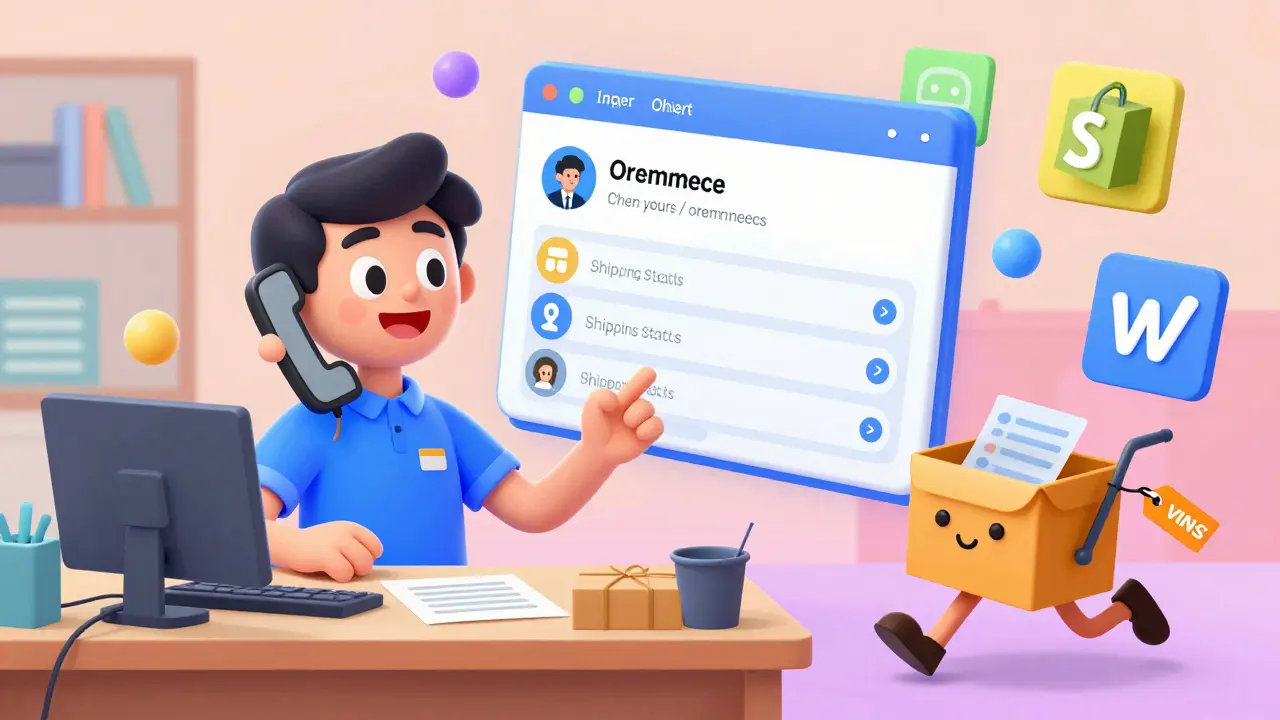

Imagine a customer is stuck on your website, staring at their cart, wondering if they can return a product or if their payment went through. They pick up the phone. If your system can’t show their order history, shipping status, or past support tickets the moment they call - you’re losing trust, and potentially sales. That’s where VoIP for e-commerce isn’t just a nice-to-have anymore. It’s the backbone of modern customer service.
Why VoIP Beats Traditional Phone Systems for Online Stores
Traditional phone systems? They’re expensive, rigid, and disconnected. You need physical lines, on-site hardware, and separate tools for CRM, order tracking, and call logging. Most small e-commerce businesses can’t afford that. Even if they could, it doesn’t solve the real problem: agents don’t know who’s calling until the customer starts explaining their issue from scratch. VoIP changes that. Instead of copper wires, it uses your internet connection to make calls. But more importantly, it connects directly to your Shopify, WooCommerce, or Magento store. When a customer calls, their name, order history, cart status, and even recent chat logs pop up on the agent’s screen. No more asking, “What’s your order number?” That’s not convenience - it’s efficiency. According to Unity Communications (2024), e-commerce businesses using VoIP see up to 37% better first-call resolution rates. That means fewer repeat calls, happier customers, and less workload for your team. Plus, the cost savings are real. The U.S. Chamber of Commerce (2023) found VoIP cuts phone bills by 40-60% compared to old PBX systems. No more long-distance charges. No more paying for unused lines. And since it’s cloud-based, you can scale up or down in minutes - perfect for Black Friday or flash sales.How VoIP Integrates With Your E-Commerce Platform
Integration isn’t just about making calls. It’s about making your whole system smarter. The best VoIP platforms for e-commerce don’t just ring - they talk to your store. For Shopify users, there are over 200 apps in the Shopify App Store that connect VoIP systems directly to your backend. Nextiva and VoIPstudio both offer one-click integrations that sync customer data in real time. When someone calls from a number tied to a past purchase, your agent instantly sees:- What they bought and when
- Current shipping status
- Open support tickets
- Previous payment issues
- Subscription status (if applicable)
Key Features That Actually Matter for E-Commerce
Not all VoIP features are created equal. For e-commerce, you need specific tools that solve real problems:- CRM Screen Pops: 92% of top e-commerce VoIP systems do this. It cuts average handle time by 22 seconds per call - that’s hours saved per week.
- Click-to-Call: 87% of implementations use this. Agents can click a customer’s name in their dashboard and instantly call them - no dialing, no mistakes.
- AI Call Analytics: 63% of mid-to-large stores now use this. AI listens to calls, flags frustration, identifies upsell opportunities, and even summarizes key points. Vonage’s AI now transcribes calls with 95.7% accuracy in e-commerce contexts.
- Mobile App Access: Your team can work from home, the car, or a coffee shop. No desk phone needed. One Reddit user said this saved their holiday season: “We had 4 agents working remotely. Without VoIP, we’d have lost half our support capacity.”
- Call Recording & Compliance: Important for PCI DSS and GDPR. You can’t record payment details unless your system is compliant. 43% of VoIP setups still have security gaps here - don’t be one of them.
Real Results: What Happens When You Get It Right
Mobilia, a European e-commerce brand selling home goods, switched to VoIPstudio in early 2024. Before: customers waited 12 minutes on average to speak to someone. After: response time dropped to 7 minutes. But the real win? Customer retention jumped 23% in their subscription model. Why? Because agents could see past purchases and offer personalized recommendations during calls. One customer, who had returned a lamp twice, was offered a free replacement and a discount on a new style - and ended up buying a whole bedroom set. Another case: a Shopify store owner in Texas used VoIP to handle 3x the usual call volume during Prime Day. With screen pops and automated call routing, they didn’t hire extra staff. Their average order value increased by 18% - customers who spoke to an agent spent more than those who only used chat.
The Pitfalls: Where E-Commerce VoIP Goes Wrong
It’s not all smooth sailing. Many businesses rush into VoIP without planning. Here’s what goes wrong:- Integration nightmares: 31% of negative reviews mention “it took weeks to connect to Shopify.” Custom setups can cost $5,000-$15,000. Stick to pre-built apps if you can.
- Call quality crashes during sales: 28% of small stores had issues during Black Friday 2023. Why? Not enough bandwidth. You need at least 1.5 Mbps per call. For 10 concurrent calls, aim for 25+ Mbps upload speed. Test it before your big sale.
- CRM field mapping errors: 38% of integrations mismap data. A customer’s name shows up as “NULL.” Their order number is blank. That’s worse than no data at all. Use middleware like Zapier ($299/month) or hire a developer to fix it.
- Security oversights: If your VoIP system records calls that include credit card numbers, and it’s not PCI DSS compliant, you’re at risk. Ask your provider: “Is your system certified for payment handling?” If they hesitate, walk away.
Costs and Providers: What You Actually Pay in 2025
Pricing varies wildly. Here’s the real breakdown as of January 2025:| Provider | Price per User/Month | Best For | Key Feature |
|---|---|---|---|
| AVOXI | $14.99 | Small stores (1-5 agents) | Simple setup, no contract |
| Nextiva | $25.95 | Mid-sized stores | Shopify Flow integration (launched Jan 2025) |
| Vonage Business | $35 | Enterprise, high volume | AI-powered Conversation AI |
| VoIPstudio | $22.50 | Europe-focused stores | Best 4.6/5 rating on Trustpilot |
| RingCentral | $30 | Global teams | Strong international calling |
What’s Next? The Future of VoIP in E-Commerce
The next wave is AI and automation. Vonage’s Conversation AI now tags calls with 89% accuracy - “refund request,” “delivery complaint,” “upsell opportunity.” Nextiva’s new Shopify Flow integration auto-creates tasks after calls: “Follow up with customer about return,” “Send discount code for next purchase.” By 2027, Gartner predicts 90% of e-commerce VoIP systems will include real-time sentiment analysis. Imagine a call where the system detects frustration and instantly alerts a supervisor to step in. Or a bot that offers a discount before the customer even asks. WebRTC browser calling is also rising - 37% of new deployments now let customers click a “Call Us” button on your site and connect directly through their browser. No app. No download. Just instant voice. But the biggest shift? It’s no longer about phone systems. It’s about customer experience. If your competitors are using VoIP to make service faster, smarter, and more personal - you’re falling behind. Forrester’s 2025 report says e-commerce businesses without integrated VoIP will see 28% higher customer churn by 2026. That’s not a guess. That’s data.
Getting Started: Your 5-Step Plan
1. Check your internet: Run a speed test. You need at least 1.5 Mbps upload per call. For 5+ calls, aim for 25+ Mbps. If you’re on a home plan, upgrade. 2. Choose your platform: If you’re on Shopify, start with Nextiva or VoIPstudio. WooCommerce? Look at AVOXI or RingCentral. Magento? Ask for certified extensions. 3. Test the integration: Use a free trial. Make a test order. Call your own number. See if the data pops up. If it doesn’t, walk away. 4. Train your team: Basic use: 8-12 hours. Mastering analytics and CRM workflows: 25+ hours. Don’t skip this. 5. Monitor and optimize: Track first-call resolution, average handle time, and customer satisfaction. If those numbers don’t improve in 30 days, reevaluate.Frequently Asked Questions
Do I need a special internet connection for VoIP in e-commerce?
Yes. Standard home internet isn’t enough. You need a business-grade connection with at least 1.5 Mbps upload speed per concurrent call. For stores handling 10+ calls at once, aim for 25+ Mbps upload. Low upload speed causes lag, dropped calls, and poor audio quality - especially during sales. Test your connection with tools like Speedtest.net before choosing a provider.
Can VoIP handle high call volumes during Black Friday?
Absolutely - if you plan for it. Many small businesses fail because they assume their current setup will scale. VoIP systems can handle thousands of calls, but only if you’ve tested capacity, upgraded bandwidth, and enabled auto-scaling features. Providers like Vonage and Nextiva offer surge capacity options for holiday peaks. Don’t wait until the day before Black Friday to find out you’re overloaded.
Is VoIP secure for handling payment information?
Only if your provider is PCI DSS compliant. Never let agents take payment details over the phone unless your VoIP system encrypts and tokenizes that data. Ask your vendor for their PCI certification. If they can’t show it, use a secure payment link instead. 43% of e-commerce VoIP setups have security gaps - don’t become a statistic.
How long does VoIP integration take for an e-commerce store?
It depends. A simple Shopify store with a pre-built app can be live in 5-7 business days. Complex setups with custom CRM fields or Magento can take 3-4 weeks. The biggest delay? Mapping data correctly between your store and VoIP system. Use Zapier for basic syncing, or hire a developer for custom work. Budget $299-$15,000 depending on complexity.
What’s better: VoIP or live chat for e-commerce support?
They’re not competitors - they’re teammates. Live chat is great for quick questions. VoIP is better for complex issues, payment verification, or frustrated customers who want to talk. Businesses using both see 18% higher average order value than those using chat alone. Use chat for volume, VoIP for value.









Ronak Khandelwal
20 Dec 2025 at 01:36OMG this is literally life-changing 🤯 I used to spend 10 minutes just asking customers for their order numbers-now I can see everything before they even finish saying ‘hi’! My team’s burnout dropped by half, and customers are sending us thank-you notes. VoIP isn’t tech-it’s empathy with a dial tone. If you’re still using email-only support, you’re basically yelling into a void while your competitors are hugging their customers. Do the thing. 💛