



Why Media Production Can’t Afford to Stick With Old-School Intercoms
Picture this: It’s 3 a.m. on a film set. The director needs to tell the camera operator to pan left, the sound guy needs to mute the boom mic, and the AD has to warn the actor that the next take starts in 10 seconds. In 2010, that meant running wires across the floor, plugging in beltpacks, and praying no one tripped over a cable. Today? One button press on a wireless beltpack, and the whole team hears it-no wires, no delays, no chaos.
This isn’t science fiction. It’s VoIP for media production. Voice over Internet Protocol, once just a cheaper way to make office calls, has transformed into the backbone of communication on film sets, live broadcasts, and remote studios. And it’s not just convenient-it’s necessary. By 2025, 95% of new broadcast facilities will be built entirely on IP-based systems, according to Media Technology Partners. Legacy analog intercoms? They’re becoming museum pieces.
How VoIP Actually Works in a Production Environment
Forget your Zoom call. Media production VoIP isn’t about talking to a coworker in another city. It’s about real-time, crystal-clear, zero-tolerance communication between dozens of people working in sync under pressure. Think of it as a high-stakes radio system, but running over Ethernet cables and Wi-Fi instead of radio waves.
Here’s how it works: Your voice gets converted into digital packets using specialized codecs like Opus, optimized for broadcast audio. These packets travel over a dedicated network-separate from your office Wi-Fi-using protocols like RTP and SMPTE ST 2110-30. The system ensures latency stays under 150ms, so when the director says, “Roll sound,” the mixer hears it instantly, not after a half-second delay that would ruin lip-sync.
Hardware matters too. You won’t find a regular headset here. Instead, you’ll see beltpacks from Clear-Com or Riedel, matrix panels with dozens of channels, and network interface cards built for broadcast environments. These aren’t plug-and-play gadgets-they’re mission-critical tools.
Why This Is Better Than Wired Intercoms
Old-school intercom systems like Riedel’s MediorNet or Clear-Com’s Analog Partyline required miles of cables, heavy patch panels, and hours of setup. A single multi-camera shoot could need 500 feet of twisted-pair wire, all of it prone to damage, interference, and tripping hazards.
IP-based systems cut that by 60-70%. No more dragging cables across wet floors or taping wires down on set. A single Cat6 cable can carry audio, control signals, and even power (via PoE) to multiple beltpacks. Power consumption drops 45%, weight plummets, and setup time shrinks from days to hours.
But the real game-changer? Flexibility. On a live sports broadcast, you might need to add five remote commentators from different cities. With analog, that meant shipping hardware, running new lines, and waiting hours. With VoIP? You log them in via a web portal. Done in five minutes. NBC Sports used this exact setup during the 2022 Winter Olympics, connecting 17 venues with one unified communication system.

What You Need to Make It Work
It’s not enough to just buy a VoIP system and plug it in. Media production demands precision. Here’s what you actually need:
- Dedicated network VLAN: Your production audio can’t share bandwidth with email or streaming. A separate VLAN ensures priority traffic gets through, even during peak moments.
- Quality of Service (QoS) settings: You must prioritize RTP audio packets over everything else. Otherwise, during a live event, a file upload could cause a glitch in the director’s headset.
- PTPv2 time synchronization: If your audio doesn’t match your video frame-perfectly, you’ll have lip-sync issues. IEEE 1588-2008 (PTPv2) keeps everything locked in time.
- AES67 and SMPTE ST 2110-30 compliance: These are the industry standards that let different brands (Clear-Com, Riedel, Yamaha) talk to each other. Without them, you’re stuck with one vendor.
- Redundant paths: One network cable going down shouldn’t kill your entire communication system. Most professional setups use dual network paths or failover switches.
And yes, you need trained staff. A 2023 IBC report found that 87% of successful implementations included staff trained specifically in broadcast IP networks-not just general IT people. The Society of Broadcast Engineers now certifies IP production technicians, and demand for them has jumped 40% since 2020.
Costs, Brands, and What’s Actually Worth It
Let’s talk money. A basic VoIP intercom system for a small indie film crew? Around $15,000 for 8-12 users (like Matrix Intercom’s MiCon-10). A full broadcast facility with 500+ channels? Half a million dollars. That’s not a typo.
But here’s the real math: The average production company saves 30-40% on equipment and labor compared to analog systems, according to Broadcast Beat’s 2022 survey. Less cabling, fewer crew hours, faster setups-it adds up.
Market leaders? Clear-Com (32% share), Riedel (28%), and Atomos (19%). These aren’t consumer brands. They’re the only ones that build for broadcast-grade reliability. General VoIP providers like RingCentral or Zoom? They don’t even compete here. Their systems can’t handle sub-150ms latency, AES67, or SMPTE sync.
On the product side, Clear-Com’s Eclipse HX-Delta and Riedel’s Artist Digital Matrix are industry standards. Yamaha’s Rivage PM10 now includes built-in VoIP with 64 channels and under 50ms latency. LiveU’s LU6000 lets you send intercom audio over bonded cellular-critical for remote shoots without fiber.
Where It Falls Short (And How to Fix It)
VoIP isn’t magic. It has real weaknesses.
First, network congestion. During a live sports event, when ten cameras, five commentators, and a dozen crew members are all transmitting at once, your network can choke. SVG America found 37% of broadcast communication failures in 2022-2023 were caused by overloaded networks. The fix? Dedicated bandwidth, strict QoS, and monitoring tools that alert you before a crash.
Second, wireless dropouts. Beltpacks can glitch in high-interference environments like stadiums or near LED lighting. One Reddit user, SoundGuy42, reported audio dropouts in his studio until he ran a spectrum analysis and switched to a cleaner RF channel.
Third, setup complexity. Film mixer David Chen spent three days and $250/hour just getting Riedel’s Bolero system running. The quoted price didn’t include the engineering labor. That’s why many indie producers wait-until they hit a project that demands remote collaboration.
And yes, redundancy matters. Veteran engineer Mark Reynolds pointed out in TV Technology that 22% of major broadcast failures in 2022-2023 came from over-reliance on IP without backup. The fix? Dual network paths, backup power, and manual fallback modes.
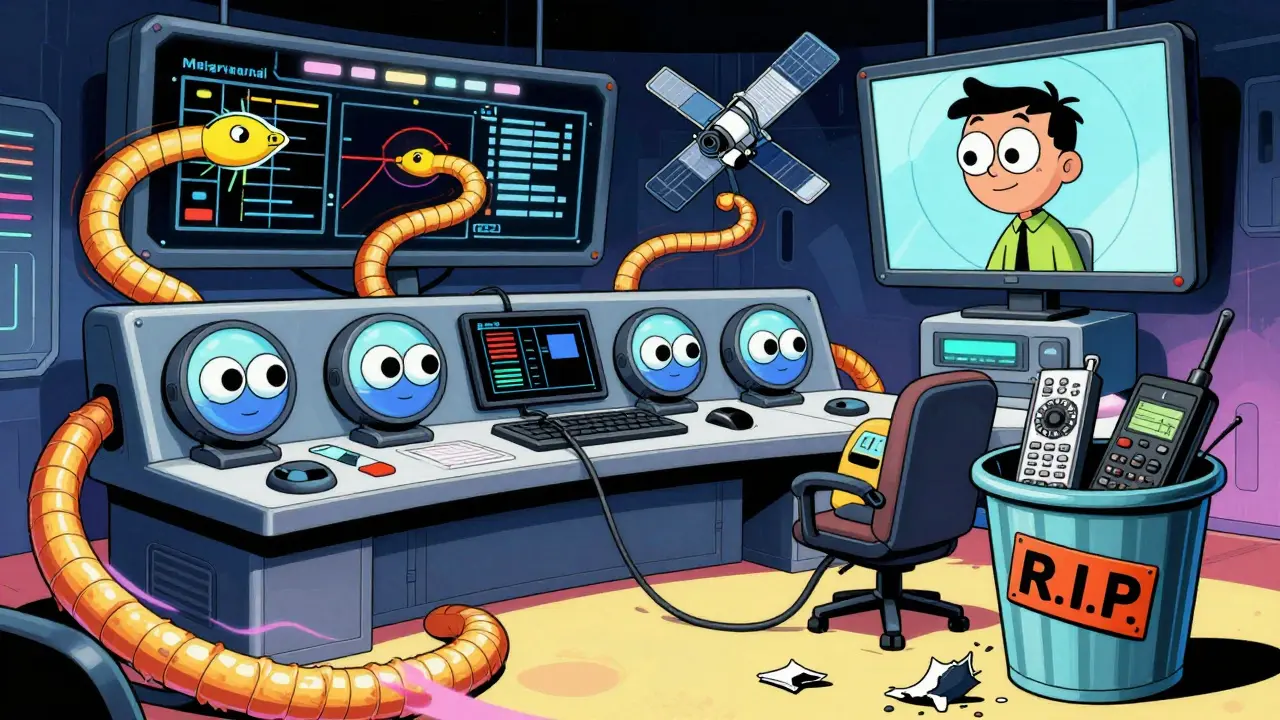
What’s Next? AI, 2025, and the End of Analog
The future is here-and it’s getting smarter.
In 2024, Riedel started testing AI-powered noise suppression tuned for production environments. In beta, it cut ambient noise by 22dB. That means you can run a noisy set without having to yell into your mic. Yamaha’s new systems use AI to auto-assign channels based on who’s speaking. And in 2025, SMPTE will release ST 2110-31, a new standard that tightens synchronization even further.
By 2026, 87% of top-tier broadcast facilities will have fully switched to IP intercoms, according to Dr. Sarah Chen’s 2023 white paper. The ESTA’s E1.33-2022 standard now requires 99.995% uptime for mission-critical systems. That’s five nines. Analog systems can’t touch that.
Independent producers are catching up. As costs come down and cloud-based control panels improve, even small documentary teams are ditching wired beltpacks. The pandemic forced remote collaboration-and now, no one wants to go back.
Is VoIP Right for Your Production?
Ask yourself these questions:
- Do you ever work with remote crew members or satellite feeds?
- Do you spend more than 4 hours setting up intercoms for a shoot?
- Have you had a communication failure during a live event?
- Are you planning to shoot in multiple locations or on location with no fixed infrastructure?
If you answered yes to even one, you’re already paying more than you need to with analog.
Start small. Get a 4-channel system with a single beltpack. Test it on your next shoot. If it works-and it will-you’ll wonder how you ever lived without it.
What to Do Next
Don’t wait for a crisis to force your hand. Start planning now:
- Map your current communication workflow. Where do delays happen? Where do cables get tangled?
- Reach out to Clear-Com or Riedel for a demo. Ask for a 7-day trial on a small setup.
- Train one crew member in IP network basics. YouTube has free tutorials on AES67 and QoS.
- Build a budget. Factor in training, network upgrades, and redundancy-not just the hardware.
- Test before you commit. Run a mock shoot with your new system. Time how long it takes to add a remote contributor.
The shift to IP isn’t optional anymore. It’s the new standard. The question isn’t whether you should switch. It’s how fast you can make the leap before your competitors leave you behind.









Yashwanth Gouravajjula
15 Dec 2025 at 23:46In India, we just patched together walkie-talkies and WhatsApp voice notes. But seeing this? Game changer. No more shouting over drum sets during indie shoots.