



Bitcoin isn’t just the first cryptocurrency-it’s still the anchor of the entire market. But over the last few years, altcoins have started pulling ahead in bursts, sometimes leaving Bitcoin in the dust. If you’ve watched Bitcoin hover around $90,000 while Ethereum, Solana, or AI tokens surge 50% in weeks, you’re not imagining things. There’s a real pattern here. And understanding it could mean the difference between holding steady or catching a major move.
What Bitcoin Dominance Really Tells You
Bitcoin dominance isn’t just a number on a chart. It’s the percentage of the entire crypto market’s value that Bitcoin controls. As of December 2025, it’s at 59%. That might sound high, but it’s down from 69% just six months ago. That drop isn’t random. It’s a signal. When Bitcoin dominance falls below 60%, history shows capital starts flowing into altcoins. Not always, but often enough to be a reliable clue. The Altcoin Season Index, developed by CoinMarketCap, tracks this more precisely. It measures how many of the top 100 cryptos are outperforming Bitcoin over a 90-day window. If that index hits 75% or higher, you’re in what traders call “Altcoin Season.” Right now, it’s at 68%. Close. Very close. That’s where the action usually starts.Altcoins Don’t Move Like Bitcoin
Bitcoin’s price swings are wild by traditional standards-4% to 6% in a single day is normal. But altcoins? They’re a different beast. Mid-cap altcoins regularly swing 15% to 25% daily. That’s not a bug-it’s a feature. Higher volatility means higher risk, but also higher reward. Take the 2021 bull run. Bitcoin climbed 300%. Ethereum? It went up 820%. That’s not a typo. In the same period, some DeFi tokens returned over 1,200%. Meanwhile, privacy coins like Monero barely moved. Altcoins don’t move as a group. They move by sector. AI tokens, Layer-2 solutions, and DeFi protocols are leading right now. If you’re just buying “altcoins” blindly, you’re playing Russian roulette with your portfolio.When Altcoins Crush Bitcoin-and When They Get Crushed
Altcoins shine in bull markets. But they bleed harder in bear markets. When Bitcoin dropped 75% from its 2021 peak, many altcoins fell 90-95%. That’s not an exaggeration. It’s what happened. If you bought micro-cap tokens during the hype, you likely lost most of your money when the tide turned. The key is timing. Altcoin seasons usually start after Bitcoin has had a solid 30-40% run. That’s when traders start looking for the next opportunity. Ian Balina from TokenMetrics says AI tokens and infrastructure projects like Launchcoin often lead the charge. They’re the canaries in the coal mine. If you see those tokens climbing while Bitcoin stalls, pay attention. But here’s the catch: not every drop in Bitcoin dominance means altcoin season is here. In April 2025, Bitcoin dominance dipped to 58%-a classic signal. Traders rushed in. Then Bitcoin bounced back to 63% in a week. Those who bought early lost 35-40%. False signals happen. That’s why you need more than one indicator.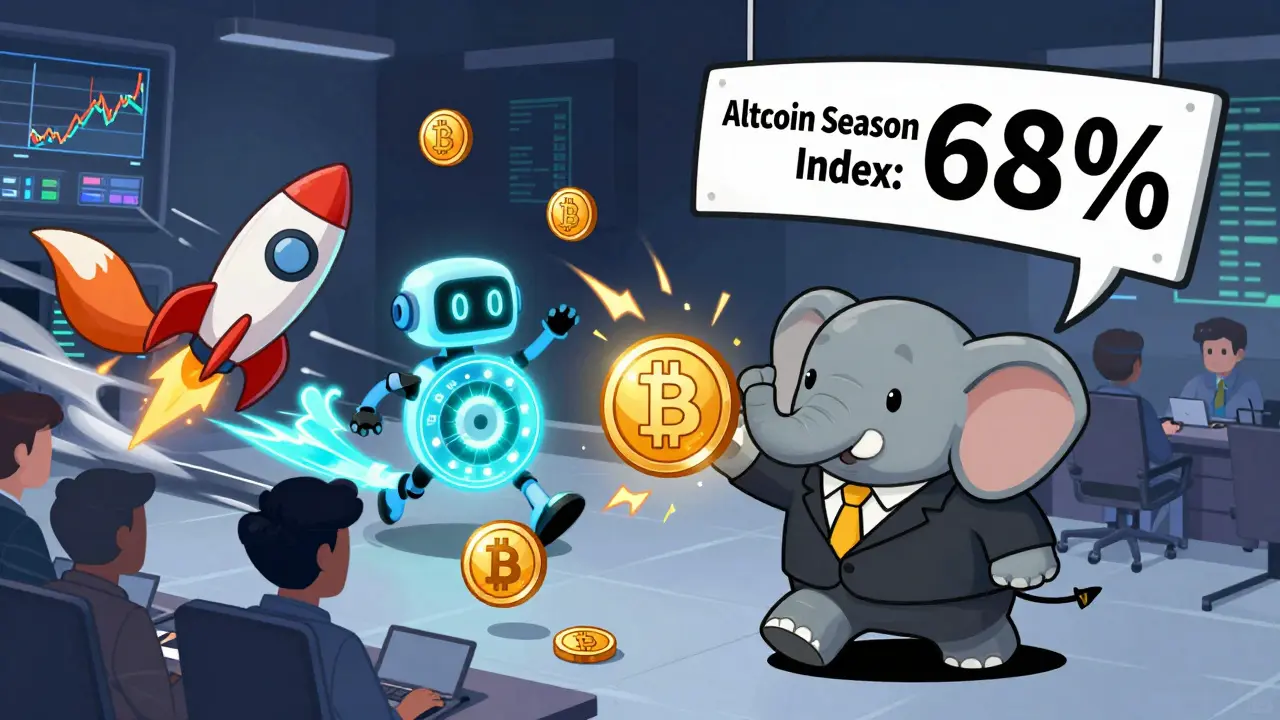
What Tools Do Real Traders Use?
Most beginners just check CoinMarketCap or CoinGecko. That’s fine for starters. But serious traders use a mix of tools:- CoinGecko’s dominance chart - Free, simple, and great for spotting long-term trends.
- TokenTerminal - Tracks sector performance. Shows you which types of altcoins are gaining traction.
- Glassnode - On-chain data. Tells you if big wallets are accumulating or dumping.
- TradingView scripts - Automate the Altcoin Season Index so you don’t have to calculate it manually.
Who’s Winning Right Now? (December 2025)
As of this month, AI cryptocurrencies have a combined market cap of $280 billion. DeFi tokens sit at $190 billion. These aren’t small players anymore. They’re the main drivers of altcoin growth. Ethereum, thanks to its upcoming “UltraSonic” upgrade in Q2 2026, is also gaining traction. The upgrade will cut its supply growth to just 0.2% annually-making it more like Bitcoin in scarcity. Meanwhile, Bitcoin is stuck near $90,000. No big breakout. No major news. That’s exactly the environment where altcoins thrive. Investors are looking for growth. And right now, AI and infrastructure projects are offering it.The Institutional Divide
Big money still loves Bitcoin. Over 78% of crypto ETF holdings are in Bitcoin. The largest altcoin ETF, Grayscale’s Ethereum Trust, is only $12.4 billion. That’s tiny compared to Bitcoin’s $100+ billion in ETFs. But institutions are starting to shift. A CoinDesk report from Q3 2025 found that 68% of institutional investors now allocate 15-25% of their crypto portfolios to altcoins when Bitcoin dominance drops by 5% or more. And when they do, they’re putting most of it into DeFi (45%) and AI (30%). That’s important. It means altcoin rallies aren’t just retail hype anymore. Real money is getting involved. That adds legitimacy-and staying power.
What Could Go Wrong?
The biggest risk isn’t price. It’s regulation. The EU’s MiCA framework is clear and structured. It could make it easier for altcoins to get approved as securities or tokens. But the U.S. is still chaotic. The SEC hasn’t given clear rules for most altcoins. If they start cracking down hard, investors could flee to Bitcoin as the “safe” option. JPMorgan warns that regulatory pressure could shrink altcoin market share to 30% by 2026. Standard Chartered, on the other hand, predicts altcoins will hit 55% by Q3 2026. The truth? It depends on Washington. Another risk: liquidity. When Bitcoin drops suddenly, altcoin trading volume often dries up. Reddit user u/HODL4Ever lost 65% in September 2025 because he bought into AI tokens during a Bitcoin correction-and couldn’t sell when the market froze.What Should You Do?
If you’re holding Bitcoin and wondering whether to move into altcoins, here’s a simple checklist:- Is Bitcoin dominance below 60%? (It’s at 59%-close enough.)
- Is the Altcoin Season Index above 65%? (It’s at 68%-yes.)
- Are AI or DeFi tokens showing strong volume and price action? (Yes, they’re leading.)
- Are you prepared for 20-30% swings? (If not, don’t go all in.)
What’s Next?
If Bitcoin dominance drops below 55% in January 2026-as 65% of analysts predict-altcoins could surge 80-150% over the next 90 days. That’s not speculation. That’s what happened in 2021. And 2017. And 2015. The pattern repeats. But if Bitcoin breaks above $100,000 and dominance climbs back to 65%, altcoins could stall-or worse, drop hard. That’s why you watch the numbers, not the headlines. Let the data tell you when to act. Not the hype.Is Bitcoin still the best cryptocurrency to hold?
Bitcoin remains the most stable and widely accepted cryptocurrency. It’s the market anchor and the safest bet for long-term holding. But it’s not the only one. Altcoins offer higher growth potential during bull markets, especially when Bitcoin dominance falls below 60%. Holding only Bitcoin means you miss out on those explosive moves. A balanced approach-70% Bitcoin, 30% altcoins-is common among experienced investors.
What’s the difference between Bitcoin and altcoins?
Bitcoin was designed as digital money with a fixed supply of 21 million coins. Altcoins are any other cryptocurrency built after Bitcoin. Many, like Ethereum, add smart contracts, faster transactions, or new use cases like DeFi or AI. Bitcoin’s purpose is store of value. Altcoins often aim to improve or expand on Bitcoin’s original idea. That’s why their prices move differently.
How do I know when an altcoin season is starting?
Look for three things: Bitcoin dominance falling below 60%, the Altcoin Season Index rising above 65%, and a spike in altcoin trading volume compared to Bitcoin. Also watch for early movers-AI tokens, Layer-2 networks, and DeFi protocols often lead the charge. Don’t act on one signal alone. Wait for confirmation across multiple indicators.
Are altcoins riskier than Bitcoin?
Yes, significantly. Altcoins have higher volatility, lower liquidity, and more regulatory uncertainty. A single bad news story can wipe out 50-80% of a micro-cap altcoin’s value overnight. Bitcoin, while volatile, has proven resilience over 15+ years. Altcoins are speculative. Bitcoin is the foundation. Treat them differently in your portfolio.
Should I sell Bitcoin to buy altcoins?
Don’t sell all of it. Instead, rebalance. If you’re holding 100% Bitcoin, consider moving 10-20% into high-quality altcoins when conditions are right. This lets you benefit from altcoin rallies without abandoning Bitcoin’s stability. Many successful investors use this strategy. Selling Bitcoin entirely during a rally is risky-you might miss the next Bitcoin surge.
What altcoins should I consider in 2026?
Focus on projects with real use cases, strong teams, and growing adoption. Ethereum (ETH) is still the leader in smart contracts. Solana (SOL) offers speed and low fees. Chainlink (LINK) powers real-world data for DeFi. AI tokens like Render (RNDR) and Fetch.ai (FET) are gaining institutional interest. Avoid tokens with no clear product, no community, or no trading volume. Quality matters more than hype.








michael T
16 Dec 2025 at 07:27Bro, I bought Solana when it was $35 and watched it hit $280 in three weeks. Then I got greedy, held through the dump, and now I’m living in my mom’s basement eating ramen while she asks if I’m ‘still into that crypto stuff.’ Worth it? Maybe. Do I regret it? Nah. Altcoin season ain’t for the faint of heart-it’s for the dumb, the bold, and the emotionally unstable. I’m all three.
Bitcoin’s just the anchor. Altcoins are the fireworks. And I’m the idiot standing too close with a lighter.