

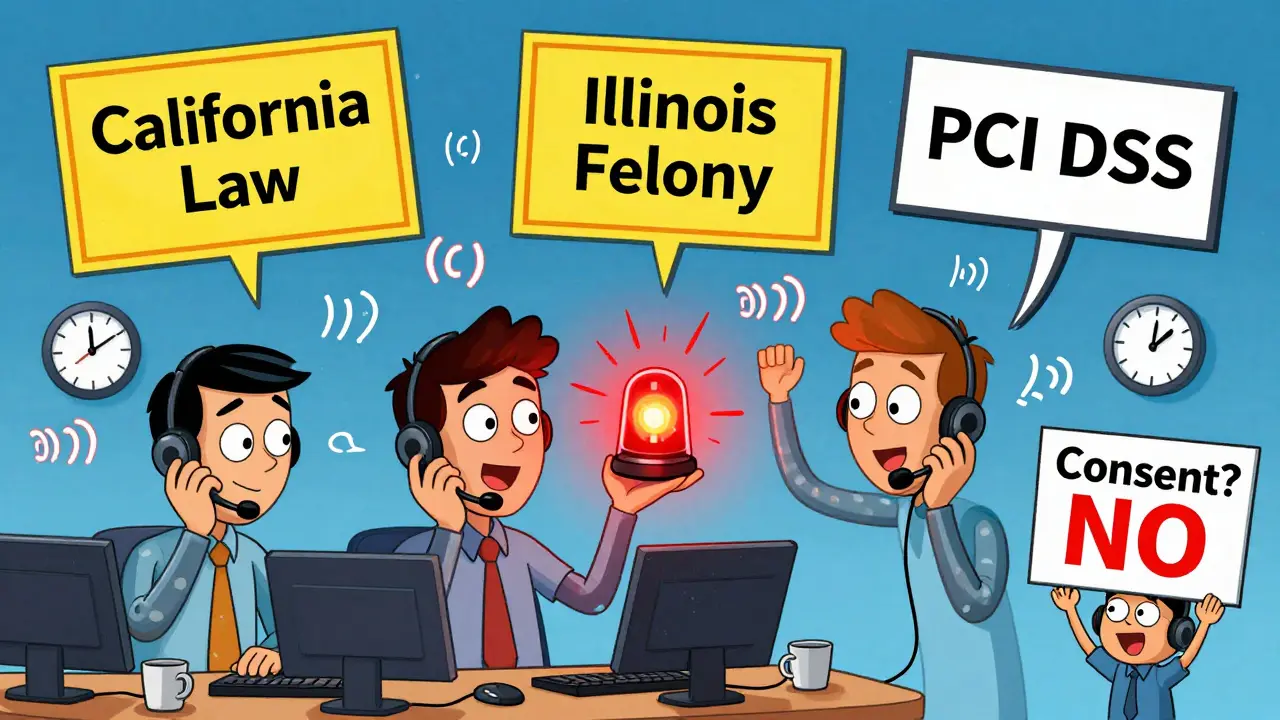

Every time a customer calls your support line, you’re not just handling a question-you’re creating a legal record. In 2025, call center recording isn’t just about training or quality control. It’s a minefield of state laws, federal rules, and international regulations that can land your business in court-or worse, on the wrong side of a $20 million fine.
What You’re Allowed to Record (And What Can Get You Sued)
Federal law says you only need one person’s consent to record a call. That’s it. If you’re on the line, you can record. Simple, right? Not even close.
Twelve U.S. states require all-party consent. That means every single person on the call-customer, agent, even someone who accidentally got patched in-must agree before recording starts. These states include California, Illinois, Florida, Massachusetts, Pennsylvania, and Connecticut. In Illinois, violating this rule isn’t a slap on the wrist. It’s a felony. First offense? Up to five years in prison and a $25,000 fine. Second offense? Seven years.
And it’s not just about the state you’re in. If your customer is in California but your call center is in Texas, you still have to follow California’s rules. Jurisdiction follows the customer, not the agent. That’s why big call centers now treat every call as if it’s coming from the strictest state in the country.
The Tone That Could Cost You Millions
Most companies use a simple audio beep to signal recording. It’s cheap. It’s common. But in California, that beep isn’t optional-it’s legally required. The beep must repeat every 15 seconds, loud enough to be heard over background noise. If your system skips a beep or mutes it during a hold, you’re in violation.
And it’s not just about the beep. The verbal disclosure matters too. In Massachusetts, you must say: “This call may be recorded for quality and training purposes. Do you consent?” If the customer says nothing, you can’t assume consent. Silence isn’t agreement. In California, you only need to say: “This call may be recorded or monitored.” But if you say “we record all calls,” and then fail to record one, you could be accused of deception.
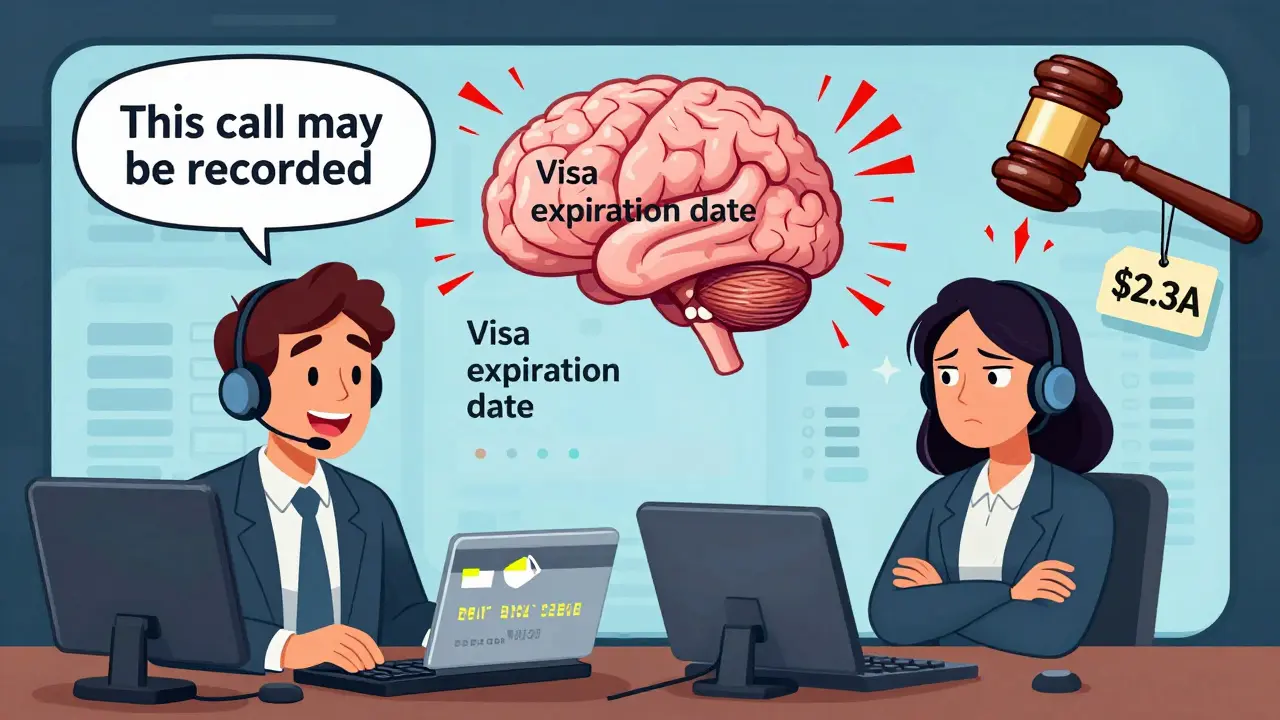
Even small wording changes matter. A call center in Pennsylvania settled for $2.3 million after using the phrase “calls are recorded” instead of “calls may be recorded.” The court ruled the word “may” implied choice. The word “are” implied certainty. That tiny difference turned consent into coercion.
What Happens When You Record Payment Info
Recording a call with a credit card number isn’t just risky-it’s a direct violation of PCI DSS standards. The Payment Card Industry Security Standards Council requires systems to pause recording the moment an agent starts entering card details and resume only after the number is confirmed.
One company got hit with a $45,000 fine because their system didn’t auto-pause. An agent read a card number aloud during a troubleshooting call. The recording was stored. The card number was exposed. The payment processor didn’t care if the agent was trained. They didn’t care if it was an accident. The system failed. The fine stood.
Even if you don’t record the number, if your AI system analyzes speech and detects a card number, you’re still handling PCI data. Many companies don’t realize that AI-driven sentiment analysis or keyword detection can trigger compliance obligations. If your system listens for “credit card,” “Visa,” or “expiration date,” it’s processing sensitive data-and you need to secure it like you would a physical card.
International Rules Are a Different World
If you serve customers in Europe, Canada, or Australia, U.S. rules don’t apply. You need to follow theirs.
Under GDPR, you need a legal basis to record-consent is just one option. You can also rely on “legitimate interest,” but you must prove it outweighs the customer’s privacy rights. You must tell them why you’re recording, how long you’ll keep it, and give them the right to delete it. Fines for violations? Up to €20 million or 4% of your global revenue. One UK-based call center paid €1.8 million in 2024 after failing to delete recordings when requested.
In Canada, PIPEDA doesn’t explicitly ban recording, but it requires “meaningful consent.” Courts have ruled that a simple beep isn’t enough. Customers must understand what they’re agreeing to. In Australia, federal law leans toward all-party consent. In the UAE, recording without permission is a criminal offense-you could go to jail.
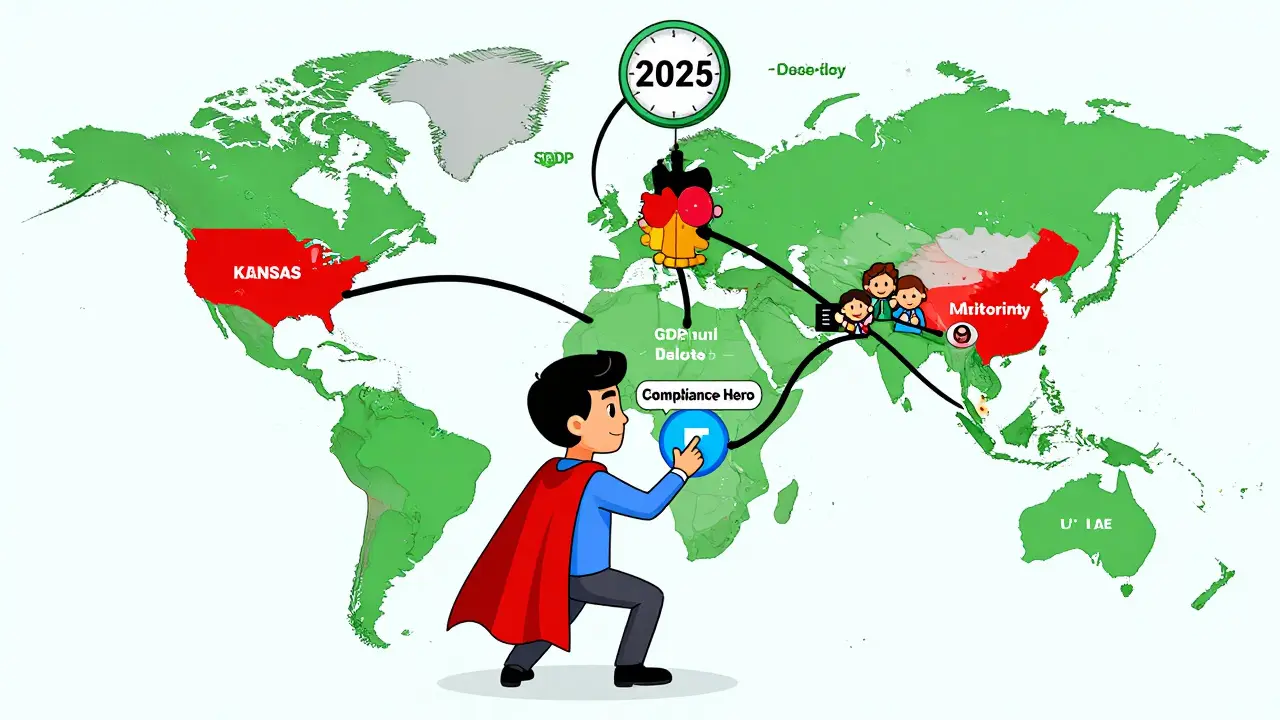
Global companies now use location-based routing. If a call comes from Germany, the system triggers GDPR-compliant disclosures. If it’s from Texas, it uses the one-party script. If it’s from California, it adds the beep tone and confirms consent verbally. It’s complex. But it’s cheaper than a lawsuit.
AI Is Changing the Game-And It’s Not Legal Yet
Today, 43% of call centers use AI to analyze conversations in real time. The system listens for frustration, detects upsell opportunities, or flags compliance risks. But here’s the problem: if the AI is processing the audio, it’s recording it.
State laws haven’t caught up. In Illinois, even listening without saving the audio can be considered eavesdropping. In California, real-time transcription counts as recording under CCPA. The FCC hasn’t clarified whether AI monitoring triggers consent rules. Courts are split.
Some companies are using AI to monitor compliance instead. Observe.AI’s system checks if agents say the right words at the right time. It flags calls where the beep was missed, consent wasn’t confirmed, or PCI pause failed. In 2024, they analyzed 12 million calls and caught 98.7% of violations before they became lawsuits.
What You Must Do Right Now
You don’t need a legal team to fix this. But you do need a system. Here’s what works:
- Use all-party consent everywhere. Even if you’re only in one state, assume every call could be from California or Illinois. It’s the only way to avoid guessing wrong.
- Record the consent. Don’t just say “do you consent?”-record their “yes.” If they say “okay” or “sure,” that’s not enough. You need clear, verbal agreement.
- Pause for payments. Your system must auto-pause when card numbers are entered. Test this monthly. Automate it.
- Encrypt everything. Recordings stored on servers, in the cloud, or on laptops must be encrypted. No exceptions. Use AES-256 or better.
- Set retention limits. Keep recordings only as long as you need them. Most states require deletion after 30 to 90 days unless needed for legal disputes. Automate deletion.
- Train agents weekly. One agent forgetting the script can trigger a class action. Role-play consent disclosures. Record the training. Review it.
Why Compliance Isn’t a Cost-It’s a Competitive Edge
Most companies see compliance as a burden. But the data says otherwise.
Customers are 68% more likely to trust a company that clearly explains why calls are recorded. They’re 31% more likely to say they’d recommend you. In a world where 78% of disputes hinge on what was said on the phone, a clean recording is your best defense.
Companies with strong compliance programs see 42% lower dispute resolution costs. They also get fewer complaints to the FTC. In 2024, the FTC received 320% more complaints about call recording than in 2019. The ones that survived? The ones that were transparent.
The market for compliance tools is exploding-growing at 17.3% a year. That’s because businesses are tired of getting sued. You don’t need to be the next headline. You just need to get the basics right.
What’s Coming in 2025
Twenty-three states are expected to change their recording laws in 2025. Some want stricter consent. Others want clearer disclosure rules. The White House has signaled it may push for a federal standard-but that’s not guaranteed.
In the meantime, the safest move is to assume every new call could be from a state with the strictest rules. Use all-party consent. Record the agreement. Pause for payments. Encrypt everything. Delete after 90 days. Train your team. Monitor with AI.
Compliance isn’t about checking boxes. It’s about treating every customer like they’re in California-even if they’re in Kansas. Because in 2025, that’s the only way to stay out of court and in business.









Paritosh Bhagat
15 Dec 2025 at 20:43Man, I just had a call with a US-based support line from India, and they didn’t even beep. Zero warning. I asked if it was recorded and they said ‘oh yeah, all calls are.’ I nearly hung up. Then I realized-this is why companies get sued. No one reads the fine print, and agents just parrot scripts they don’t understand. If you’re gonna record, say it like you mean it. Not ‘may be recorded’ like you’re apologizing for existing. Say it loud, clear, and repeat it. And stop treating customers like they’re dumb. We hear you. We just want to know if our voice is being stored forever.