


Five9 and Talkdesk aren’t just another pair of VoIP tools-they’re full cloud contact center platforms built for businesses that can’t afford dropped calls, slow responses, or frustrated customers.
If you’re comparing Five9 and Talkdesk, you’re likely managing a team of 50+ agents or planning to scale. Maybe your customer service costs are climbing, or your current system can’t handle chat, email, and social media alongside voice. You need something that works now, scales later, and doesn’t turn your IT team into full-time coders.
Both platforms promise AI, omnichannel support, and seamless CRM integration. But the real differences? They’re not in marketing brochures. They’re in how fast your agents get up to speed, whether your compliance audits pass, and if your customer data actually flows between systems without breaking.
Let’s cut through the noise. Here’s how Five9 and Talkdesk really stack up-based on real deployments, user reports from 2025, and what happens when you move beyond the free trial.
Who’s Five9 For? Enterprises That Need Deep Analytics and Outbound Power
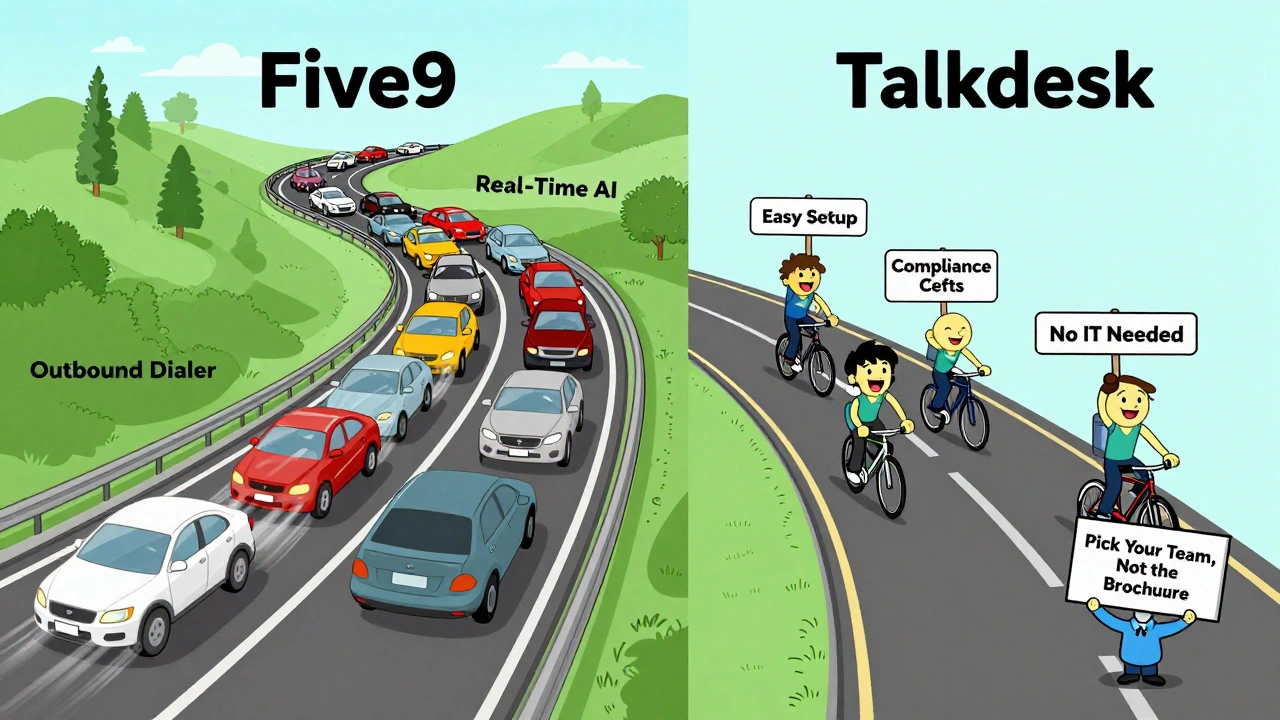
Five9 isn’t trying to be easy. It’s trying to be powerful. If your business handles thousands of calls a day-think banks, insurance companies, or large retailers-Five9 is built for that scale.
Its AI Insights tool analyzes 100% of every customer interaction, not just a sample. That means you don’t miss patterns like customers hanging up after hearing “your call is important to us.” You see exactly where agents struggle, what phrases trigger complaints, and which scripts actually close sales.
Five9 also leads in outbound capabilities. Its predictive dialer doesn’t just blast numbers. It learns when agents are likely to be free, avoids calling during lunch breaks, and even adjusts timing based on historical answer rates. For telemarketing-heavy teams, that’s a 20-30% boost in connect rates.
And if you’re on Salesforce? Five9’s integration moves 27% more data fields in real time than Talkdesk. That’s not a minor tweak-it’s the difference between an agent seeing the full case history or just a name and phone number.
But here’s the catch: Five9’s complexity comes at a cost. Implementation takes 8 to 12 weeks. Training each agent takes 40 hours. And if your team isn’t tech-savvy, you’ll hit walls with custom workflows. Users report software crashes, especially during peak hours, and delays of 2-3 seconds between a customer answering and the agent connecting-enough to lose sales in healthcare or emergency services.
Talkdesk: The Mid-Market Favorite That Gets You Live in Weeks, Not Months
Talkdesk is what happens when you design a contact center for people, not IT departments.
Most teams get up and running in 4 to 6 weeks. No complex configuration. No months of vendor-led workshops. Agents log in, see a clean interface, and start taking calls. That’s why 73% of Talkdesk reviews mention “ease of use” as their top reason for staying.
Its pricing is transparent, too. You don’t need to request a quote for the entry-level plan. CX Cloud Essentials starts at $85 per user per month. No hidden fees. No minimum user counts. That’s a game-changer for growing companies that don’t want to be locked into a 100-agent contract just to get basic features.
Talkdesk’s AI is slightly less aggressive than Five9’s-it analyzes about 85% of interactions-but it makes up for it in speed and simplicity. Its AI Agents can handle routine questions like “What’s my balance?” or “When’s my appointment?” with 87% containment rates. That means fewer calls hit live agents, cutting wait times and labor costs.
And if compliance matters? Talkdesk wins. It holds 15 industry-specific certifications, including FedRAMP Moderate, HITRUST, and CJIS-something Five9 doesn’t fully match. For healthcare providers, government agencies, or financial firms under strict regulations, that’s not a bonus. It’s a requirement.
But Talkdesk isn’t perfect. Its outbound dialing is basic. No predictive intelligence. No advanced campaign controls. And while its user interface is clean, it lacks Five9’s multi-role dashboards. Supervisors can’t see real-time SLA alerts across teams. And some users report callback scheduling simply doesn’t work in production, even on the top-tier plan.
AI and Analytics: Five9 Sees Everything. Talkdesk Just Needs to Help.
AI isn’t a buzzword here-it’s the core of performance.
Five9’s Genius AI suite doesn’t just transcribe calls. It listens for emotional cues, flags compliance risks in real time, and suggests next-best actions to agents during live conversations. In one healthcare client, it reduced missed HIPAA disclosures by 41% by alerting agents when they mentioned patient names in unsecured channels.
Talkdesk’s AI is more focused on automation. It doesn’t analyze every call for sentiment. Instead, it answers questions, routes calls faster, and writes summaries after the fact. That’s perfect for teams that want to reduce handle time, not dive into deep analytics.
If you need to prove ROI to executives with charts showing call resolution trends, customer satisfaction dips, or agent performance over time-Five9 gives you that out of the box. Talkdesk gives you reports you can build… if you have time and a data analyst.
Integration, Compliance, and Scalability: Who Plays Well With Others?
Integration isn’t about connecting to Salesforce or Zendesk. It’s about whether your data stays accurate when you add a new tool.
Talkdesk supports 300+ third-party apps. Five9 supports 250. That sounds close-but it’s not. Talkdesk’s integrations are often pre-built and plug-and-play. Five9’s require more configuration, even for common tools like Microsoft Teams or HubSpot.
Compliance? Talkdesk wins again. Its FedRAMP Moderate certification means federal agencies can use it. Five9 is only “FedRAMP Ready”-a status that means it’s eligible, but not yet approved. For government contractors or healthcare providers, that’s a dealbreaker.
Scalability? Five9 handles 1,000+ agents with ease. Talkdesk works great for 50-500 agents. Push it beyond 700, and you’ll start hitting performance limits. Five9’s 99.999% uptime SLA is non-negotiable for enterprises. Talkdesk’s is 99.9%, which is still excellent-but not enterprise-grade.
Support and Training: Who’s There When Things Break?
Both offer 24/7 support. But what does that actually mean?
Five9 gives you phone, chat, and email support with an average first response time of 12 minutes. You can call a human at 2 a.m. and get help. That’s why 68% of Five9 users praise its support.
Talkdesk’s phone support? Only during business hours. Outside that, you get AI chatbots and a knowledge base. For non-critical issues, response times can stretch to 24-48 hours. That’s fine if your system runs smoothly. But if your entire outbound campaign crashes on a Friday night? You’re on your own until Monday.
Training? Five9 needs 40 hours per agent. Talkdesk? 25-30. That’s a savings of $15,000-$20,000 per 100 agents in labor costs alone. For fast-growing teams, that’s huge.
Real-World Trade-Offs: What You Gain and What You Lose
Here’s the truth: you can’t have it all.
If you choose Five9, you get:
- Deep analytics on every interaction
- Enterprise-grade reliability and uptime
- Best-in-class outbound dialing
- Superior Salesforce integration
But you sacrifice:
- Speed of deployment (3-4 months vs. 1-2)
- Ease of use (steeper learning curve)
- Transparent pricing (custom quotes only)
- Industry-specific compliance (fewer certifications)
If you choose Talkdesk, you get:
- Fast setup and easy adoption
- Clear, upfront pricing
- Strong compliance for healthcare and government
- More integrations out of the box
But you sacrifice:
- Real-time AI insights on every call
- Advanced outbound automation
- Multi-role dashboards for supervisors
- Enterprise-scale reliability (above 700 agents)
Who Should Pick Which?
Choose Five9 if:
- You have 1,000+ agents or plan to scale that fast
- Your team needs to analyze every single customer interaction
- You rely heavily on outbound campaigns
- You’re on Salesforce and need deep data sync
- You can afford a 3-4 month rollout and 40 hours of training per agent
Choose Talkdesk if:
- You’re a mid-market company with 50-500 agents
- You need to go live in under 6 weeks
- Compliance (HIPAA, FedRAMP, CJIS) is non-negotiable
- You want transparent pricing and no minimums
- Your agents aren’t tech experts and need a simple interface
What’s Next in 2025?
Five9’s acquisition by Zoom in late 2024 changes the game. Expect tighter video calling integration, unified communications features, and deeper Zoom Phone sync by Q3 2025. If you’re already using Zoom for meetings, Five9 could become your natural contact center hub.
Talkdesk’s roadmap focuses on predictive workforce management. By Q4 2025, its scheduling tool will predict staffing needs with 95% accuracy. That’s huge for call centers with fluctuating volumes-like retailers during holidays or insurers after natural disasters.
Neither platform offers native unified communications yet. If you want voice, video, chat, and team messaging in one tool, you might still need RingCentral or 8x8.
Is Five9 better than Talkdesk?
It depends on your size and needs. Five9 is better for large enterprises needing deep analytics, outbound automation, and Salesforce integration. Talkdesk is better for mid-market teams that want fast setup, easy use, and strong compliance. Neither is universally better.
Which platform has better AI?
Five9’s AI analyzes 100% of interactions for sentiment, compliance, and agent coaching. Talkdesk’s AI focuses on automating routine tasks like answering FAQs and routing calls. Five9 gives you deeper insights; Talkdesk gives you faster resolution.
Can I use Talkdesk for healthcare?
Yes. Talkdesk holds HITRUST and HIPAA certifications, making it one of the few CCaaS platforms approved for handling protected health information. Five9 supports HIPAA but lacks the full suite of healthcare-specific compliance certifications.
How much do Five9 and Talkdesk cost?
Talkdesk starts at $85 per user per month with clear pricing tiers. Five9 starts at $119 but requires custom quotes for most plans. Five9’s higher price reflects enterprise features; Talkdesk’s lower entry point suits growing teams.
Which platform has better support?
Five9 offers 24/7 phone support with 12-minute average response times. Talkdesk offers phone support only during business hours and relies more on AI chatbots. If you need help at night or on weekends, Five9 is the clear winner.
Do I need a big IT team to run either platform?
Not with Talkdesk. Its drag-and-drop interface lets non-technical users manage workflows. Five9 requires more technical oversight, especially for custom integrations and advanced reporting. You’ll need at least one dedicated admin for Five9.
Can I switch from one to the other later?
Yes, but it’s costly. Data migration, retraining agents, and rebuilding workflows can take 3-6 months and cost tens of thousands. Choose wisely upfront. Talkdesk is easier to scale into enterprise use than Five9 is to simplify for mid-market teams.
Final Thought: Pick Based on Your Team, Not the Brochure
Don’t choose Five9 because it’s “enterprise.” Don’t choose Talkdesk because it’s “affordable.”
Ask yourself: Do we need to analyze every call-or just answer them faster? Do we need compliance certifications-or just a system that works? Do we have the time to train agents for months-or do we need them live by next quarter?
The right platform isn’t the one with the most features. It’s the one that lets your team do their best work-without burning them out or breaking your budget.







selma souza
2 Dec 2025 at 14:57The assertion that Talkdesk lacks enterprise-grade reliability above 700 agents is misleading. Performance metrics are contingent on architecture, not arbitrary thresholds. Many organizations deploy Talkdesk at scale with proper resource allocation and load testing-this is not a product limitation but a failure of implementation planning.