

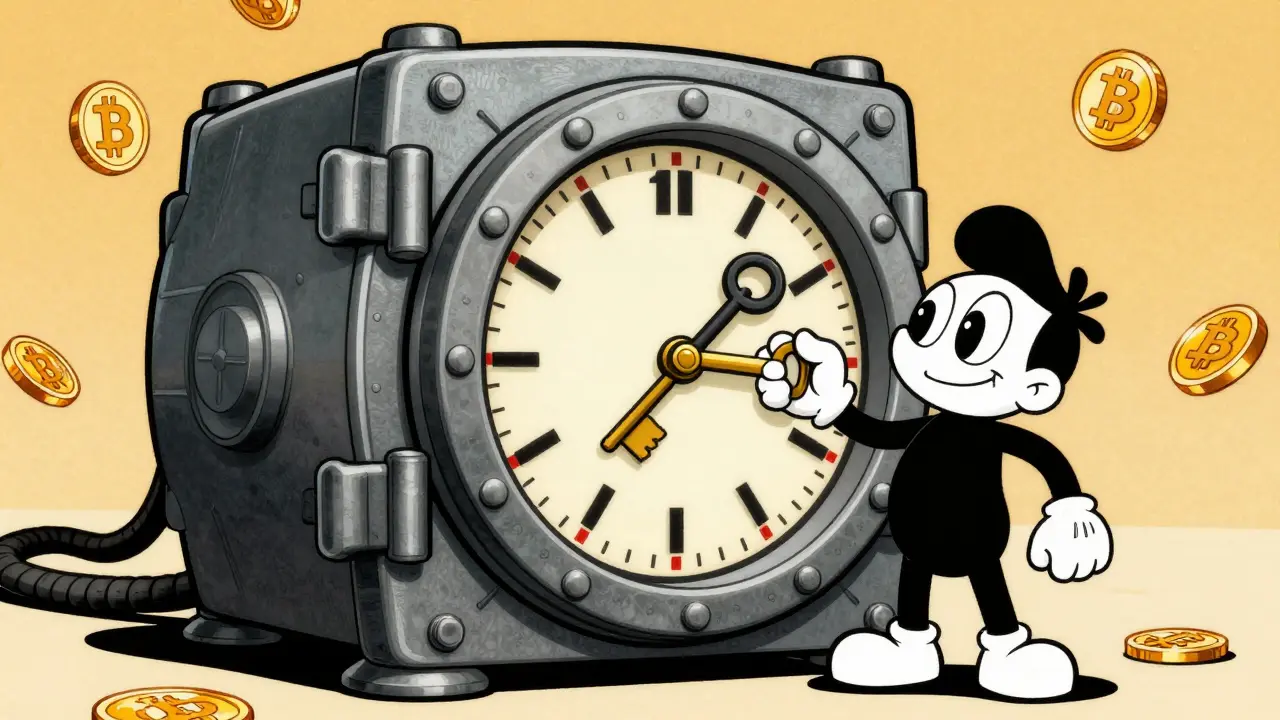

Imagine locking a digital vault and knowing that no matter who has the key, the door simply won't open until January 1st, 2027. That is exactly how time-locked transactions work in Bitcoin. Unlike a standard transfer where funds move instantly, these mechanisms bake a waiting period directly into the blockchain. Because this is enforced by the network's protocol, not a third-party company, the lock is practically unbreakable until the conditions are met.
| Mechanism | Lock Type | Enforced By | Best Use Case |
|---|---|---|---|
| CLTV | Absolute | Block height or Unix time | Inheritance / Vesting |
| CSV | Relative | Blocks since confirmation | Lightning Network / Vaults |
| nLockTime | Transaction-level | Transaction field | Delayed broadcasting |
| nSequence | Input-level | Transaction input | Replace-by-Fee / CSV trigger |
How Absolute Locks Work with CLTV
When you want funds to be unavailable until a specific date, you use CLTV is CheckLockTimeVerify, an opcode defined in BIP-65 that prevents a Bitcoin script from being satisfied until a specific block height or timestamp is reached . Think of this as an "alarm clock" for your money. You can set the lock to a specific Unix timestamp (like a calendar date) or a block number (like block 900,000).
If a user tries to spend a UTXO locked with CLTV before the time arrives, miners will simply reject the transaction. It isn't just that the transaction is "pending"; it is technically invalid in the eyes of the network. This creates a cryptographic guarantee that no one-not even the person with the private keys-can touch the funds early. This makes it a powerhouse for Time-Locked Bitcoin Transactions when dealing with long-term financial planning.
Understanding Relative Locks and CSV
Not every lock needs a calendar date. Sometimes, you just need the funds to be locked for a set amount of time after they are sent. This is where CSV is CheckSequenceVerify, a relative time-lock mechanism defined in BIP-112 that requires a UTXO to age for a specific number of blocks after it appears on-chain comes into play.
While CLTV says "Wait until Friday," CSV says "Wait 14 days from now." This is critical for security workflows. For example, if you're building a recovery system, you might set a CSV lock of 4,320 blocks (roughly 30 days). If a hacker steals your keys and tries to move funds, they have to wait 30 days before the funds are spendable. This window gives the rightful owner time to notice the theft and use a recovery key to move the funds to a safe address first.
One technical catch: CSV has a hard limit. You cannot set a relative lock longer than 65,535 blocks, which is about 15 months. If you need a lock for five years, you have to use an absolute CLTV lock instead.

Real-World Use Cases for Time-Locks
These aren't just theoretical tools; they are the backbone of some of the most advanced features in the ecosystem. Here is how they are actually used in the wild:
- Digital Wills and Inheritance: You can create a script where funds are locked until a specific date years in the future. If you don't move the funds by then, a secondary key (held by a family member) becomes active, ensuring your BTC doesn't vanish if you lose your keys.
- Employee Vesting: Companies can issue bonuses in BTC that only become spendable after a year. The network enforces the vesting period, so the company doesn't need to manage a centralized escrow account.
- The Lightning Network: Lightning Network is a Layer 2 scaling solution that enables nearly instant, low-cost payments by using payment channels depends entirely on timelocks. When a channel is closed, timelocks ensure that one party cannot cheat the other by broadcasting an old state without giving the other party time to contest it.
- Atomic Swaps: When trading BTC for another coin without a centralized exchange, timelocks ensure that if one party disappears, the other can eventually recover their funds after a timeout period.
- Vault Constructions: High-security "vaults" use a combination of multisig and CSV. Any attempt to spend funds triggers a time-delay, allowing the owner to veto a fraudulent transaction before it matures.
The Technical Workflow: From Script to Broadcast
Creating these transactions requires a different approach than a simple "Send" button in a basic wallet. For developers, the process usually involves a library like rust-bitcoin to construct the script. The logic follows a specific order: first, the lock value (e.g., 900,000) is pushed to the stack, followed by the OP_CHECKLOCKTIMEVERIFY opcode, then OP_DROP to clean the stack, and finally the public key and signature check.
For regular users, specialized wallets like BitVault provide an interface to set these delays without writing raw code. The general flow looks like this:
- Choose Lock Type: Decide between absolute (date/block) or relative (number of blocks).
- Set Parameters: Define the exact duration (e.g., 180 days).
- Construct the Script: The wallet generates the necessary opcodes to lock the UTXO.
- Broadcast: The transaction is sent to the network, where miners validate the lock and commit it to the blockchain.

Key Trade-offs and Limitations
Time-locks are powerful, but they aren't a magic bullet. The biggest risk is accessibility. If you set a lock for two years and your situation changes, there is no "override" button. You simply have to wait. The Bitcoin protocol is designed so that transactions only become more permissible over time; they never become invalid. This prevents a bug from accidentally destroying your funds forever, but it means once you set a lock, you're committed to that timeline.
There is also the challenge of multisig coordination. If you lock every single key in a multisig setup, you can't perform "sweep" transactions to move funds to newer, more secure key types until the lock expires. You have to be very strategic about which keys are locked and which remain liquid.
Can a miner ignore a time-lock and process a transaction early?
No. Time-locks are enforced at the protocol level. If a miner includes a transaction that violates a CLTV or CSV condition, the rest of the network will see that block as invalid and reject it. Miners follow these rules to ensure their blocks are accepted and they get paid.
What happens if I set a time-lock for a date that has already passed?
The transaction is processed normally. Since the condition (the date) has already been met, the lock is essentially "open," and the funds can be spent immediately.
Is there a difference between nLockTime and CLTV?
Yes. nLockTime is a field in the transaction itself that tells miners not to include the transaction in a block until a certain time. CLTV is part of the script (the locking condition) of the UTXO. CLTV is much more flexible and powerful because it can be used in complex smart contracts.
How long can a relative lock (CSV) actually last?
The maximum value for a CSV lock is 65,535 blocks. Based on the average 10-minute block time, this works out to approximately 15 months.
Can I use time-locks to hide my transactions from chain analysis?
To some extent, yes. By using time-locks to spend funds at unpredictable future intervals rather than immediately, you can break the immediate temporal link between receiving and spending, which can make pattern analysis more difficult for observers.
Next Steps for Implementation
If you are a casual user looking for a "digital will," start by exploring wallets that support basic timelocks. Don't lock your entire portfolio immediately; try a small amount first to ensure you understand how the unlock process works.
For developers, the best path is to experiment with the rust-bitcoin library or Bitcoin Core's CLI. Start by creating a 2-of-3 multisig address and adding a relative CSV lock to one of the outputs. This will give you a practical feel for how the UTXO matures on-chain before it can be spent.








Ray Htoo
14 Apr 2026 at 15:56This is some seriously top-tier wizardry for anyone trying to build a fortress for their bags. I've always wondered how the Lightning Network handled those disputes without a middleman breathing down their neck, and the CSV explanation really clears the fog. The idea of a digital will is absolutely brilliant, honestly, just imagining the peace of mind knowing your heirs aren't left guessing while fighting over a seed phrase is a total game changer. Definitely diving into some rust-bitcoin experiments this weekend to see if I can brew up something similar for my own stash.