

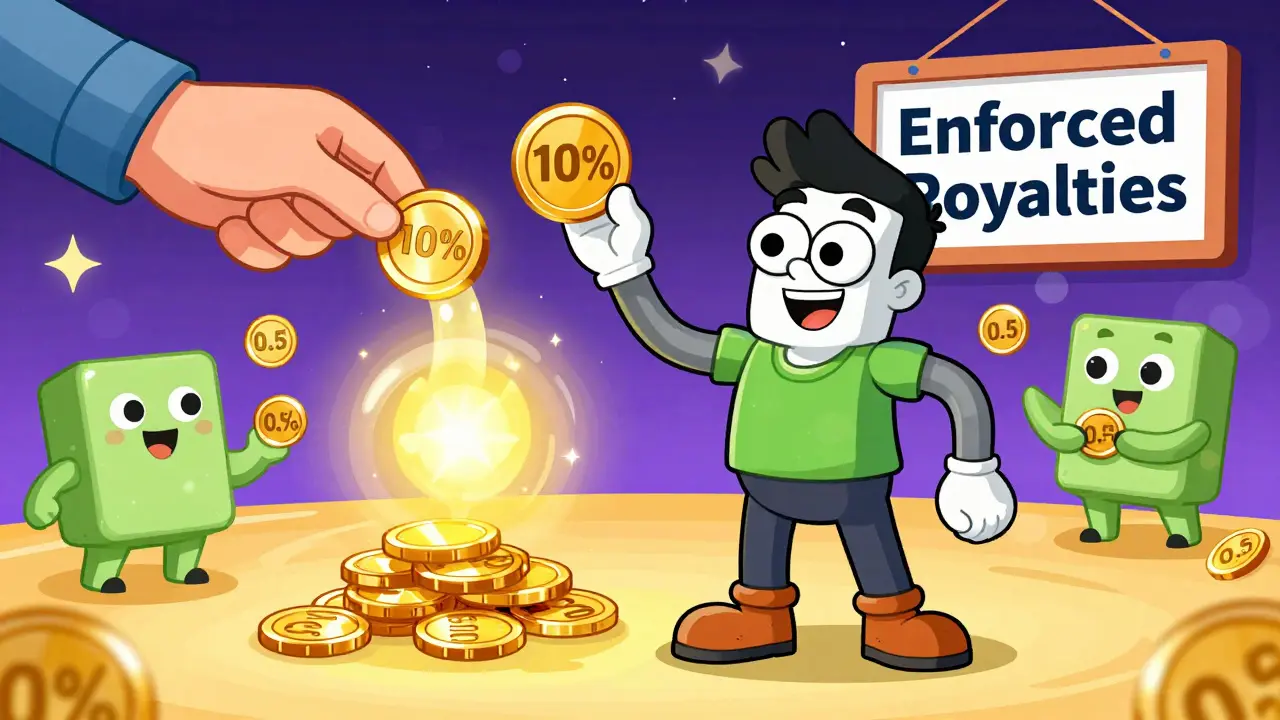

When an artist sells an NFT for the first time, they get paid. But what happens when someone else resells it later? That’s where NFT royalties come in. Unlike traditional art or music, where artists rarely see money after the first sale, NFTs are built to keep paying creators every time their work changes hands. It sounds simple - a percentage of every resale goes back to the original creator. But in practice, it’s messy. Not all marketplaces enforce it. Some let buyers skip it entirely. And that’s changing how creators make money - for good or bad.
How NFT Royalties Actually Work
NFT royalties aren’t a feature added after the fact. They’re coded into the token the moment it’s created. When an artist mints an NFT, they set a royalty percentage - usually between 5% and 10%. That number gets locked into a smart contract on the blockchain. Every time that NFT is resold, the contract automatically sends that percentage to the creator’s wallet.
Let’s say you sell a digital artwork for 1 ETH. Later, someone buys it from another buyer for 5 ETH. If your royalty is 10%, you get 0.5 ETH - no paperwork, no invoice, no middleman. The blockchain handles it. This is the core promise of NFTs: creators benefit from long-term value, not just the initial sale.
It’s not just art. Musicians, game developers, and virtual fashion designers use it too. A song NFT with a 7% royalty means the artist earns money every time it’s flipped on a marketplace. That’s the dream - a passive income stream tied directly to your work’s popularity.
Where the System Breaks Down
Here’s the catch: blockchain doesn’t force anyone to follow the rules. The smart contract says, “Pay the creator.” But it doesn’t stop someone from transferring the NFT outside that rule. That’s where marketplaces come in.
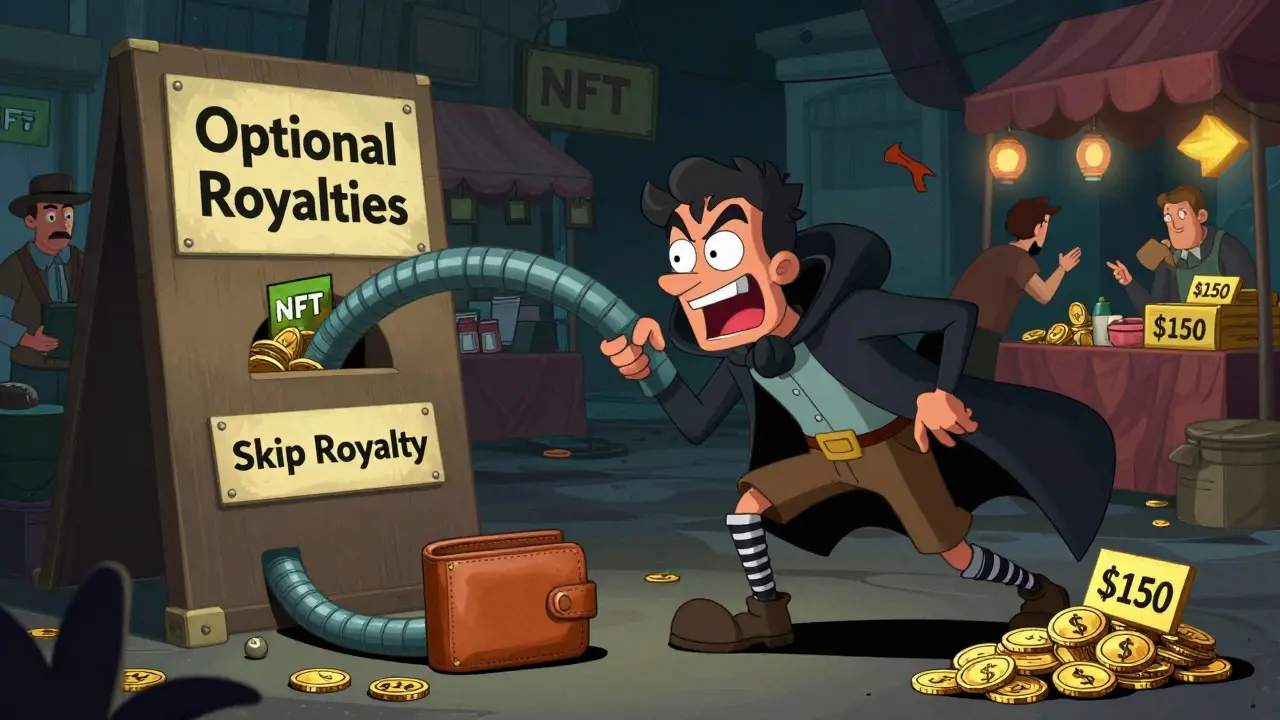
Platforms like OpenSea and Rarible check the smart contract before completing a sale. If the NFT has a 10% royalty, they make sure it’s paid. They enforce it. But other platforms - LooksRare, Magic Eden, X2Y2 - don’t. They let buyers bypass royalties entirely. Why? Because traders want to keep more profit. If you can buy an NFT for $1,000 and resell it for $1,500 without paying the 10% royalty ($150), you pocket an extra $150. That’s a big incentive.
It’s not a bug - it’s a business model. Marketplaces that drop mandatory royalties attract more volume. More traders = more fees from listing and trading. So they choose profit over creator pay.
Marketplace Wars: Enforced vs. Optional Royalties
Today, you’ve got two camps:
- Enforced Royalties: OpenSea, Rarible, Coinbase. These platforms read the smart contract and automatically send royalties. If you sell an NFT here, the creator gets paid - no exceptions.
- Optional Royalties: LooksRare, Magic Eden, X2Y2. These let buyers choose. You can buy an NFT and ignore the royalty. The transaction still goes through. The creator gets nothing.
It’s not just about ethics. It’s about economics. When a marketplace drops royalties, it doesn’t just affect one creator - it affects the whole ecosystem. If buyers know they can avoid royalties on one platform, they’ll go there. That puts pressure on other platforms to follow, or lose users.
Some creators have responded by refusing to mint on optional-royalty platforms. Others have started using tools that block transfers to non-compliant marketplaces. But that’s a workaround, not a fix.
How Royalties Are Calculated
It’s easy to assume royalties are taken after marketplace fees. They’re not. Both are taken from the sale price at the same time.
Example: You sell an NFT for $1,000. You set a 10% royalty. The marketplace charges a 3% seller fee.
- Creator gets: $100 (10% royalty)
- Marketplace gets: $30 (3% fee)
- Seller gets: $870 ($1,000 - $100 - $30)
No stacking. No delay. Both deductions happen in one step. That’s why it’s important to understand the total cost of a sale - not just the royalty.
The Bigger Problem: Composability vs. Control
One of the biggest promises of Web3 is that digital assets should work everywhere. An NFT should be usable in games, apps, marketplaces - anywhere. But if you lock your NFT to only work on platforms that pay royalties, you break that promise.
Some solutions are being tested:
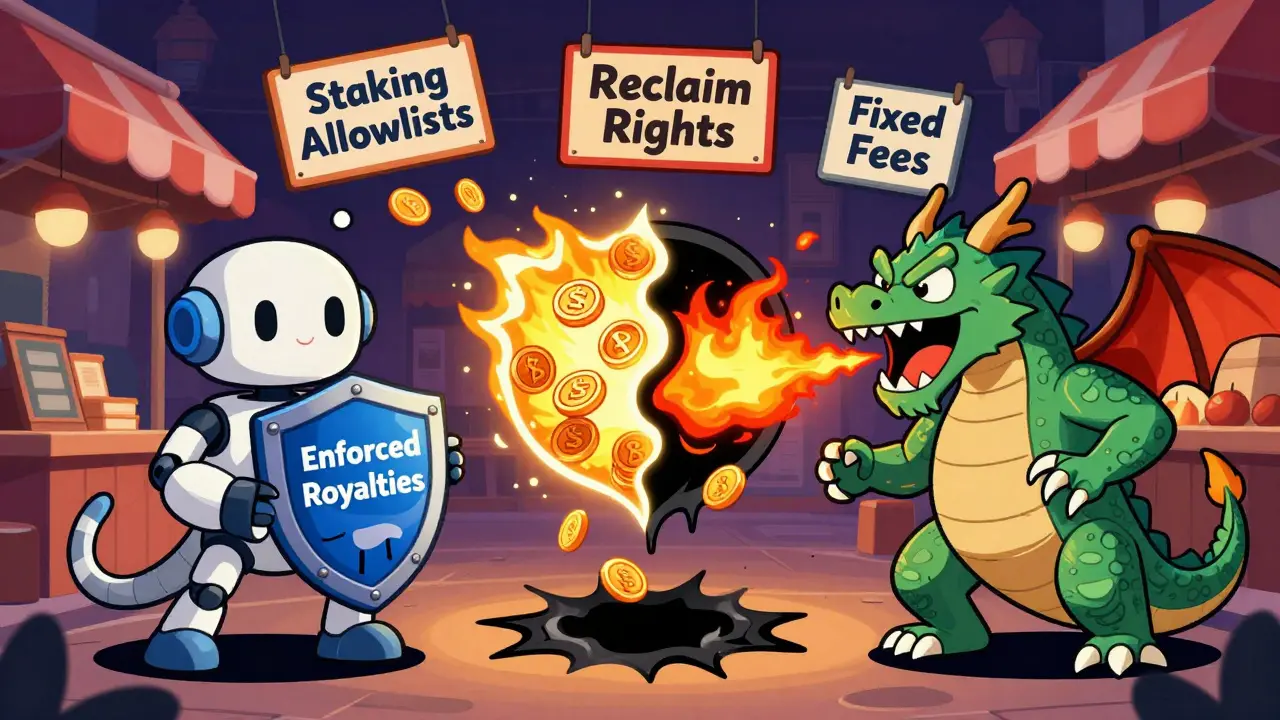
- Staking Allowlists: New marketplaces can join a “trusted” list by staking money. If they don’t pay royalties, they lose their stake.
- Right of Reclaim: Creators can take back an NFT if it’s sold on a non-compliant platform. It’s a strong deterrent - but risky for buyers.
- Fixed Fee Royalties: Instead of 10%, charge $5 per resale. Simpler. Harder to avoid.
None of these are perfect. Staking requires capital. Reclaiming NFTs feels like control, not freedom. Fixed fees might hurt high-value sales. The industry is still figuring it out.
What This Means for Creators
If you’re an artist, musician, or developer making NFTs, here’s what you need to know:
- Set your royalty at minting - it’s your only chance to lock it in.
- Don’t assume it’ll be paid. Check which marketplaces your NFTs are listed on.
- Use platforms that enforce royalties if you want consistent income.
- Track your earnings. Some creators use dashboards to monitor secondary sales across platforms.
- Consider minting on multiple platforms - but only if they all respect your terms.
There’s no global NFT royalty system. There’s no central authority. The system works only if enough marketplaces choose to enforce it. Right now, they’re not all choosing to.
What’s Next?
The future of NFT royalties isn’t written yet. It’s being shaped by market pressure, technical innovation, and creator resistance.
Some believe the market will self-correct. If buyers realize that NFTs without royalties are less valuable - because the creator might not keep making content - they’ll pay more on compliant platforms. Others think the race to the bottom will win, and royalties will become rare.
One thing’s clear: if you’re a creator, you can’t rely on the system to protect you. You have to choose your tools carefully. Your smart contract sets the rule. But who enforces it? That’s up to the marketplace - and the buyers who use it.
Do NFT royalties work on all blockchains?
Royalties are implemented through smart contracts, which exist on most major blockchains like Ethereum, Solana, and Polygon. But enforcement depends on the marketplace, not the blockchain. A Solana NFT with a 10% royalty won’t get paid if sold on a marketplace that ignores royalties - even if the blockchain supports it.
Can I change my royalty percentage after minting?
No. Once an NFT is minted, the royalty percentage is locked into the smart contract. It can’t be changed. That’s why creators need to set it correctly the first time - and choose marketplaces wisely.
Are NFT royalties taxed?
Yes. In the U.S., royalties from NFT secondary sales are considered income. If you receive ETH or another cryptocurrency as a royalty, it’s taxed based on its value in USD at the time you receive it. Creators should track every payment and keep records for tax reporting.
Why do some buyers avoid paying royalties?
Because it’s profitable. If an NFT is resold for $2,000 with a 10% royalty, $200 goes to the creator. On a marketplace that allows bypassing royalties, the buyer can pocket that $200 instead. For high-volume traders, that adds up fast. It’s not about ethics - it’s about margins.
Can I still sell my NFT if a marketplace doesn’t pay royalties?
Yes. You can list and sell your NFT anywhere. But if you’re the original creator, you won’t get paid the royalty unless the marketplace enforces it. The NFT still transfers ownership - you just lose the cut. That’s why some creators avoid listing on optional-royalty platforms altogether.




Ajit Kumar
27 Feb 2026 at 12:24NFT royalties are not a technical innovation-they're a moral imperative. The blockchain was designed to eliminate intermediaries, not to enable predatory behavior from traders who treat digital art as a casino chip. When a creator spends months crafting a piece, pouring their soul into every pixel, they aren't just selling a file-they're offering a piece of their identity. To bypass royalty payments is to steal not just income, but dignity.
Marketplaces like LooksRare and X2Y2 aren't merely indifferent-they're complicit in a systemic erosion of creative labor. They market themselves as 'innovative' or 'trader-friendly,' but what they're really doing is incentivizing theft under the guise of freedom. This isn't Web3. This is Web2 with better branding.
There is no such thing as 'composability' if the asset loses its value the moment it leaves a compliant ecosystem. An NFT that can be resold without royalty is not an NFT-it's a counterfeit. The smart contract is meaningless if no one enforces it. And yet, we pretend this is progress.
Creators who mint on non-enforcing platforms are not 'expanding reach'-they're surrendering their future. You think listing on ten platforms increases exposure? No. You're training buyers that your work has no inherent value beyond the initial sale. You're training the market to treat creators as disposable.
The solution isn't staking or reclaiming rights-it's boycott. Refuse to trade on non-compliant marketplaces. Refuse to list on them. Refuse to even acknowledge them. If the volume dries up, the greed will collapse. Capitalism works both ways: if buyers stop paying royalties, they stop getting art. Simple.
And don't get me started on the tax implications. People treat crypto income like Monopoly money. Royalties are income. Full stop. The IRS doesn't care if you got paid in ETH. You owe taxes on the USD equivalent at the time of receipt. Ignorance isn't a defense. Record everything. Track every transaction. Because if you don't, you'll get audited-and you won't have an excuse left.
This isn't about technology. It's about ethics. And ethics don't negotiate. They don't compromise. They don't wait for regulation. They demand action. And creators? You have more power than you think. Use it.