

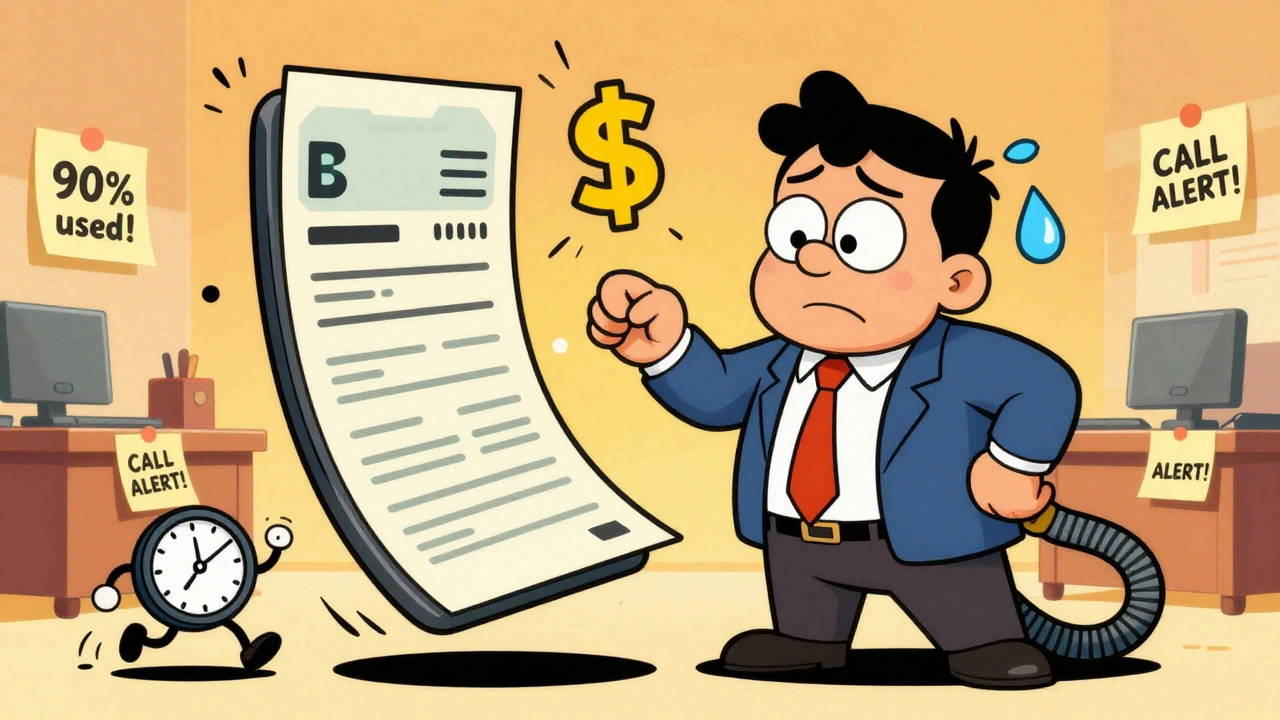

Most businesses assume their VoIP plan covers all their calling needs-until they get a bill that’s 30% higher than expected. Overage charges on VoIP plans aren’t just annoying; they can eat into your bottom line fast. If you’re paying extra for every minute over your limit, you’re not saving money-you’re gambling with your telecom budget.
What Are VoIP Overage Charges?
VoIP overage charges are fees added when you use more minutes, data, or features than your plan allows. Unlike older phone plans that charged per call, modern VoIP services bundle a set number of minutes, international destinations, or concurrent calls into a flat monthly rate. Go past that limit, and you’re hit with a per-minute or per-GB fee-often $0.05 to $0.25 per minute, sometimes more.These charges aren’t always obvious. Your provider might not warn you until after you’ve already gone over. A team member makes 20 extra international calls during a product launch. A remote worker streams a Zoom meeting over the company’s main line. Suddenly, your bill jumps from $1,200 to $1,650. No warning. No notice. Just a surprise charge.
According to Gartner’s 2023 Subscription Economy Survey, 58% of VoIP and SaaS providers still use overage billing. But that’s changing fast. Providers like RingCentral and Vonage now offer unlimited domestic calling on most plans. Others, like 8x8, cap overages at $15 per month instead of charging per minute. The trend is clear: businesses are demanding transparency, and providers are responding.
How Overage Charges Work in VoIP
There are three main ways VoIP providers charge for overages:- Flat-rate overage: You pay a fixed fee per extra minute. Example: $0.15 per minute beyond your 1,000-minute limit. Simple, but expensive if you go over often.
- Tiered overage: Rates change as you use more. First 50 extra minutes at $0.10/min, next 50 at $0.20/min. This punishes heavy users and can make budgeting impossible.
- Pay-as-you-go: No hard cap, but usage is billed at a much higher rate than your plan’s included minutes. Think of it like a hotel minibar-$5 for a bottle of water you could’ve bought for $1 outside.
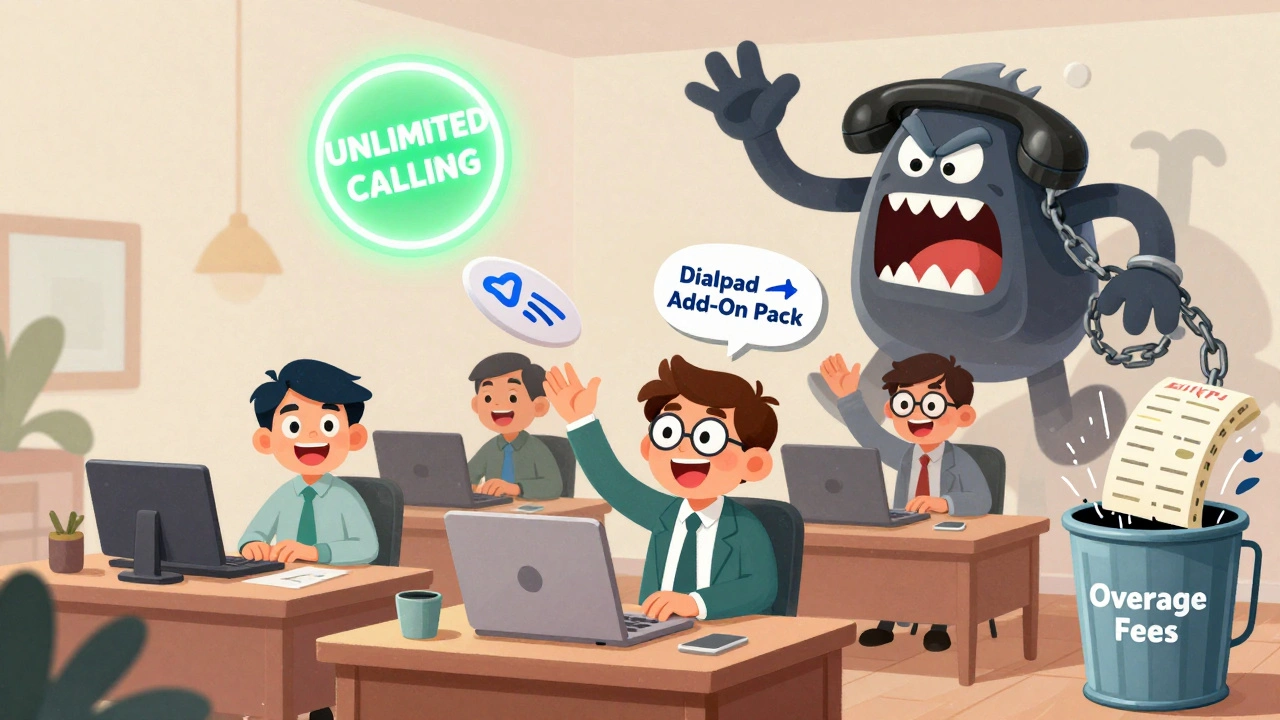
Some providers, like Nextiva, don’t charge overages at all. Instead, they automatically upgrade your plan if you consistently exceed your limit. Others, like Dialpad, let you buy add-on packs of 100 or 500 minutes at a discount before you hit the overage threshold.
Here’s how it breaks down by provider in 2025:
| Provider | Overage Rate (Domestic) | Overage Cap? | Automatic Upgrade? |
|---|---|---|---|
| RingCentral | $0.00 (Unlimited included) | Yes | Yes |
| Vonage | $0.05/min | No | No |
| 8x8 | $0.10/min | Yes ($15/month max) | No |
| Nextiva | $0.00 (Unlimited included) | Yes | Yes |
| Dialpad | $0.12/min | No | Yes (with add-on packs) |
Notice the pattern? The top performers don’t charge overages. They either include unlimited calling or give you a way to buy more at a fair price before you’re penalized.
Why Overage Charges Are a Problem for Businesses
It’s not just about the money. Overage charges create trust issues. A 2023 J.D. Power study found that businesses with VoIP providers that use overages reported 27% higher churn than those without. Why? Because overages feel like a trap.Imagine this: Your sales team makes 1,200 calls in a month. Your plan includes 1,000. You’re charged $0.15 per extra minute. Each call averages 6 minutes. That’s 300 extra minutes = $45 in overage fees. Sounds manageable? Now multiply that across 20 sales reps. That’s $900 extra per month. $10,800 a year. For something you didn’t even know you were going to use.
And it gets worse. Many VoIP systems don’t alert you until after the fact. You get your bill, panic, and call support. They say, “You went over your limit.” You ask, “Why didn’t you warn me?” They reply, “We sent an email.” You check your inbox. It’s buried under 47 other newsletters. That’s not customer service. That’s negligence.
According to Gartner’s 2023 Voice of Customer analysis, 57% of businesses only learn about overages after they’ve been charged. That’s unacceptable.
How to Avoid VoIP Overage Charges
You don’t have to live with surprise bills. Here’s how to take control:- Check your usage reports weekly. Most VoIP platforms-RingCentral, 8x8, Dialpad-have dashboards that show real-time usage. Look at trends. Are you consistently hitting 90% of your limit? That’s a red flag.
- Set usage alerts. Enable notifications when you hit 80% or 90% of your monthly limit. Most systems let you choose email, SMS, or in-app alerts. Turn them on.
- Know what’s included. Some plans include unlimited calling to the U.S. and Canada but charge for Mexico, the UK, or Australia. If your team calls overseas often, upgrade to a global plan. It’s cheaper than paying $0.30 per minute for international calls.
- Use add-on packs, not overages. If your provider offers them, buy extra minutes in bulk. Dialpad’s 500-minute pack costs $25. That’s $0.05 per minute-half the overage rate.
- Switch providers if needed. If your current provider charges overages and doesn’t offer alerts or caps, it’s time to look elsewhere. RingCentral and Nextiva offer unlimited calling on all their business plans. No overages. No surprises.
One Madison-based marketing agency switched from Vonage to RingCentral in early 2024. They were paying $400 in overages every month. After switching, their bill dropped to $950 from $1,350. That’s $4,800 saved in a year. All because they stopped paying for penalties.
What to Look for in a VoIP Provider
When evaluating VoIP providers, ask these questions:- Do you charge overage fees for extra minutes or data?
- Is there a monthly cap on overage charges?
- Do you offer automatic plan upgrades when usage increases?
- Can I get real-time usage alerts via email or app?
- Are international calls included, or are they extra?
Don’t be afraid to ask for a trial. Most providers offer 14- to 30-day free trials. Use it to simulate your team’s calling patterns. See how close you get to the limit. See if you get alerts. See if the system feels transparent.
Also, read the fine print. Some providers say “unlimited” but mean “unlimited during business hours” or “unlimited to 50 countries.” Make sure you know exactly what’s included.

The Future of VoIP Billing
The era of punitive overage charges is ending. By 2026, Gartner predicts only 22% of VoIP providers will still use traditional overage models. The rest will move to transparent, usage-based pricing-where you pay for what you use, but without surprise fees.Microsoft Azure’s shift to consumption-based pricing in 2023 set the standard. No overages. No caps. Just a clear monthly bill based on actual usage. VoIP providers are following suit. RingCentral’s “Unlimited Everything” plans, Nextiva’s “No Surprises” pricing, and Dialpad’s “Smart Add-Ons” are signs of the new normal.
Businesses that cling to old-school overage plans aren’t saving money-they’re creating friction. Customers notice. Employees notice. And they leave.
Final Thought: Pay for Value, Not Penalties
Your VoIP plan should make communication easier, not more expensive. If you’re paying extra every month just because your team talked a little too much, you’re being punished for doing your job. That’s not a feature-it’s a flaw.Look for providers that reward growth, not penalize it. Choose transparency over hidden fees. Pick unlimited calling if your team is active. Use add-ons before you hit overages. And if your provider still treats overages like a profit center? It’s time to move on.
VoIP isn’t about saving pennies per minute. It’s about building a communication system that scales with your business-without surprises.
Are VoIP overage charges legal?
Yes, VoIP overage charges are legal in the U.S. and most countries. However, providers must clearly disclose them in your contract and provide advance notice before charging. The FCC requires transparency in billing, but there’s no federal cap on how much they can charge. Many states have consumer protection laws that may apply if overages are hidden or misleading.
How can I tell if I’m being overcharged?
Compare your monthly usage reports with your bill. If you see charges for minutes you didn’t use, or if your bill jumps without a clear reason, request a detailed call log. Most providers allow you to download your usage history. If the numbers don’t match, dispute the charge. Keep records of all communications.
Do unlimited VoIP plans really have no limits?
Most “unlimited” VoIP plans have fair usage policies. For example, you can’t use the plan to run a call center with 200 lines or make 50-hour-long conference calls nonstop. Providers typically define “reasonable use” as 1,000-5,000 minutes per user per month. If you exceed that, they may contact you to upgrade-not charge you overage fees.
Can I negotiate lower overage rates?
Yes, especially if you’re a business with 10+ users. Enterprise contracts often include negotiated overage rates as low as $0.03 per minute-far below the standard $0.10-$0.25. Always ask for a custom quote. Don’t accept the default pricing.
What’s the average cost of a VoIP overage?
Domestic overage charges average $0.10 to $0.15 per minute. International overages can be $0.25 to $0.50 per minute. Some providers charge per second, so even a 12-second call can trigger a fee. Always check your provider’s rate sheet before signing up.
Do VoIP overage charges apply to video calls?
It depends. Some providers include video minutes in your calling limit. Others charge separately for video bandwidth or data usage. Check your plan’s terms. A 1-hour Zoom call can use 1-2 GB of data. If your plan has a data cap, you could hit overages even if your call minutes are fine.
Next steps: Log into your VoIP dashboard today. Check your usage for the last 30 days. If you’re consistently over your limit, contact your provider. Ask about upgrade options. If they don’t offer a better solution, start comparing providers. Your next bill shouldn’t be a surprise.









Kasey Drymalla
4 Dec 2025 at 10:08They're not just charging you for minutes-they're charging you for your trust. Every overage fee is a tiny knife twist. You think you're saving money with VoIP? Nah. They're milking you while you sleep. Your 'unlimited' plan? A lie wrapped in a dashboard. I've seen it. They watch your usage patterns. Wait till you're mid-campaign. Then BAM. $400 surprise. It's predatory. And they know you won't fight back.